On this page
- 01Key takeaways
- 02What types of human error affect routine work?
- 03Why does attention fade on repetitive tasks?
- 04How do you design errors out of a routine task?
- 05What do error rates look like in numbers?
- 06Does outsourcing reduce human error?
- 07What does this look like in practice?
- 08Error reduction checklist
- 09Next step
- 10Sources and further reading
- 11Frequently asked questions
Key takeaways
Human error in repetitive tasks is mostly slips and lapses: skilled people doing familiar steps on autopilot, then missing one. The Health and Safety Executive groups human failures into errors (slips, lapses and mistakes) and violations. Training and telling people to concentrate do little for slips. Designing checks into the method does much more.
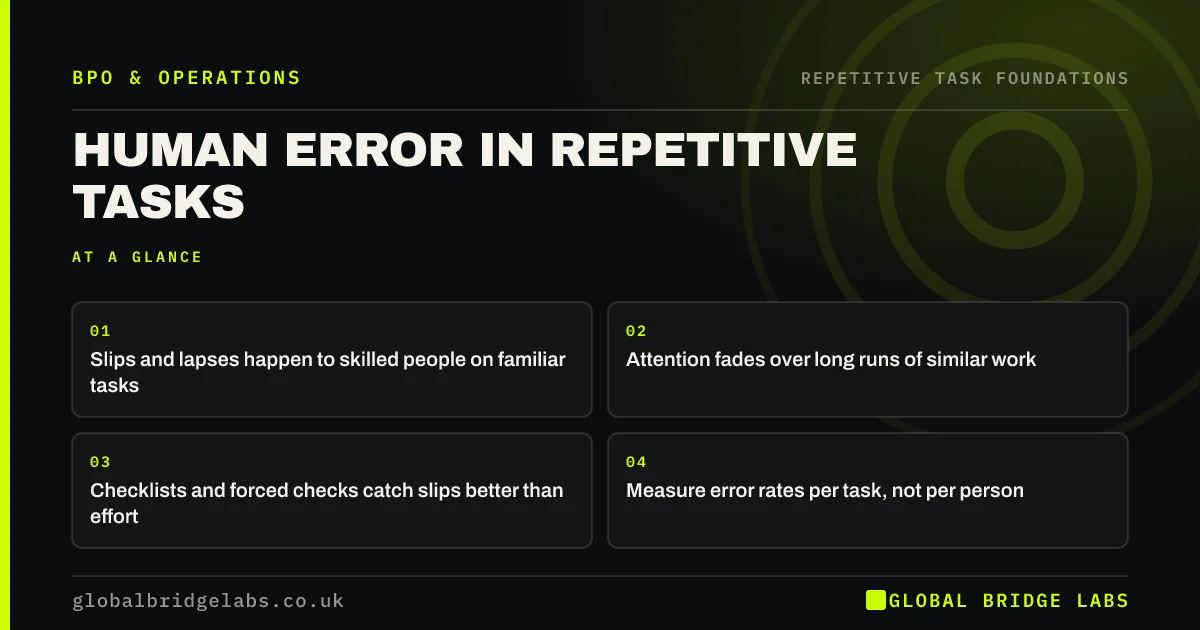
- Slips and lapses happen to skilled people on familiar tasks.
- Attention fades over long runs of similar work.
- Checklists and forced checks catch slips better than effort.
- Measure error rates per task, not per person.
Seeing the same slips on a routine task? Message us on WhatsApp with what goes wrong.
Chat on WhatsApp →What types of human error affect routine work?
HSE describes slips as actions done wrongly, such as keying 18 instead of 81, and lapses as steps forgotten, such as not attaching a document. Mistakes are wrong decisions made with full attention, often because a rule was misunderstood. Violations are deliberate shortcuts. Repetitive work produces mostly slips and lapses, which is why experience does not prevent them.
Why does attention fade on repetitive tasks?
People monitoring similar items for long periods detect fewer problems as time goes on, an effect called vigilance decrement, first studied in radar operators in the 1940s. On office work it shows up as more missed fields and wrong codes late in a batch or a shift. Short runs, breaks and varied work reduce it; willpower does not.
How do you design errors out of a routine task?
Design the method so the common slips are hard to make or easy to spot. Use drop-down fields instead of free text, check totals against a control figure, require the attachment before the record can close, and sample finished work. Each control should target an error you have actually seen.
- Fix inputs so the wrong value cannot be entered.
- Use a short checklist at the point of completion.
- Reconcile totals to a control figure each batch.
- Sample finished items and log the error type.
What do error rates look like in numbers?
In an illustrative example, a team keys 1,200 purchase invoices a month with 2% needing correction: 24 corrections, each taking 15 minutes to find and fix, which is 6 hours of rework. These are example figures. Halving the rate with a total check and a required field saves 3 hours a month and the supplier calls that come with errors.
- Right first time rate: the quality number that cuts cost
- Purchase order processing: raise, match and close POs
Want help working out what errors cost on one of your tasks? Send us the volumes on WhatsApp.
Chat on WhatsApp →Does outsourcing reduce human error?
Outsourcing reduces error when the handover forces a written method, built-in checks and measured accuracy, and when a dedicated team works the task in short, managed runs. It does not reduce error if the same unwritten method is simply moved to new people. The improvement comes from the design, not the location.
What does this look like in practice?
A pattern we see: one person is blamed for frequent errors, but sampling shows the same slips from everyone who does the task. The fix is a required field and a total check, and the blame stops along with the errors.
Error reduction checklist
Apply these steps to any routine task with repeat errors.
- Log each error with its type: slip, lapse or mistake.
- Find the step where each type occurs.
- Add one control per common error.
- Keep runs short and vary the work.
- Measure the error rate monthly.
Next step
Send us the routine task with the most corrections. We will help you classify the errors and suggest the controls that would catch them.
Message us on WhatsApp to reduce errors on a task, or book a 30-minute consultation.
Chat on WhatsApp →Sources and further reading
- Human factors: managing human failures · Health and Safety Executive
- What are the Management Standards for work-related stress? · Health and Safety Executive
Frequently asked questions
What causes human error in repetitive tasks?
Most errors in repetitive tasks are slips and lapses: experienced people doing familiar steps automatically and missing or mis-keying one. Fading attention over long runs, interruptions, poor input design and missing checks all make them more likely. They are best reduced by design rather than training.
What is the difference between a slip and a mistake?
A slip is the right intention carried out wrongly, such as typing the wrong number. A mistake is a wrong intention, such as applying the wrong rule because it was misunderstood. Slips need better checks and input design; mistakes need clearer rules and training.
How do you reduce errors in data entry?
Restrict inputs with drop-downs and validation, check batch totals against a control figure, require supporting documents before a record closes, keep runs short, and sample finished work weekly. Target each control at an error you have actually seen, and measure the rate monthly.
Written by

Global Bridge Labs (GBL) is a UK–Sri Lanka partner for social media, websites and BPO. Everything here comes from client delivery, not theory.