On this page
- 01Short answer
- 02How do you decide what to outsource?
- 03Which front-office tasks can you outsource?
- 04Which back-office tasks can you outsource?
- 05What should a small business never outsource?
- 06What is it worth outsourcing, in pounds?
- 07How do you pick your first task?
- 08When is a task not ready to outsource?
- 09What does this look like in practice?
- 10Checklist: build your outsourcing list
- 11Next step
- 12Sources and further reading
- 13Frequently asked questions
Short answer
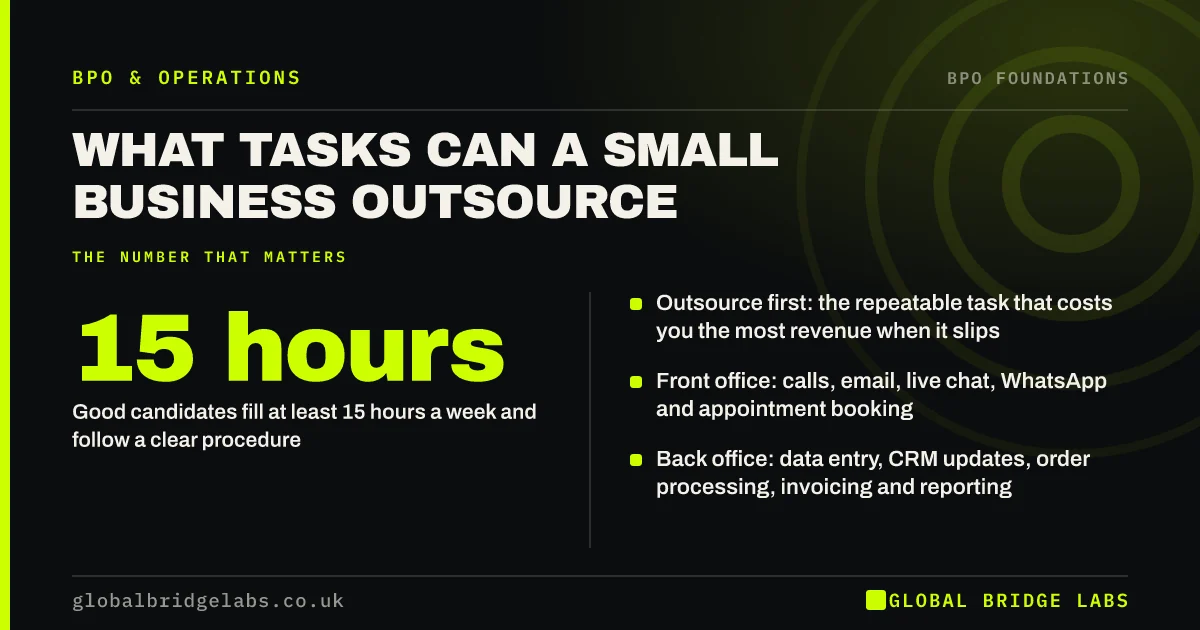
What tasks can a small business outsource? Any task that is repeatable, follows rules you can write down, and can be done inside your own systems. In practice that means customer support, call answering, inbox management, bookings, data entry, CRM updates, order processing, invoicing and credit control.
- Outsource first: the repeatable task that costs you the most revenue when it slips.
- Good candidates fill at least 15 hours a week and follow a clear procedure.
- Front office: calls, email, live chat, WhatsApp and appointment booking.
- Back office: data entry, CRM updates, order processing, invoicing and reporting.
- Keep in-house: strategy, pricing, key client relationships, hiring and final sign-off.
Want your task list sorted into outsource and keep? Message us on WhatsApp with what fills your week.
Chat on WhatsApp →How do you decide what to outsource?
Decide by testing each task against four questions: is it repeatable, can the rules be written down, can it be done inside your systems, and does it pull a senior person away from revenue-earning work? A task that passes all four is a strong candidate for business process outsourcing (BPO).
Volume matters too. A task that takes two hours a week is rarely worth the setup effort of outsourcing on its own. Group related tasks, such as inbox triage, CRM updates and quote follow-up, into a role of 15 to 40 hours and outsource the role.
Which front-office tasks can you outsource?
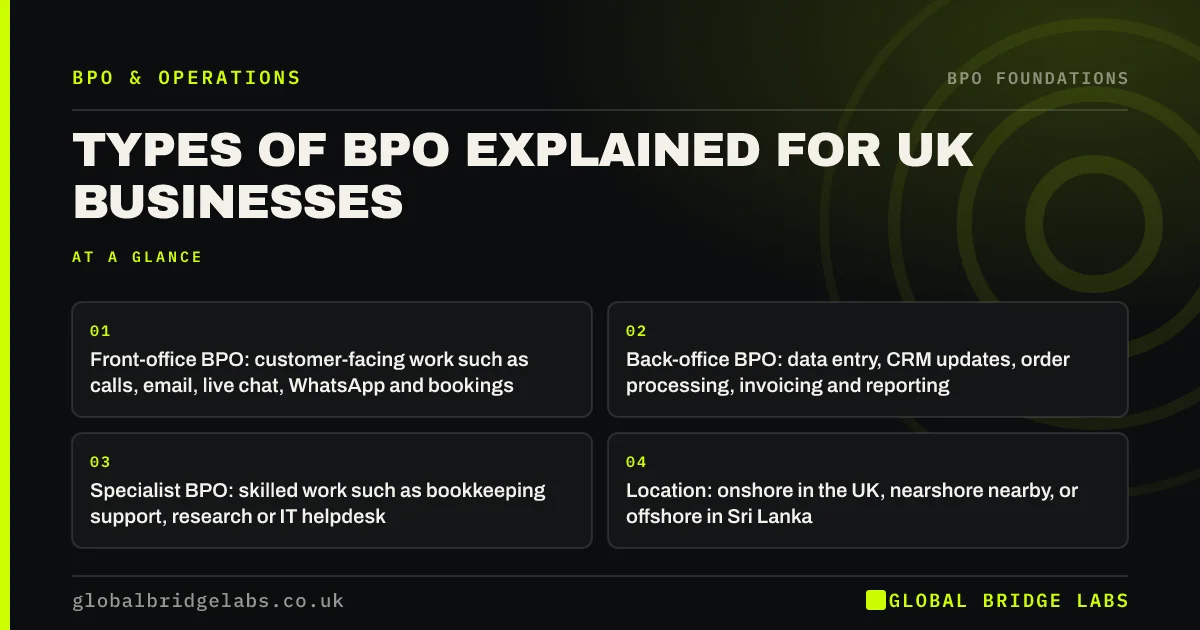
Front-office tasks are the customer-facing ones, and they are often the most valuable to outsource because slow replies cost sales immediately. A trained team can cover them throughout trading hours with escalation to your staff for anything commercial.
- Answering inbound calls, taking details and booking jobs or appointments.
- Replying to customer emails and helpdesk tickets.
- Running live chat on your website.
- Handling WhatsApp Business and social media messages.
- Following up quotes and missed enquiries.
- Logging and routing complaints to the right person.
Which back-office tasks can you outsource?
Back-office tasks keep the business running behind the scenes. They are rules-based and measurable, which makes them easy to hand over and easy to check. They are also where owners lose most of their evenings.
- Data entry, document processing and scanning into systems.
- CRM updates, de-duplication and pipeline hygiene.
- Order processing, returns and stock updates.
- Raising invoices, preparing supplier bills and credit control chasing.
- Compiling weekly and monthly reports.
- Inbox management: triage, tagging and drafting replies for approval.
What should a small business never outsource?
Never outsource the decisions that define the business: strategy, pricing, which customers to take on, hiring and firing, and relationships with your most important clients. Keep final sign-off on anything that commits money or reputation, such as large refunds, contract terms and public responses to serious complaints.
You can outsource the preparation behind those decisions. A team can compile the pricing data, draft the complaint response or shortlist CVs. The decision stays with you.
What is it worth outsourcing, in pounds?
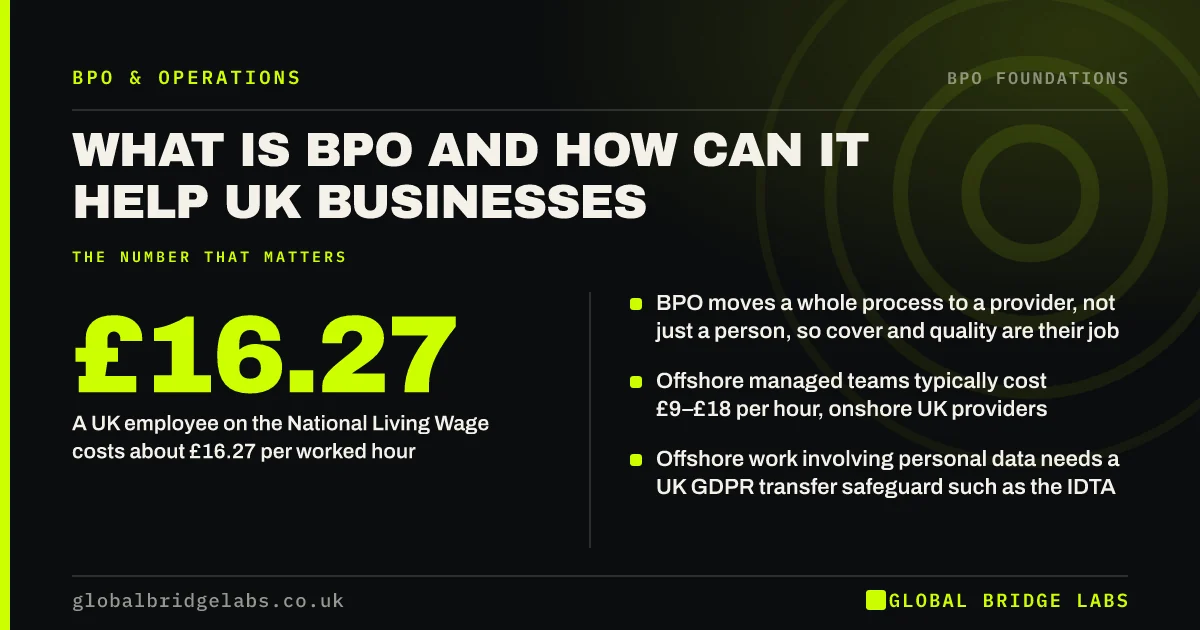
Value a task by what it costs to do in-house and what it frees up. From April 2026 the National Living Wage is £12.71 an hour and employer National Insurance is 15% above £5,000 a year. With the 3% pension contribution and 28 days' holiday, a minimum-wage employee costs about £16.27 per worked hour before overheads. If the owner does the task, value their hour at what they could bill or sell instead.
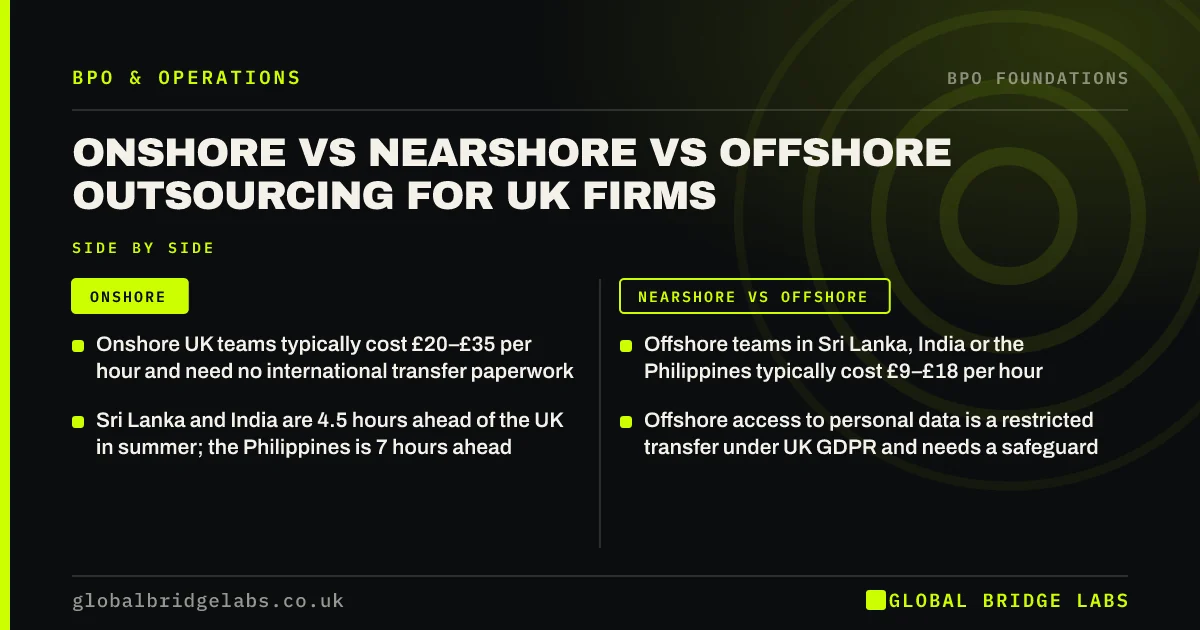
Managed offshore BPO typically costs £9–£18 per hour and onshore UK providers £20–£35, as indicative market ranges. A task worth outsourcing usually shows a clear saving on the first number and a larger gain on the second.
Want your first outsourced task costed against doing it yourself? Send us the task and hours on WhatsApp and we will discuss your requirements.
Chat on WhatsApp →How do you pick your first task?
Pick the task that is both painful and safe: frequent enough to matter, documented enough to hand over, and low-risk enough that a mistake in week one is fixable. Inbox triage and call answering are common first choices because the gain is immediate and drafts can be reviewed.
- Score each task 1 to 5 for hours, revenue impact, documentation and risk.
- Pick the highest total with a risk score you are comfortable with.
- Run it for 90 days, then add the next task.
When is a task not ready to outsource?
A task is not ready if the rules change every week, if only one person knows how it works and cannot explain it, or if it depends on systems the team cannot access securely. Fix those first. Documenting the task often reveals that half of it could be simplified or automated.
What does this look like in practice?
A pattern we see in owner-run businesses: the owner lists "admin" as the problem, but the list shows 12 separate tasks. Five of them, including CRM updates, quote chasing and supplier invoice entry, make up most of the hours and follow clear rules. Those become one outsourced role. The other seven stay, or are dropped.
Checklist: build your outsourcing list
Do this in one sitting with your diary for the last two weeks.
- List every recurring task and the hours it took.
- Mark each as front office, back office or decision.
- Cross out every decision; those stay in-house.
- Score the rest for hours, revenue impact, documentation and risk.
- Group related tasks into roles of 15 to 40 hours.
- Pick one role to outsource first.
- Write the procedure for that role before asking for quotes.
Next step
Send us your task list and we will tell you what to outsource first, what to keep, and what the first role would cost. 30 minutes, no pitch.
Message us on WhatsApp with your task list, or book a 30-minute consultation.
Chat on WhatsApp →Sources and further reading
- National Minimum Wage and National Living Wage rates · GOV.UK
- Rates and thresholds for employers 2026 to 2027 · HM Revenue & Customs
- Holiday entitlement · GOV.UK
Frequently asked questions
What admin tasks can I outsource?
You can outsource inbox management, data entry, CRM updates, diary management, document processing, invoicing, supplier bill entry, credit control chasing and report compilation. Anything repeatable that follows written rules and can be done securely inside your own systems is a good candidate for an outsourced admin team.
Should a small business outsource customer service?
Often yes, especially when enquiries wait hours for a reply or the owner answers messages in the evening. An outsourced team can cover all trading hours and escalate commercial issues to you. Keep complex complaints and key client relationships with your own staff.
How many hours of work make outsourcing worthwhile?
As a guide, 15 to 20 hours a week of related work justifies the setup effort of a managed seat. Below that, group several small tasks into one role, or use a part-time arrangement. A few scattered hours rarely justify documentation, access setup and training.
What is the easiest task to outsource first?
Inbox triage and call answering are usually easiest, because the rules are simple, the gain is visible within days, and early work can be reviewed before customers see it. Data entry is another easy start, because accuracy is simple to check against the source documents.
Written by

Global Bridge Labs (GBL) is a UK–Sri Lanka partner for social media, websites and BPO. Everything here comes from client delivery, not theory.