On this page
- 01Key takeaways
- 02Does UK GDPR allow offshore outsourcing?
- 03What is a restricted transfer?
- 04Which countries have UK adequacy?
- 05What are the IDTA and the UK Addendum?
- 06What is a transfer risk assessment?
- 07What must the processor contract include?
- 08How do practical controls reduce the risk?
- 09Are there special rules for sensitive data?
- 10What does this look like in practice?
- 11Checklist: GDPR for offshore outsourcing
- 12Next step
- 13Sources and further reading
- 14Frequently asked questions
Key takeaways
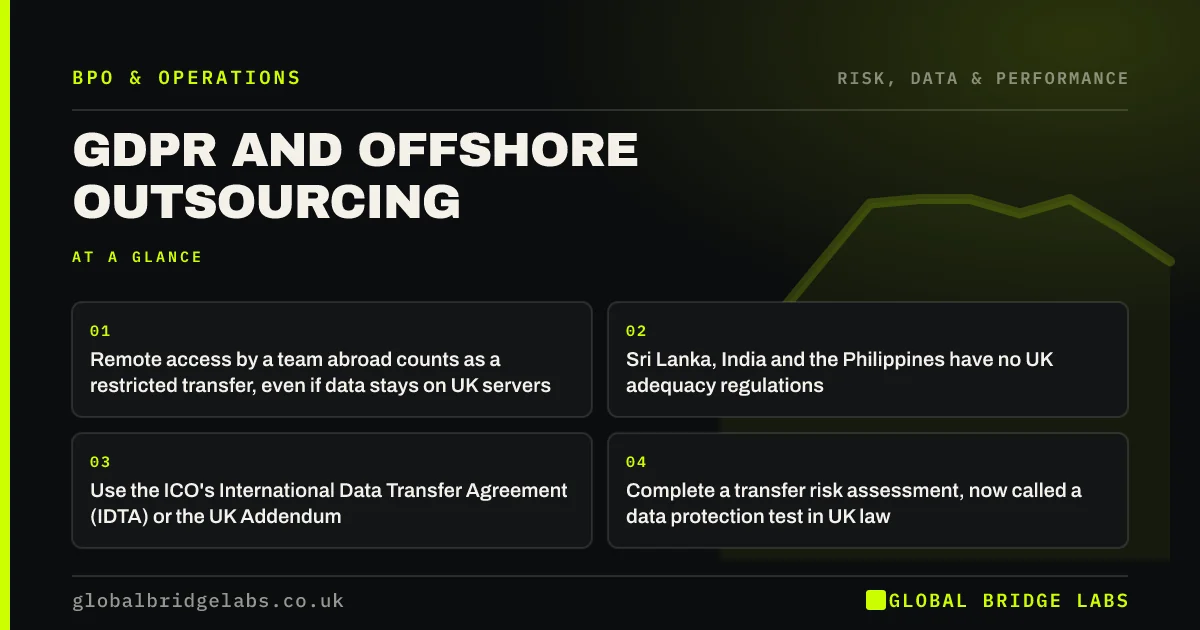
GDPR offshore outsourcing is lawful and common, but it needs the right paperwork. When a team outside the UK can access personal data you control, UK GDPR treats it as a restricted transfer. For countries without UK adequacy regulations, you need an appropriate safeguard, a transfer risk assessment and a controller-processor contract.
- Remote access by a team abroad counts as a restricted transfer, even if data stays on UK servers.
- Sri Lanka, India and the Philippines have no UK adequacy regulations.
- Use the ICO's International Data Transfer Agreement (IDTA) or the UK Addendum.
- Complete a transfer risk assessment, now called a data protection test in UK law.
- Sign a processor contract with the terms the ICO lists, and update your privacy notice.
Want to check your offshore set-up against UK GDPR? Message us on WhatsApp and we will walk through the documents you need.
Chat on WhatsApp →Does UK GDPR allow offshore outsourcing?
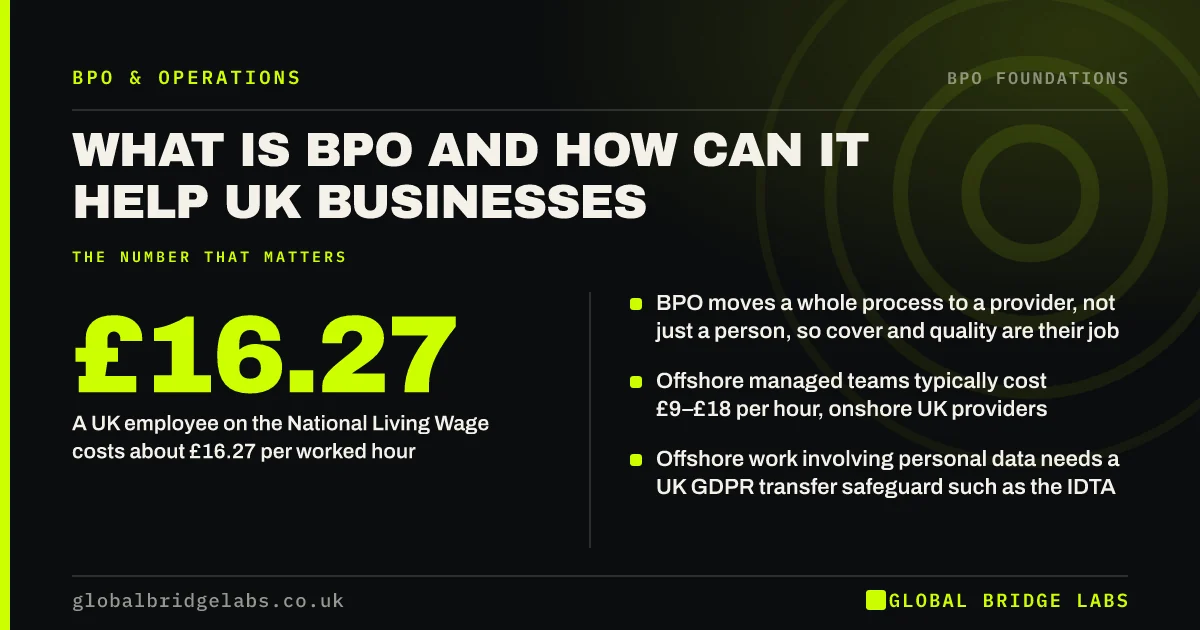
Yes. UK GDPR does not ban sending personal data abroad or giving overseas teams access to it. It requires that the protection travels with the data. Offshore business process outsourcing (BPO) is lawful when the transfer rules are followed and the provider is bound by a proper processor contract.
This article explains the main steps in plain English. It is not legal advice; for complex or high-risk processing, take specialist advice.
What is a restricted transfer?
A restricted transfer is when personal data subject to UK GDPR is sent to, or made accessible to, a receiver in a country outside the UK. The ICO is clear that making data accessible counts: an offshore team logging into your UK-hosted helpdesk or CRM is receiving a restricted transfer.
Restricted transfers are allowed if the destination has UK adequacy regulations, if an appropriate safeguard is in place, or, in limited cases, if an exception applies. Exceptions are narrow and not suitable for routine outsourcing.
Which countries have UK adequacy?
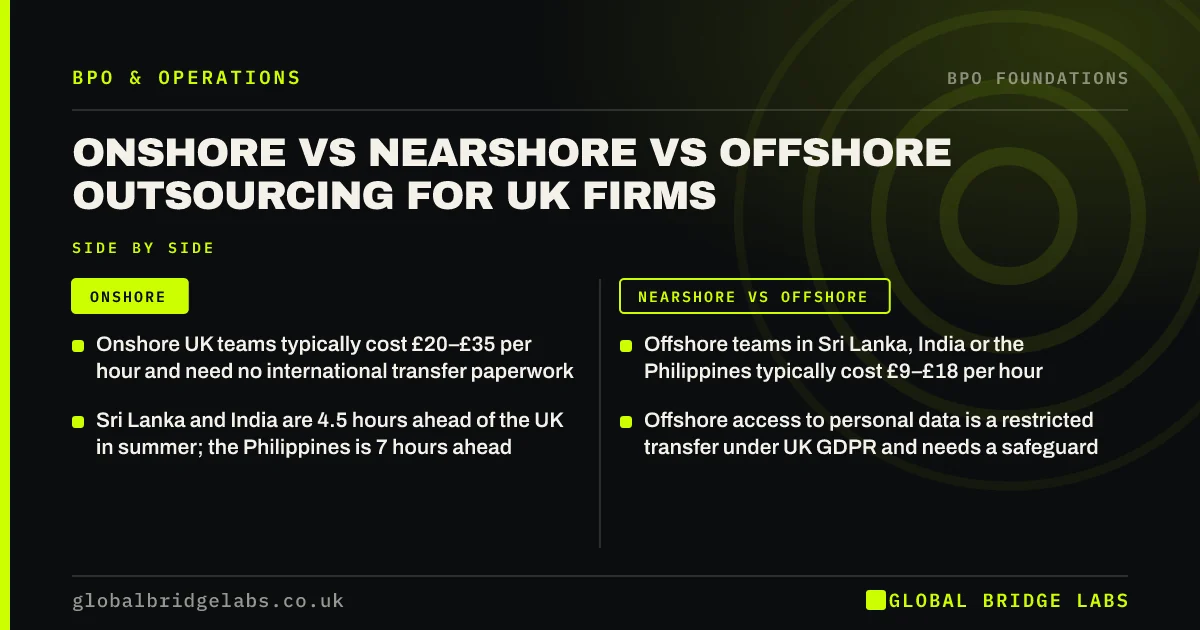
UK adequacy regulations cover the EU and EEA and a list of other countries and territories the UK has assessed. Common offshore outsourcing destinations such as Sri Lanka, India and the Philippines are not on that list, so transfers to teams there need an appropriate safeguard.
Check the ICO's current list before relying on adequacy, as it can change.
What are the IDTA and the UK Addendum?
The International Data Transfer Agreement (IDTA) is a standard contract issued by the ICO that a UK exporter and an overseas importer sign to protect a restricted transfer. The UK Addendum is an alternative that adds UK terms to the EU standard contractual clauses, useful when a provider already uses the EU clauses.
Either works as an appropriate safeguard. The provider should be familiar with them and ready to sign. If it is not, that tells you something about its maturity.
What is a transfer risk assessment?
A transfer risk assessment (TRA) checks whether the protection in the IDTA or Addendum will work in practice in the destination country, considering local laws and the safeguards around the data. The ICO notes that UK legislation now refers to this as a "data protection test", following the Data (Use and Access) Act 2025.
For routine support and admin work where the team works inside your UK systems under strong access controls, the assessment is often straightforward. Record it, and review it if the processing changes.
What must the processor contract include?
Separately from the transfer safeguard, UK GDPR requires a written contract between you (the controller) and the provider (the processor). The ICO lists the minimum terms.
- Process data only on your documented instructions.
- Confidentiality duties for everyone handling the data.
- Appropriate security measures.
- Rules for using sub-processors.
- Help with individuals' rights requests and with breaches.
- Deletion or return of data at the end of the contract.
- Audit and inspection rights.
How do practical controls reduce the risk?
Paperwork is necessary but not sufficient. Keep the team working inside your systems rather than on exported copies, give each person an individual login with multi-factor authentication and least-privilege permissions, restrict downloads and exports, and keep activity logs. These controls make the transfer risk assessment easier and actual breaches less likely.
Security matters: the DSIT Cyber Security Breaches Survey 2025/2026 found 43% of UK businesses reported a breach or attack in the previous year.
Want a managed team that works inside your systems under a signed DPA and IDTA? Tell us about your data on WhatsApp and we will discuss your requirements.
Chat on WhatsApp →Are there special rules for sensitive data?
Yes. Special category data, such as health information, needs an additional condition for processing and deserves stronger controls. Healthcare providers with access to NHS patient data must also meet the NHS Data Security and Protection Toolkit standards. Financial services firms have FCA outsourcing expectations to consider. For these, take specialist advice before offshoring.
What does this look like in practice?
At Global Bridge Labs (GBL), access is role-based and logged, work runs inside the client's systems rather than copies of their data, and every process is written down. We work to UK GDPR requirements and sign a data processing agreement, with the transfer safeguard needed for delivery from Sri Lanka.
Checklist: GDPR for offshore outsourcing
Complete these before the team gets access.
- Map the personal data the team will access.
- Confirm whether the destination has UK adequacy.
- Sign the IDTA or UK Addendum.
- Complete and record the transfer risk assessment.
- Sign a processor contract with the ICO's required terms.
- Set up individual logins, MFA, least privilege and logging.
- Update your privacy notice and records of processing.
Next step
If you are outsourcing offshore, or already have and are not sure the paperwork is right, talk to us. We will walk through what is needed for your data. 30 minutes, no pitch.
Message us on WhatsApp about offshore data protection, or book a 30-minute consultation.
Chat on WhatsApp →Sources and further reading
- International transfers of personal data · Information Commissioner's Office
- Contracts and liabilities between controllers and processors · Information Commissioner's Office
- Data (Use and Access) Act 2025 · legislation.gov.uk
- Cyber security breaches survey 2025/2026 · DSIT and Home Office
Frequently asked questions
Can UK companies outsource to countries without adequacy?
Yes, with an appropriate safeguard such as the ICO's International Data Transfer Agreement or the UK Addendum to the EU standard contractual clauses, plus a transfer risk assessment. A processor contract with the ICO's required terms is also needed. Sri Lanka, India and the Philippines all fall into this category.
Is remote access to data a transfer under UK GDPR?
Yes. The ICO treats making personal data accessible to a receiver outside the UK as a restricted transfer, even if the data remains on UK servers. An offshore team logging into your UK-hosted systems therefore needs the transfer rules to be met.
What is the IDTA?
The IDTA, or International Data Transfer Agreement, is a standard contract published by the ICO for restricted transfers of personal data from the UK. The UK exporter and the overseas importer sign it, and it provides an appropriate safeguard under UK GDPR alongside a transfer risk assessment.
Do I need to tell customers their data is handled offshore?
Your privacy notice should explain who receives personal data, including processors, and whether data is transferred outside the UK and how it is protected. You do not usually need individual consent for routine processing by a properly contracted processor.
Written by

Global Bridge Labs (GBL) is a UK–Sri Lanka partner for social media, websites and BPO. Everything here comes from client delivery, not theory.