On this page
- 01Key takeaways
- 02Why do review requests need a routine?
- 03What does a good request routine look like?
- 04What does the law say about review requests?
- 05What does a review routine take?
- 06When is a review routine the wrong focus?
- 07What does this look like in practice?
- 08Review request checklist
- 09Next step
- 10Sources and further reading
- 11Frequently asked questions
Key takeaways
Asking for reviews works best as a routine: every completed job or order gets one polite request at the right moment, with one reminder. Ask all customers, not only the happy ones, and never offer incentives for positive reviews. The Digital Markets, Competition and Consumers Act 2024 and CMA guidance treat fake or misleading reviews seriously.
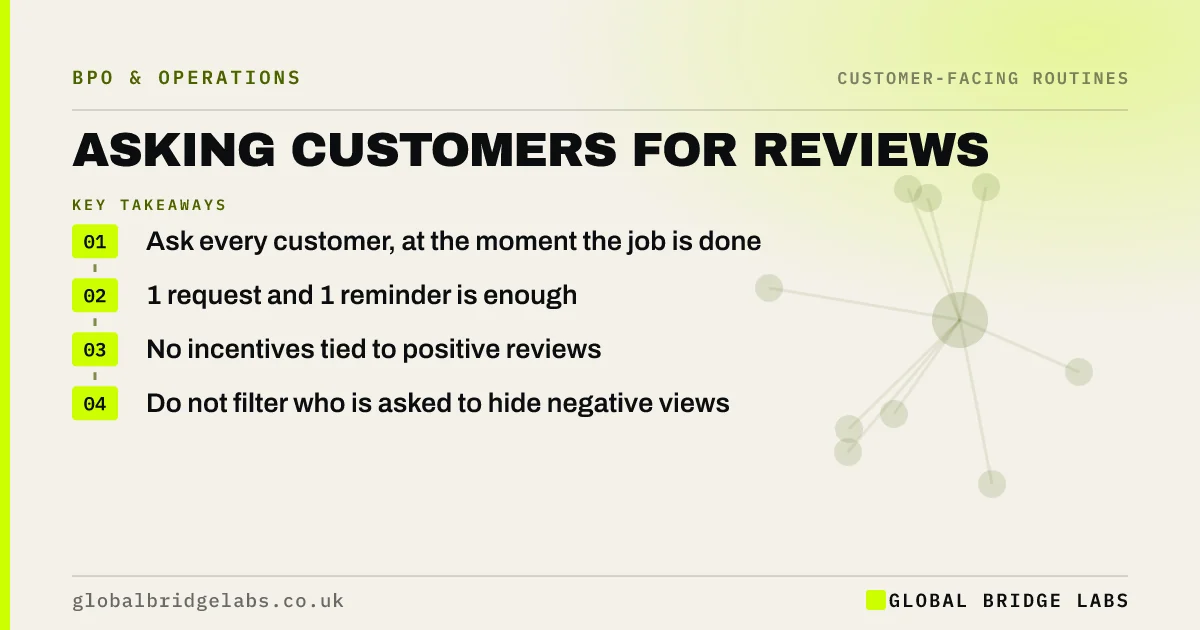
- Ask every customer, at the moment the job is done.
- 1 request and 1 reminder is enough.
- No incentives tied to positive reviews.
- Do not filter who is asked to hide negative views.
Want a review request routine that runs every week? Message us on WhatsApp with your job volume.
Chat on WhatsApp →Why do review requests need a routine?
Without a routine, review requests depend on someone remembering, so they happen in bursts after a good week and stop when it gets busy. A steady flow of recent reviews is more useful to customers than a cluster from last year. The routine is simple and repetitive, which makes it easy to hand over.
What does a good request routine look like?
Trigger the request when the customer has experienced the result: after delivery, after the job is signed off, or after the first week of use. Keep it short, name the platform, include a direct link, and send one reminder a few days later. Log who was asked and when.
- Trigger on completion, not on payment.
- Short message with a direct link.
- One reminder after three to five days.
- Every customer asked, logged by date.
What does the law say about review requests?
The DMCC Act 2024 bans fake reviews and concealed incentivised reviews, and the CMA has published guidance for businesses that publish or invite reviews. Selectively inviting only customers you expect to be positive can give a misleading picture and should be avoided. Respond to negative reviews rather than suppressing them.
What does a review routine take?
In an illustrative example, a trades firm completing 60 jobs a month spends about 2 minutes per request and reminder, around 4 hours a month including logging. If one in five customers leaves a review, that is about 12 new reviews a month. These are example figures; response rates vary by sector.
Send us your monthly job count on WhatsApp and we will help you plan the routine.
Chat on WhatsApp →When is a review routine the wrong focus?
If reviews are poor because the service is poor, more requests will produce more poor reviews. Fix the cause first. A review routine also needs care in regulated sectors, such as healthcare, where patient confidentiality limits what you can say in replies.
What does this look like in practice?
A pattern we see: a business with excellent service has a handful of reviews, all years old, because nobody asks. A weekly routine that asks every completed customer builds a steady flow within a few months.
Review request checklist
Check your routine against these points.
- Every customer asked, not a selection.
- Request sent on completion.
- One reminder only.
- No incentives for positive reviews.
- Negative reviews answered, not hidden.
Next step
Send us how you ask for reviews today, if at all. We will suggest a compliant routine and what a team could run each week.
Message us on WhatsApp about review requests, or book a 30-minute consultation.
Chat on WhatsApp →Sources and further reading
- Publishing consumer reviews and complying with consumer protection law · Competition and Markets Authority
- Digital Markets, Competition and Consumers Act 2024 · legislation.gov.uk
Frequently asked questions
When is the best time to ask for a review?
Ask when the customer has experienced the result, such as after delivery, after a job is signed off or after the first week of using a service. A short request with a direct link, followed by one reminder a few days later, usually works best.
Is it legal to offer an incentive for a review?
Offering incentives in exchange for positive reviews, or hiding that a review was incentivised, can breach the DMCC Act 2024 and consumer protection law. Check the CMA's guidance before running any incentive, and never make a reward conditional on what the review says.
Can I only ask happy customers for reviews?
Selectively inviting only customers you expect to be positive can give a misleading picture of your business, and the CMA's guidance warns against practices that distort reviews. The safer routine is to ask every customer and respond constructively to negative reviews.
Written by

Global Bridge Labs (GBL) is a UK–Sri Lanka partner for social media, websites and BPO. Everything here comes from client delivery, not theory.