On this page
Key takeaways
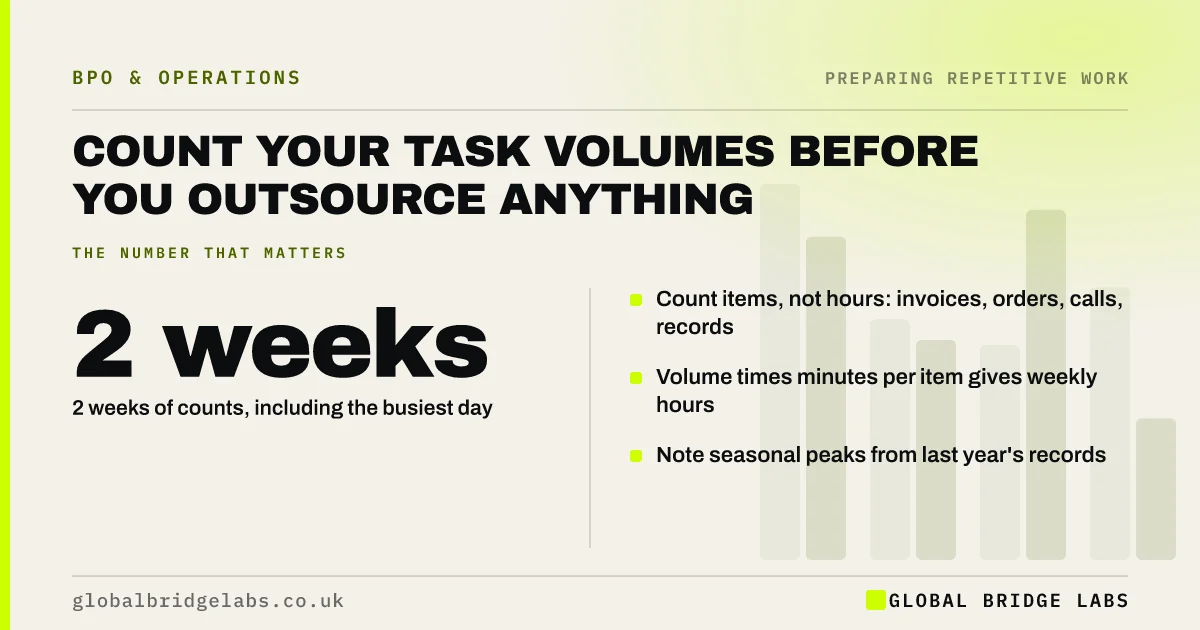
Task volume is the number of items a repetitive task processes in a period, such as invoices a week or calls a day. Counting it for two weeks, with minutes per item and the busiest day, turns guesses into hours, cost and team size. Without volumes, any outsourcing quote or plan is built on opinion.
- Count items, not hours: invoices, orders, calls, records.
- 2 weeks of counts, including the busiest day.
- Volume times minutes per item gives weekly hours.
- Note seasonal peaks from last year's records.
Want a simple volume tracker? Message us on WhatsApp and we will send one.
Chat on WhatsApp →What should you count?
Count the unit of work the task produces: one invoice raised, one order query answered, one record updated. Count exceptions separately, because they usually take three to five times longer than standard items. Record the day and time of arrival too, since the pattern of arrival decides turnaround and cover.
Where do the counts come from?
Most volumes already exist in your systems: invoices in the accounts package, orders in the shop platform, tickets in the helpdesk, calls in the phone system. Where nothing is logged, a tally sheet for two weeks is enough. Check last year's figures for peaks such as year-end, January sales or summer bookings.
How do volumes turn into hours and cost?
Multiply volume by minutes per item, then add time for exceptions. In an illustrative example, 300 invoices a week at 4 minutes is 20 hours, plus 15 exceptions at 15 minutes, nearly 4 more: about 24 hours a week. At an indicative managed offshore rate of £9–£18 an hour, that is £216–£432 a week. These are example figures, not GBL prices.
- Work out your cost per task before you outsource
- Standard times: how long should a routine task take?
- BPO cost per hour in the UK
Send us your counts on WhatsApp and we will turn them into hours with you.
Chat on WhatsApp →When are volumes misleading?
Averages mislead when work arrives in bursts. A task with 50 items a day on average but 150 on Mondays needs cover sized for Monday or an agreed catch-up time. Volumes also mislead when one item type hides several variants, so count the variants separately if their times differ.
What does this look like in practice?
A pattern we see: owners estimate volumes from memory and land within half or double the real figure. Two weeks of counts settles the question and usually changes which task goes first.
Volume count checklist
Record these for each task.
- Unit of work and where it is logged.
- Daily counts for two weeks.
- Exceptions counted separately.
- Typical minutes per item and per exception.
- Busiest day and seasonal peaks.
Next step
Send us two weeks of counts for your largest repetitive task. We will help you turn them into hours, cover and an outline of what a managed team would need.
Message us on WhatsApp with your volumes, or book a 30-minute consultation.
Chat on WhatsApp →Sources and further reading
- Labour productivity · Office for National Statistics
- Rates and thresholds for employers 2026 to 2027 · HM Revenue & Customs
Frequently asked questions
How do you measure the volume of admin work?
Count the units each task produces, such as invoices, orders or records, for at least two weeks, using system logs where they exist and a tally sheet where they do not. Count exceptions separately and note the busiest day, then multiply by minutes per item to get hours.
Why do outsourcing providers ask for volumes?
Volumes tell a provider how many hours the work needs, how to staff for peaks and what turnaround is realistic. Without them, a quote is a guess. Good volume data also gives you a baseline to check the provider's productivity against later.
How long should you count task volumes?
Two weeks is usually enough for daily and weekly tasks, as long as the period is not unusually quiet or busy. Add last year's figures for seasonal peaks. For monthly tasks, use the last three to six months from your systems.
Written by

Global Bridge Labs (GBL) is a UK–Sri Lanka partner for social media, websites and BPO. Everything here comes from client delivery, not theory.