On this page
Key takeaways
Email list cleaning is the routine of removing hard bounces, duplicates and invalid addresses, honouring unsubscribes everywhere, and checking each contact has valid consent or soft opt-in under PECR. A clean list improves deliverability and keeps you within the rules. Done monthly, it takes a few hours; left for years, it becomes a risk.
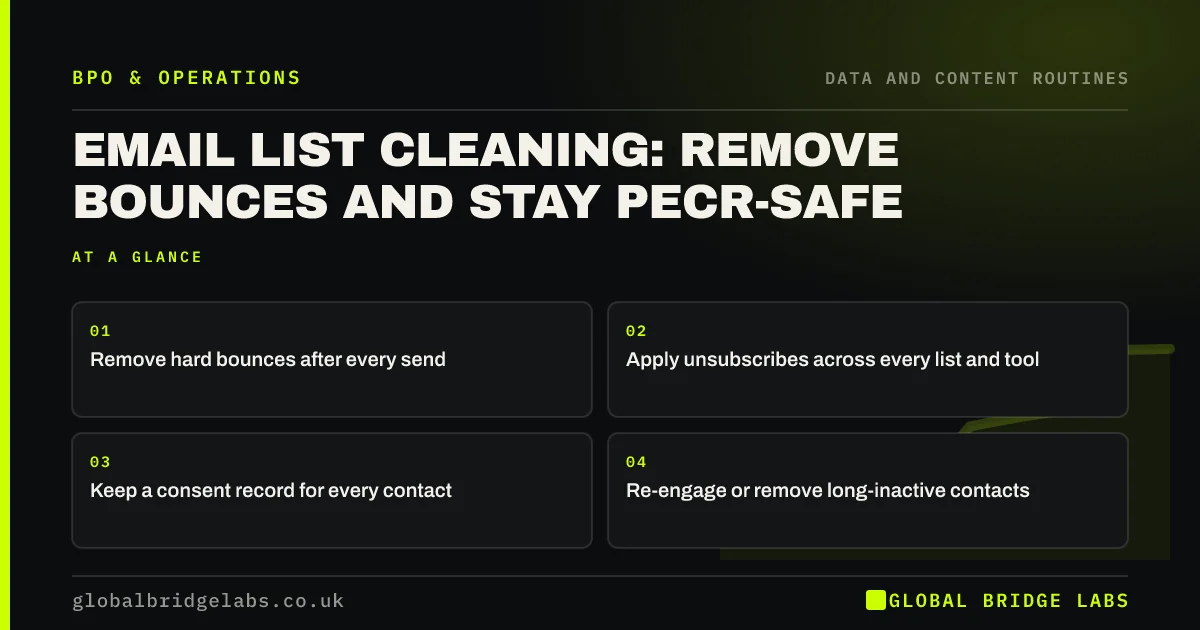
- Remove hard bounces after every send.
- Apply unsubscribes across every list and tool.
- Keep a consent record for every contact.
- Re-engage or remove long-inactive contacts.
Not sure how clean your email list is? Message us on WhatsApp with its size and age.
Chat on WhatsApp →Why does list cleaning matter?
A dirty list hurts deliverability, because mailbox providers notice bounces and complaints, and it creates legal risk if people who unsubscribed keep receiving emails. Under the Privacy and Electronic Communications Regulations (PECR), marketing emails to individuals generally need consent, or the soft opt-in for existing customers.
What does the cleaning routine involve?
Most of the routine repeats after every send and every month. It is rule-based, so it suits a dedicated team, as long as consent decisions follow a written rule.
- Remove hard bounces after each send.
- Merge duplicates and fix obvious typos.
- Sync unsubscribes across all tools.
- Check consent source for new contacts.
- Flag contacts inactive for 12 months.
What does cleaning take?
In an illustrative example, a business with 12,000 contacts and two sends a month spends about 2 to 3 hours a month on bounce removal, unsubscribe sync and consent checks, plus a one-off project to clean years of history. These are example figures. The one-off clean is usually the largest piece.
Send us your list size and send frequency on WhatsApp and we will estimate the routine with you.
Chat on WhatsApp →When should you get advice instead?
Get advice if you are unsure whether existing contacts gave valid consent, if lists were bought, or if you plan to email contacts for a new purpose. Cleaning cannot fix missing consent. In those cases, stop sending to the affected contacts until the position is clear.
What does this look like in practice?
A pattern we see: unsubscribes are honoured in the email tool, but the same contacts are re-imported from the CRM next month. Syncing unsubscribes across every system is the step that matters most.
List cleaning checklist
Run these checks every month.
- Hard bounces removed.
- Duplicates merged.
- Unsubscribes synced across tools.
- Consent source recorded for new contacts.
- Inactive contacts flagged.
Next step
Tell us your list size, tools and how contacts are added. We will suggest a monthly cleaning routine and say plainly what a team could run.
Message us on WhatsApp about email list cleaning, or book a 30-minute consultation.
Chat on WhatsApp →Sources and further reading
- Electronic and telephone marketing under PECR · Information Commissioner's Office
- What is valid consent? · Information Commissioner's Office
- Direct marketing and privacy and electronic communications · Information Commissioner's Office
Frequently asked questions
How often should you clean an email list?
Remove hard bounces after every send and run a fuller clean monthly: merging duplicates, syncing unsubscribes across tools and checking consent for new contacts. Review long-inactive contacts every six to twelve months and either re-engage or remove them.
Do you need consent to send marketing emails in the UK?
Under PECR, marketing emails to individuals generally need their consent. There is an exception, the soft opt-in, for existing customers who bought or negotiated to buy similar products and were given a chance to opt out. Business email rules differ, so check ICO guidance.
Can email list cleaning be outsourced?
Yes. Removing bounces, merging duplicates, syncing unsubscribes and recording consent sources are repetitive tasks a managed team can run monthly. Decisions about whether contacts have valid consent should follow a written rule agreed with whoever is responsible for data protection.
Written by

Global Bridge Labs (GBL) is a UK–Sri Lanka partner for social media, websites and BPO. Everything here comes from client delivery, not theory.