On this page
- 01Key takeaways
- 02What is the difference between recurring tasks and projects?
- 03Which gives more value?
- 04How are the two usually priced?
- 05What does a combined approach look like?
- 06When should you avoid outsourcing a project?
- 07What does this look like in practice?
- 08Recurring or project checklist
- 09Next step
- 10Sources and further reading
- 11Frequently asked questions
Key takeaways
Recurring tasks repeat daily, weekly or monthly with the same method, so outsourcing them returns time every week. One-off projects, such as a data migration or a backlog clearance, have a start and an end and are bought as a fixed piece of work. Most UK SMEs start with recurring work and use projects to clear the ground first.
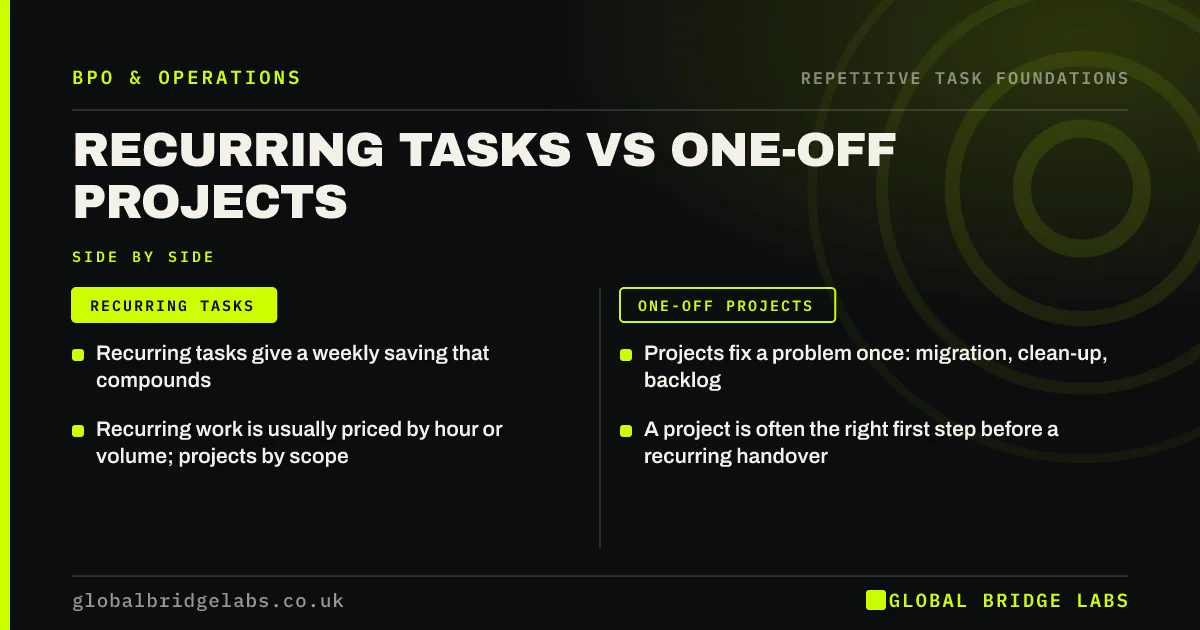
- Recurring tasks give a weekly saving that compounds.
- Projects fix a problem once: migration, clean-up, backlog.
- Recurring work is usually priced by hour or volume; projects by scope.
- A project is often the right first step before a recurring handover.
Not sure whether you need a project or ongoing support? Message us on WhatsApp with the problem.
Chat on WhatsApp →What is the difference between recurring tasks and projects?
A recurring task produces the same type of output again and again, such as invoices or reminders. A project produces a one-time change, such as moving records to a new system or clearing three months of unmatched payments. Recurring tasks need a stable method; projects need a clear scope and a finish line.
Which gives more value?
Recurring tasks usually give more value over a year because the saving repeats. Projects give value by removing a blocker, and the blocker is often what stops recurring work running well. A clean customer database makes enrichment and reminders easier; a cleared backlog lets a daily routine start from zero.
How are the two usually priced?
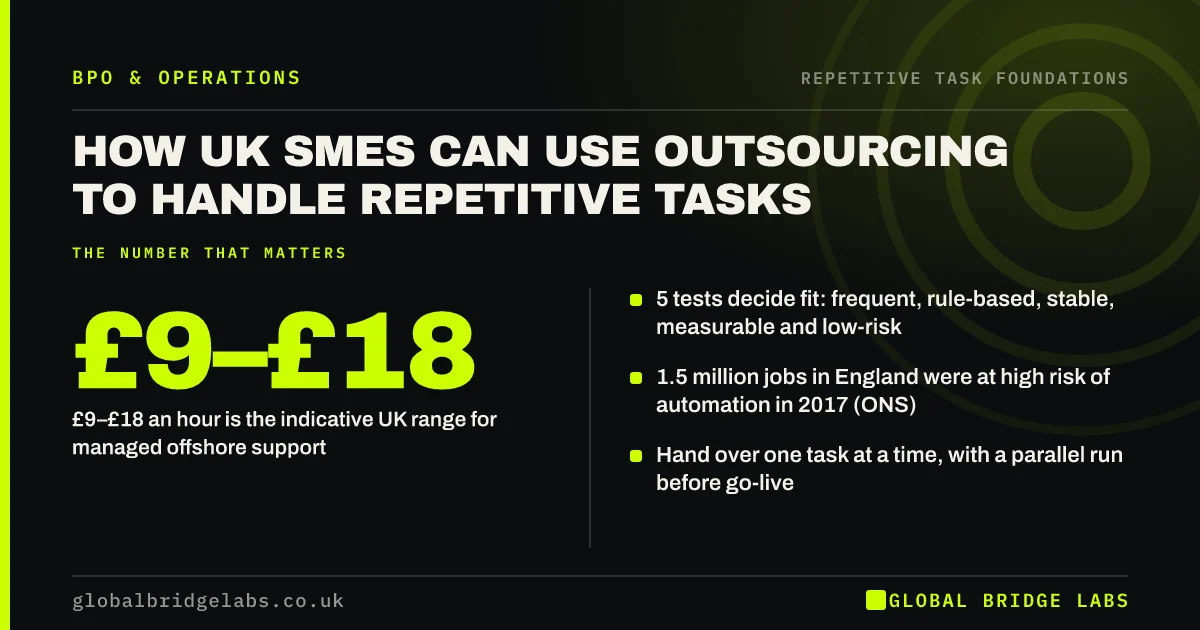
Recurring outsourced work is usually priced by the hour, by a block of hours or by volume. As indicative UK market ranges, managed offshore support costs £9–£18 an hour; these are not GBL prices. Projects are usually quoted as a fixed price for a defined scope, so the scope document matters more than the rate.
What does a combined approach look like?
In an illustrative example, a retailer migrating to a new stock system buys a four-week project to cleanse and move 6,000 product records, then hands over weekly listing updates as a recurring task to the same team. These are example figures. The team that did the migration already knows the data, so the recurring handover is faster.
- Product listing services: upload and update your catalogue
- Stock reconciliation: make the system match the shelf
Want to plan a project and a recurring handover together? Send us the details on WhatsApp.
Chat on WhatsApp →When should you avoid outsourcing a project?
Avoid outsourcing a project you cannot define, such as a redesign of a process nobody agrees on. Settle the decisions in-house first. Also avoid treating recurring work as a series of small projects, which adds briefing time every month and loses the learning a dedicated team builds.
What does this look like in practice?
A pattern we see: a business asks for a one-off clean-up of its records, and six months later the records are messy again because the daily updates never changed. Pairing the project with a small recurring task keeps the gain.
Recurring or project checklist
Ask these questions before you buy either.
- Will the same output be needed next week?
- Is there a backlog or mess to clear first?
- Can the scope be written with a finish line?
- Who keeps the result clean afterwards?
- Would one team doing both save briefing time?
Next step
Tell us what you want fixed and what you want kept running. We will say plainly whether it is a project, a recurring task or both, and how we would sequence them.
Message us on WhatsApp to discuss your requirements, or book a 30-minute consultation.
Chat on WhatsApp →Sources and further reading
- Rates and thresholds for employers 2026 to 2027 · HM Revenue & Customs
- Contracts and liabilities between controllers and processors · Information Commissioner's Office
Frequently asked questions
Is it better to outsource ongoing tasks or projects?
For lasting time savings, ongoing recurring tasks usually give more value because the saving repeats every week. Projects are better for one-time problems such as migrations or backlogs. Many small businesses use a short project to clear the ground, then hand over the recurring task.
How is recurring outsourced work priced?
Recurring work is usually priced by the hour, by a monthly block of hours or by volume, such as per item processed. As an indicative UK market range, managed offshore support costs £9–£18 an hour, though these are not GBL prices and depend on skills and volume.
Can the same team do a project and the recurring work?
Yes, and it often helps. A team that cleans or migrates your data learns your systems and rules, so taking on the recurring task afterwards needs less briefing. Agree the scope of each separately so the project has a clear finish line.
Written by

Global Bridge Labs (GBL) is a UK–Sri Lanka partner for social media, websites and BPO. Everything here comes from client delivery, not theory.