On this page
- 01Key takeaways
- 02Days 1 to 14: what should you find out?
- 03Days 15 to 30: how do you prepare the first task?
- 04Days 31 to 60: how do you go live?
- 05Days 61 to 90: what comes next?
- 06How much of your time does the plan need?
- 07When should the plan go slower?
- 08What does this look like in practice?
- 0990-day plan checklist
- 10Next step
- 11Sources and further reading
- 12Frequently asked questions
Key takeaways
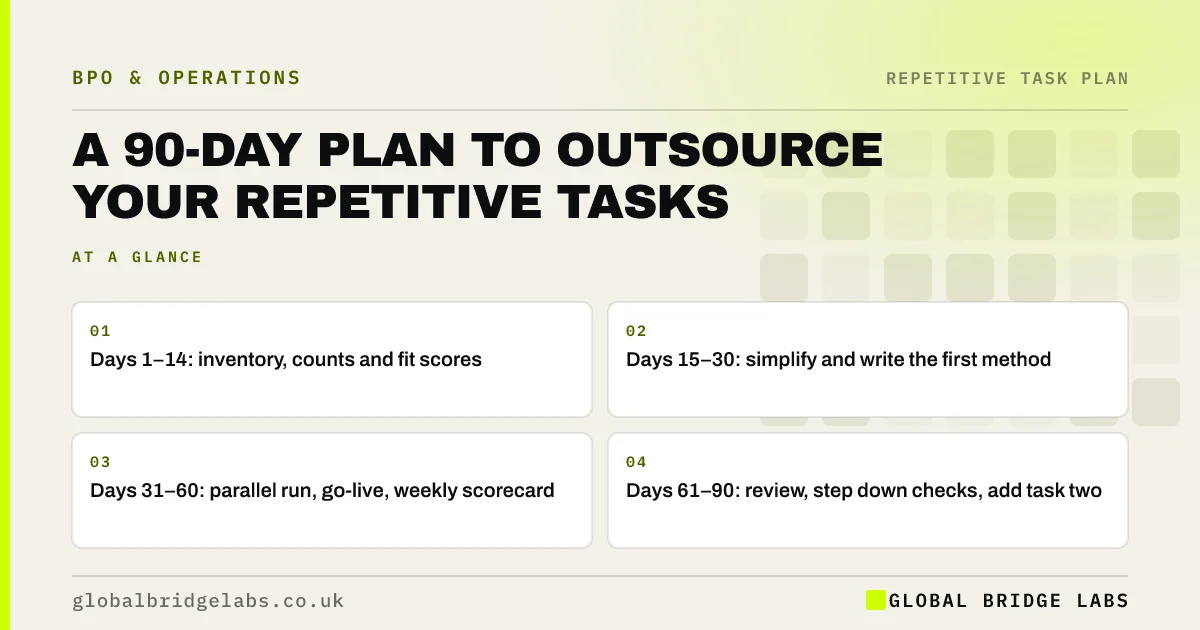
A 90-day plan gets a UK SME from a list of repetitive tasks to one or two stable, outsourced tasks with a scorecard. Days 1 to 14: inventory and score. Days 15 to 30: simplify and document the first task. Days 31 to 60: parallel run and go-live. Days 61 to 90: review, step down checks and start the second task.
- Days 1–14: inventory, counts and fit scores.
- Days 15–30: simplify and write the first method.
- Days 31–60: parallel run, go-live, weekly scorecard.
- Days 61–90: review, step down checks, add task two.
Want this plan built around your own tasks? Message us on WhatsApp with your top three.
Chat on WhatsApp →Days 1 to 14: what should you find out?
Build the task inventory, count volumes and minutes for the main tasks, and score the top ten on the fit score. Ask the team which tasks they would hand over. By day 14 you should know your first task and roughly how many hours it takes each week.
- Build the task inventory.
- Count volumes for two weeks.
- Score the top ten tasks.
- Choose the first task.
Days 15 to 30: how do you prepare the first task?
Simplify the first task with ECRS, write the method, rules and exceptions, fix the input channel, agree the scope of work and put the data protection paperwork in place. Name the in-house owner and tell the people affected. By day 30 someone new could do the task from the written method.
Days 31 to 60: how do you go live?
Run both teams in parallel for one to two weeks, compare outputs daily and fix causes in the method. Switch over when accuracy meets the target. Check every item for the first week, then about one in five. Review a weekly scorecard of volume, turnaround and accuracy with the owner.
- Parallel running: test an outsourced task safely
- Quality sampling: how many outsourced items to check
- Outsourcing efficiency KPIs: prove the work got faster
Getting close to go-live? Send us your plan on WhatsApp and we will check it with you.
Chat on WhatsApp →Days 61 to 90: what comes next?
Hold a 30-day review, step sampling down to steady state, record the hours returned and how they are used, and update the method with what you learned. Then start the second task, which reuses the method, access and scorecard and usually moves faster.
How much of your time does the plan need?
As a GBL rule of thumb, plan on 3 to 4 hours a week of owner time in the first month, mostly writing the method and answering questions, falling to 1 to 2 hours a week by month three. In an illustrative example, that buys back 10 to 20 hours a week once two tasks are stable. These are example figures.
When should the plan go slower?
Slow down when the first task involves regulated decisions, special category data or a staff consultation, or when the parallel run shows the method is not ready. Ninety days is a guide. A stable first task matters more than speed.
What does this look like in practice?
A pattern we see: businesses that finish the first 90 days with one stable task go on to hand over three or four more in the following six months, because the method and trust are already in place.
Across our client work, back-office cost per task has fallen by 42% once the process was written down and run by a managed team.
90-day plan checklist
Tick these off as you go.
- Inventory and scores done by day 14.
- First method written by day 30.
- Parallel run complete by day 45.
- Weekly scorecard running.
- 30-day review held.
- Second task chosen by day 90.
Next step
Send us your top three repetitive tasks and team size. We will sketch a 90-day plan for your business and say plainly which task should go first.
Message us on WhatsApp for a 90-day plan, or book a 30-minute consultation.
Chat on WhatsApp →Sources and further reading
- Contracts and liabilities between controllers and processors · Information Commissioner's Office
- Business transfers, takeovers and TUPE · GOV.UK
- Rates and thresholds for employers 2026 to 2027 · HM Revenue & Customs
Frequently asked questions
How long does it take to start outsourcing repetitive tasks?
A first task usually goes live within four to eight weeks: two weeks to count and choose, two weeks to document and agree scope, then one to two weeks of parallel running. Allow 90 days for the first task to settle and the second to start.
Which repetitive task should you outsource first?
The one that scores highest on the fit score: frequent, rule-based, stable, measurable and low-risk, with enough volume to matter. It should also be a task whose result you can check easily, so you build trust in the routine quickly.
How much owner time does outsourcing need at the start?
Expect around 3 to 4 hours a week in the first month for writing the method, answering questions and reviewing samples, falling to 1 to 2 hours a week by month three. These are GBL working estimates; complex or regulated tasks need more.
Written by

Global Bridge Labs (GBL) is a UK–Sri Lanka partner for social media, websites and BPO. Everything here comes from client delivery, not theory.