On this page
- 01Key takeaways
- 02What is the difference between rule-based and judgement tasks?
- 03How do you split a mixed task?
- 04Can judgement be turned into rules?
- 05What share of a typical role is rule-based?
- 06When should judgement stay in-house regardless?
- 07What does this look like in practice?
- 08Rule and judgement checklist
- 09Next step
- 10Sources and further reading
- 11Frequently asked questions
Key takeaways
A rule-based task has a written method that gives the right answer most of the time. A judgement task needs experience, context or a risk decision that cannot be fully written down. Most small-business roles mix both. Split the role, hand over the rule-based share, and keep judgement with the people accountable for it.
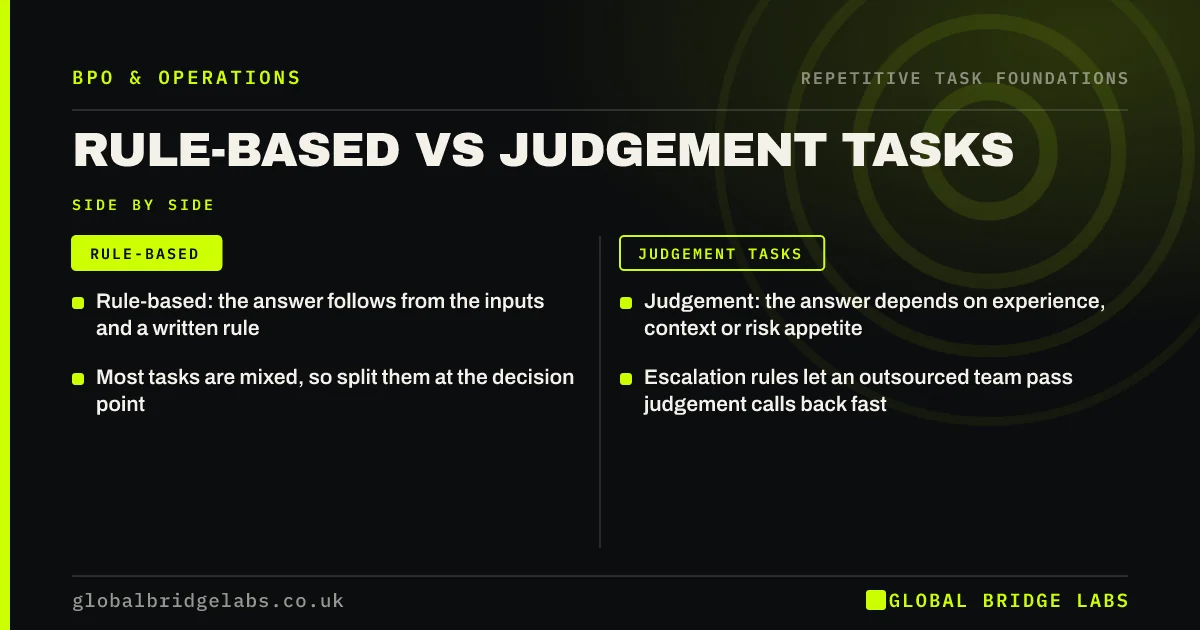
- Rule-based: the answer follows from the inputs and a written rule.
- Judgement: the answer depends on experience, context or risk appetite.
- Most tasks are mixed, so split them at the decision point.
- Escalation rules let an outsourced team pass judgement calls back fast.
Want help splitting a mixed role? Message us on WhatsApp with the tasks it covers.
Chat on WhatsApp →What is the difference between rule-based and judgement tasks?
A rule-based task can be done correctly by anyone trained on the written method, because the inputs decide the outcome. A judgement task needs someone to weigh things the method cannot capture, such as a customer relationship, an unusual risk or a commercial trade-off. Matching a payment to an invoice is rule-based; deciding whether to write off the balance is judgement.
How do you split a mixed task?
Map the task step by step and mark each step as rule or judgement. Most mixed tasks have a long rule-based run with one or two decision points. Hand over the steps up to each decision point, have the outsourced team prepare the decision with the facts, and keep the decision itself with a named person in your business.
- List the steps from trigger to finished output.
- Mark each step rule (R) or judgement (J).
- Turn repeated J steps into rules where you can.
- Agree what the team prepares before each J step.
Can judgement be turned into rules?
Often, partly. When the same judgement is made many times, the reasons usually repeat, and they can be written as a decision table: if the order is under £200 and the customer has no prior refunds, approve; otherwise refer. Rules cover the common cases and leave the rare ones for a person, which is how most outsourced processes are designed.
What share of a typical role is rule-based?
It varies widely, which is why you should measure it. In an illustrative office manager role, rotas, supplier orders, reminders and data updates might be 60% of the week and supplier negotiations and staff issues the other 40%. These are example figures. Mark a week of your own tasks R or J and add up the hours.
Want help working out the rule-based share of a role? Send us the task list on WhatsApp.
Chat on WhatsApp →When should judgement stay in-house regardless?
Keep judgement in-house when a regulator expects a named person to decide, such as a money laundering reporting decision, a clinical decision or a legal sign-off. Keep it too when the decision shapes a relationship you depend on. An outsourced team can still do the preparation, so the decision takes minutes rather than an hour.
What does this look like in practice?
A pattern we see: an owner says a task cannot be handed over because it needs judgement. Mapping it shows twelve rule-based steps and one judgement call at the end. The team now does the twelve steps and the owner spends two minutes on the call.
Rule and judgement checklist
Use these checks on any task you are considering handing over.
- Map the steps and mark each R or J.
- Write rules for any J step made the same way each time.
- Agree who makes each remaining J decision.
- Set a turnaround for referred decisions.
- Review referrals monthly for new rules.
Next step
Send us one task your team says needs judgement. We will map it with you and show where the rule-based steps end and the decision begins.
Message us on WhatsApp to map a task, or book a 30-minute consultation.
Chat on WhatsApp →Sources and further reading
- Human factors: managing human failures · Health and Safety Executive
- The Money Laundering, Terrorist Financing and Transfer of Funds Regulations 2017 · legislation.gov.uk
Frequently asked questions
What is a rule-based task?
A rule-based task is one where a written method and the inputs decide the outcome, so anyone trained on the method gets the same correct answer. Matching payments to invoices, booking appointments into set slots and checking timesheets against rotas are common examples in small businesses.
Can an outsourced team handle judgement tasks?
An outsourced team can handle judgement within clear limits, such as approving refunds under a set value. Larger or regulated decisions are better kept in-house, with the team preparing the facts and options so the decision takes minutes. Clear escalation rules make this split work.
How do you write rules for judgement calls?
Look at the last twenty times the decision was made and write down the reasons each time. Repeated reasons become rules, usually as a simple table of conditions and outcomes. Anything the table does not cover is referred to a named person, and new rules are added monthly.
Written by

Global Bridge Labs (GBL) is a UK–Sri Lanka partner for social media, websites and BPO. Everything here comes from client delivery, not theory.