On this page
- 01Key takeaways
- 02What counts as a business process?
- 03Which business processes can a UK SME outsource?
- 04How do you decide which processes to outsource?
- 05Which processes should you keep in-house?
- 06Should you outsource a whole process or split it?
- 07What does it cost to outsource a business process?
- 08When is outsourcing a process the wrong move?
- 09What rules apply to outsourced data and regulated work?
- 10How does automation change which processes you outsource?
- 11What does this look like in practice?
- 12How do you choose your processes in five steps?
- 13Guides on processes and how to choose them
- 14Guides on the tests a process must pass
- 15Guides on finance processes
- 16Guides on customer processes
- 17Guides on people processes
- 18Guides on sales and marketing processes
- 19Guides on IT and data processes
- 20Guides on operations processes
- 21Guides on decisions, risk and sequencing
- 22Guides by sector
- 23Next step
- 24Sources and further reading
- 25Frequently asked questions
Key takeaways
Which business processes should you outsource? The ones that are repeatable, defined, separable from the rest of the business, controllable through access and contracts, and that do not win you customers. For most UK SMEs that means finance processing, routine customer service, data upkeep and parts of HR, IT and operations. Pricing, strategy, key relationships and final decisions stay in-house.
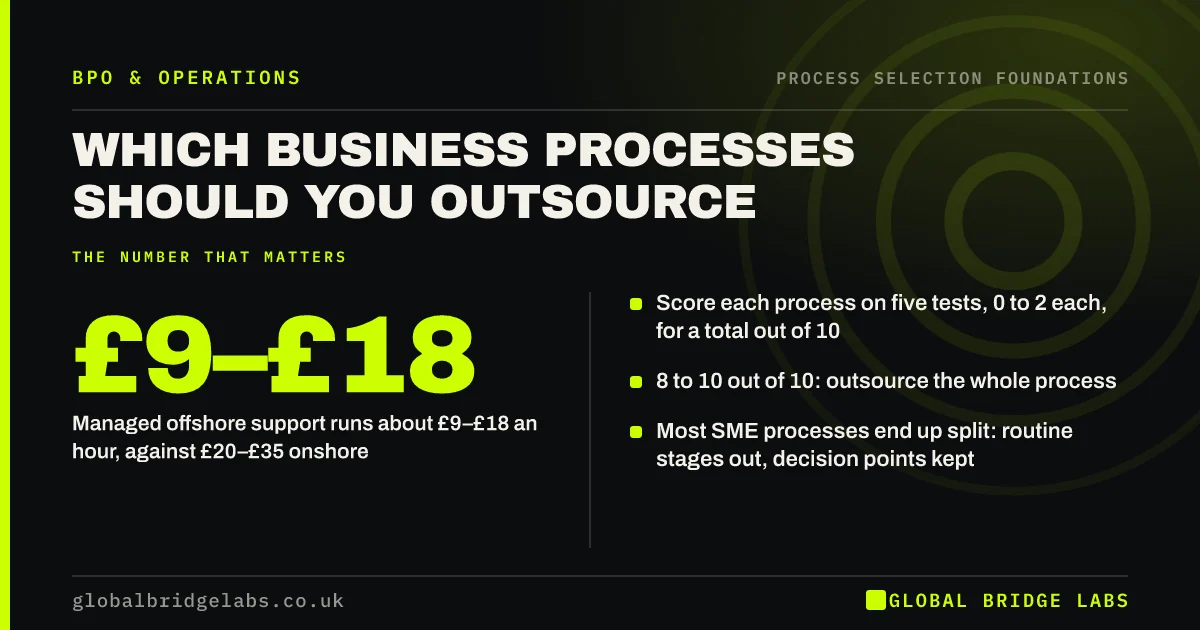
- Score each process on five tests, 0 to 2 each, for a total out of 10.
- 8 to 10 out of 10: outsource the whole process. 5 to 7: split it. 4 or below: keep it.
- Managed offshore support runs about £9–£18 an hour, against £20–£35 onshore.
- Most SME processes end up split: routine stages out, decision points kept in.
- Pricing, strategy, key relationships and final approvals stay in-house.
Want your processes scored against these tests? Message us on WhatsApp with the three that take most of your week.
Chat on WhatsApp →What counts as a business process?
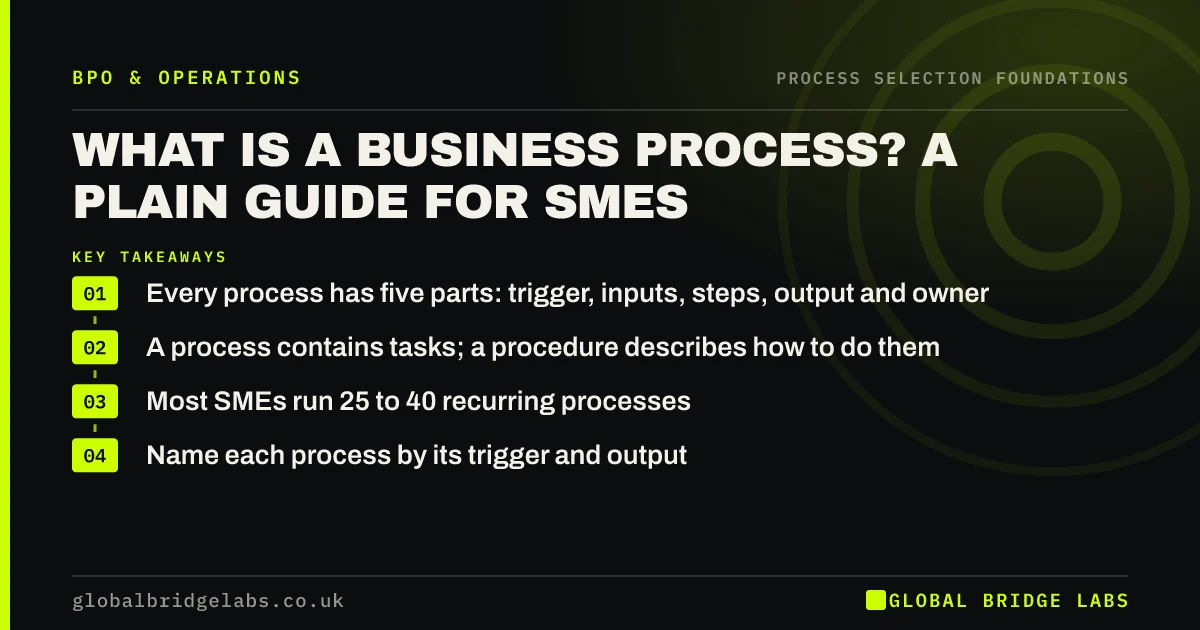
A business process is a repeatable sequence of steps, with a clear trigger, an owner and an output, that turns an input into something the business or a customer needs. Supplier invoice to payment is a process. Entering one invoice into the accounts is a task inside it. The difference matters when you outsource, because a process can be handed over with its outcome, while a task is handed over with instructions.
Most UK SMEs run between 25 and 40 recurring processes without ever listing them. They sit in people's heads, inboxes and spreadsheets. Listing them once, with a trigger, an output and an owner for each, is the first step to deciding which ones should move. If you are looking for a list of individual admin jobs rather than whole processes, our guide to what tasks a small business can outsource covers that.
Which business processes can a UK SME outsource?
Almost any process with a stable method and a measurable output can be outsourced in whole or in part. In practice, the processes UK SMEs hand over most often fall into six areas, and inside each area the routine processing moves while the decisions stay. The lists below are the processes we see score well most often, not a rule that every business should follow.
- Finance: supplier invoice processing, billing, payment run preparation, reconciliations, the management accounts pack and VAT return preparation.
- Customer: first-line service, complaint logging and routine replies, subscription renewals, satisfaction surveys and win-back calls.
- People: the HR helpdesk, absence admin, employee records, pension and benefits admin and the first sift of CVs.
- Sales and marketing: proposal production, email campaigns, pipeline and marketing reports, website content updates and event lead follow-up.
- IT and data: data quality checks, licence and asset tracking, patch and backup checks, report builds and data labelling.
- Operations: procurement admin, document control, compliance monitoring, project admin and maintenance scheduling.
How do you decide which processes to outsource?
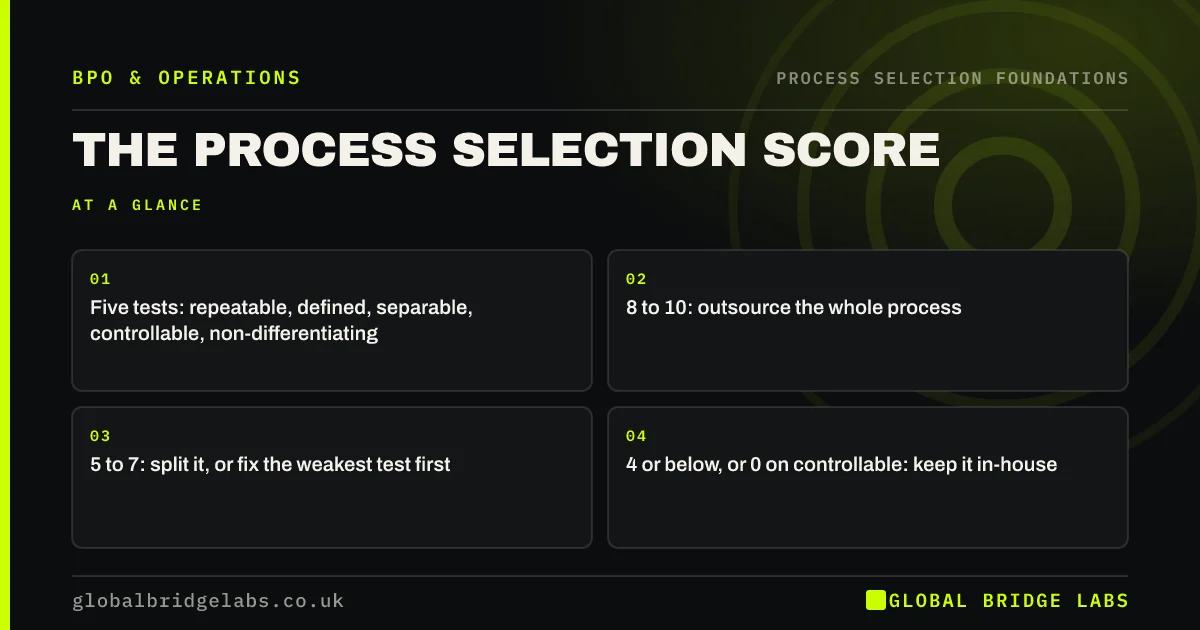
Score each process on the GBL Process Selection Score: five tests, each scored 0, 1 or 2, for a total out of 10. A process that scores 8 or more is a strong candidate to outsource whole. A score of 5 to 7 usually means split the process or fix its weakest test first. A score of 4 or below means keep it for now.
One override applies: a process that scores 0 on controllable stays in-house whatever its total, because you cannot outsource a risk you cannot contain. The score answers which process to move. Whether your business is ready to outsource at all is a separate question, answered by the outsourcing trigger scorecard, and whether a single small task is ready is answered by the repetitive task fit score.
- Repeatable: it runs often enough, at enough volume, for a team to stay practised.
- Defined: the steps and rules can be written down, and good output can be checked.
- Separable: it has a clean start, a clean end and few tangled handoffs.
- Controllable: data, regulatory and customer risk can be managed through access, checks and contracts.
- Non-differentiating: doing it better than rivals does not win you customers.
Which processes should you keep in-house?
Keep the processes that set direction, carry personal accountability or are the reason customers choose you. For most SMEs that means pricing decisions, brand and product strategy, relationships with key customers and suppliers, hiring and disciplinary decisions, and final approval of payments. You can still outsource the preparation work inside these processes, such as the data, the drafts and the admin, while the decision stays with you.
Should you outsource a whole process or split it?
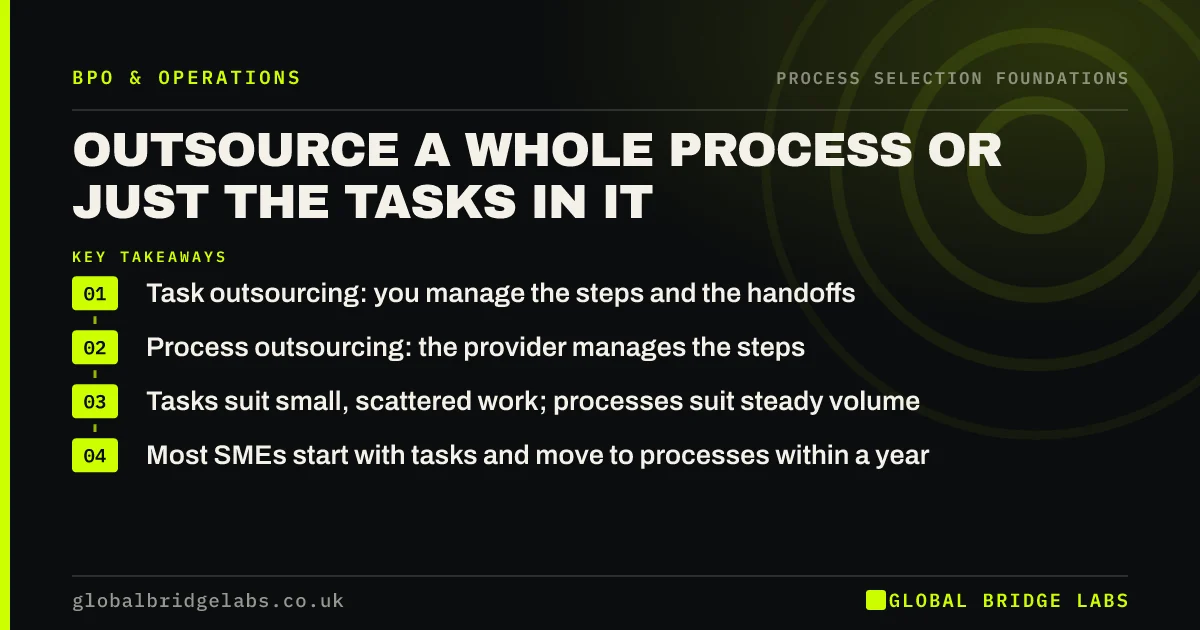
Split it, in most SME cases. Every process gets one of four verdicts: outsource it whole, split it, fix it first, or keep it. A split hands the routine stages to a managed team and keeps the decision points in-house, for example a provider prepares the supplier payment run and you approve it. Whole-process outsourcing suits high-volume, well-defined processes with one clear output.
- Outsource: score 8 to 10, stable method, measurable output.
- Split: score 5 to 7, routine stages around one or two judgement points.
- Fix first: the process would score well but is undocumented or changing.
- Keep: score 4 or below, or 0 on controllable.
What does it cost to outsource a business process?
Indicative UK market ranges put managed offshore support at about £9–£18 an hour and onshore outsourced support at about £20–£35 an hour, before set-up and management time. An employee on £30,000 costs about £19.81 per worked hour once employer National Insurance, pension and paid leave are included. These are market ranges, not a GBL price list.
In an illustrative example, three processes (supplier invoice processing, first-line email service and CRM data upkeep) take 30 hours a week in-house. At £19.81 an hour that is about £594 a week in staff cost. The same hours from a managed offshore team at £9–£18 an hour would cost about £270–£540 a week, plus your own time to review the work. The saving is real but smaller than the hourly gap suggests, and it disappears if the process is badly scoped.
- BPO cost per hour in the UK
- BPO pricing models explained
- The true cost of an employee in the UK
- Work out your cost per task before you outsource
Want a costed view of the processes you are considering? Message us on WhatsApp and we will discuss your requirements.
Chat on WhatsApp →When is outsourcing a process the wrong move?
Outsourcing a process is the wrong move when the method changes every week, when nobody can say what good output looks like, when the process is the reason customers buy from you, or when the volume is too small to keep anyone practised. It is also wrong when you are trying to escape a problem you do not understand: a provider will run a broken process faithfully, and you will pay for every repetition.
- The process changes faster than it can be written down.
- You cannot describe or measure a good result.
- Customers choose you because of how you do it.
- Volume is a few hours a month with no related work to bundle it with.
What rules apply to outsourced data and regulated work?
Under UK GDPR a provider that handles personal data on your behalf is a processor, and you need an Article 28 contract with it. Sending data to a country without UK adequacy, such as Sri Lanka, needs a transfer mechanism such as the International Data Transfer Agreement. TUPE can apply when an activity moves to a provider and an organised group of staff mainly did that work. Regulated firms keep the duty: FCA SYSC 8 says a firm remains fully responsible for outsourced functions.
How does automation change which processes you outsource?
Automation takes the most stable rule-based steps; people handle the exceptions, checks and anything that needs a judgement call. The ONS estimated in 2019 that about 1.5 million jobs in England, 7.4% of the 19.9 million analysed, were at high risk of automation, mostly routine roles. For process selection that means automate the steps a rule can do, and outsource the human work around them, such as exceptions, quality checks and customer contact.
What does this look like in practice?
A pattern we see often: an owner starts by listing tasks and ends up with 60 fragments that nobody wants to hand over one at a time. Listing processes instead groups those fragments into eight or ten units with clear outputs, and two or three of them usually score well enough to move. Across our client work, that approach has cut back-office cost per task by 42% and returned 31 hours a week to in-house teams.
How do you choose your processes in five steps?
Work through these steps in order. Most SMEs can do the first three in a single afternoon.
- List every recurring process in a register with its trigger, output, owner and weekly hours.
- Score each process on the five tests and note its weakest test.
- Give each process a verdict: outsource, split, fix first or keep.
- For the top one or two, write the method and agree what good looks like.
- Pilot one process, review it after 30 days, then follow a roadmap for the rest.
Guides on processes and how to choose them
Start here if you want the definitions and the method: what a process is, how it differs from a task, how to list and score your processes, and the four verdicts.
Guides on the tests a process must pass
Each of these takes one test in depth: volume, variability, criticality, dependencies, data, measurement, timing, regulation, differentiation and customer contact.
- How much volume makes a process worth outsourcing?
- Process variability: why some processes travel badly
- Process criticality: rate the damage if it fails
- Process dependencies: map them before you hand over
- Can you measure it? The test every outsourced process needs
- Time-critical processes: outsource them with a clock
- Customer-facing processes: outsource with care, not fear
Guides on finance processes
Process-by-process verdicts for finance: what to outsource, what to split and what to keep.
- Record to report: which parts should you outsource?
- Management accounts: outsource the pack, keep the review
- VAT return preparation: outsource the routine, own the return
- Cash flow forecasting: outsource the model, keep the calls
- Recurring billing admin: run it like clockwork
- Supplier payment runs: outsource the prep, keep approval
- Year-end preparation: get records ready for your accountant
- Grant claim admin: evidence, timesheets and deadlines
- Budgeting: the process stays yours, the admin can move
Guides on customer processes
Verdicts for customer-facing processes, where the risk is to the relationship as well as the work.
- Complaints handling: what to outsource and what to own
- Win-back calls: bring lapsed customers back
- Customer surveys: outsource the asking, keep the acting
- Subscription renewals: a process that keeps customers
- Should you outsource account management?
- Customer success outsourcing: what works for SMEs
- Inbound sales calls: outsource them or keep them close?
- Vulnerable customers: a process an outsourced team can follow
- Caller verification: confirm identity before you discuss accounts
Guides on people processes
Verdicts for HR processes, where admin can move but people decisions stay with the employer.
- Absence management: outsource the admin, keep the conversations
- HR helpdesk: answer staff questions without an HR team
- Employee records: keep them complete, lawful and current
- Pension auto-enrolment admin: duties you cannot skip
- Employee benefits admin: enrolments, changes and P11Ds
- Should you outsource performance reviews?
- Disciplinary and grievance: what you can hand over
- Candidate screening: outsource the sift, keep the choice
- Staff surveys: outsource the survey, keep the response
- People reports: headcount, absence and turnover monthly
Guides on sales and marketing processes
Verdicts for commercial processes: production and reporting move, positioning and pricing stay.
- Proposal writing support: faster proposals in your voice
- Email marketing outsourcing: what to hand over
- Sales pipeline reporting: outsource the numbers, own the calls
- Marketing reporting: one monthly view across channels
- Website content updates: who should make the changes?
- Trade show leads: follow up within days, not weeks
Guides on IT and data processes
Verdicts for the technical processes small firms often run by accident.
- Integrations between systems: who watches when they break?
- Managed security for small firms: what to outsource
- Software licence management: stop paying for empty seats
- Data quality: a routine that keeps business records usable
- IT asset management: know where every device is
- Data annotation outsourcing: labelling data for AI
- Data reporting: outsource the build and the monthly refresh
- Backup checks: test restores before you need them
- Patch management: keep software updated without drama
Guides on operations processes
Verdicts for the operational processes that keep a business compliant and supplied.
- Procurement outsourcing: buy better without a buyer
- Facilities admin: contractors, checks and renewals
- Document control: one current version of everything
- Project admin support: plans, actions and updates
- Compliance monitoring: owners, evidence and early warnings
- Health and safety admin: what you can hand over
- Supplier performance reviews: score the suppliers you rely on
- Planned maintenance scheduling: book it before it breaks
- Inventory planning: outsource the reorder routine
Guides on decisions, risk and sequencing
What stays with the owner, how to handle linked processes, and how to order the rest.
- Should you outsource product development?
- Linked processes: outsource them together or apart?
- An outsourcing risk register for each process
- What to outsource at each stage of growth
- An outsourcing roadmap: which process comes next
- Outsourced the wrong process? How to tell and what to do
- Which processes can be offshored, and which stay onshore?
Guides by sector
Process choices for sectors with their own rules and rhythms, plus seasonal processes.
- Processes a manufacturer can outsource, and what stays
- Processes a charity can outsource safely
- Property management processes to outsource
- Care provider admin: what can be outsourced?
- SaaS operations: which processes to outsource
- Training provider admin: enrolments to certificates
- Franchise back office: central processes for every site
- Seasonal processes: outsource the peak, keep the base
Next step
Send us the three processes that take most of your team's week. We will score them with you on the five tests and tell you plainly which to outsource, which to split and which to keep, with indicative costs for the ones worth moving.
Message us on WhatsApp to score your processes, or book a 30-minute consultation.
Chat on WhatsApp →Sources and further reading
- The probability of automation in England: 2011 and 2017 · Office for National Statistics
- Contracts and liabilities between controllers and processors · Information Commissioner's Office
- International transfers of personal data · Information Commissioner's Office
- Business transfers, takeovers and TUPE · GOV.UK
- FCA Handbook SYSC 8: Outsourcing · Financial Conduct Authority
- The Sourcing and Consultancy Playbooks · Cabinet Office
Frequently asked questions
What business processes are most commonly outsourced?
UK SMEs most often outsource finance processing (supplier invoices, billing, reconciliations), first-line customer service, data entry and upkeep, HR admin, IT support and procurement admin. These processes are repeatable, rule-based and measurable, so a managed team can run them to an agreed standard while the business keeps the decisions.
How do I know if a process is suitable for outsourcing?
Score it on five tests: is it repeatable, defined, separable from other work, controllable through access and contracts, and non-differentiating? Score each 0 to 2. A total of 8 or more suits outsourcing whole, 5 to 7 suits a split, and 4 or below means keep it for now.
Which business processes should never be outsourced?
Decisions that set direction or carry personal accountability: pricing, strategy, brand, product direction, key relationships, hiring and disciplinary outcomes, and final payment approval. Regulated firms also keep the responsibility for outsourced functions. The preparation work around those decisions can often still be outsourced.
Is it better to outsource one process or several at once?
Start with one, or two closely linked processes, and run them for 30 to 90 days before adding more. One process lets you test the provider, the method and your own review routine. Linked processes, such as billing and cash allocation, can move together if splitting them would create handoffs.
How much does it cost to outsource a business process in the UK?
Indicative market ranges are about £9–£18 an hour for managed offshore support and £20–£35 an hour onshore, compared with about £19.81 per worked hour for an employee on £30,000. Add set-up and your own review time. The real cost depends on volume, complexity and how well the process is defined.
Written by

Global Bridge Labs (GBL) is a UK–Sri Lanka partner for social media, websites and BPO. Everything here comes from client delivery, not theory.