On this page
- 01Key takeaways
- 02What is the difference between process and task outsourcing?
- 03Which one costs you less management time?
- 04When is task outsourcing the better choice?
- 05What does each option cost?
- 06What does this look like in practice?
- 07Process or task: a quick checklist
- 08Next step
- 09Sources and further reading
- 10Frequently asked questions
Key takeaways
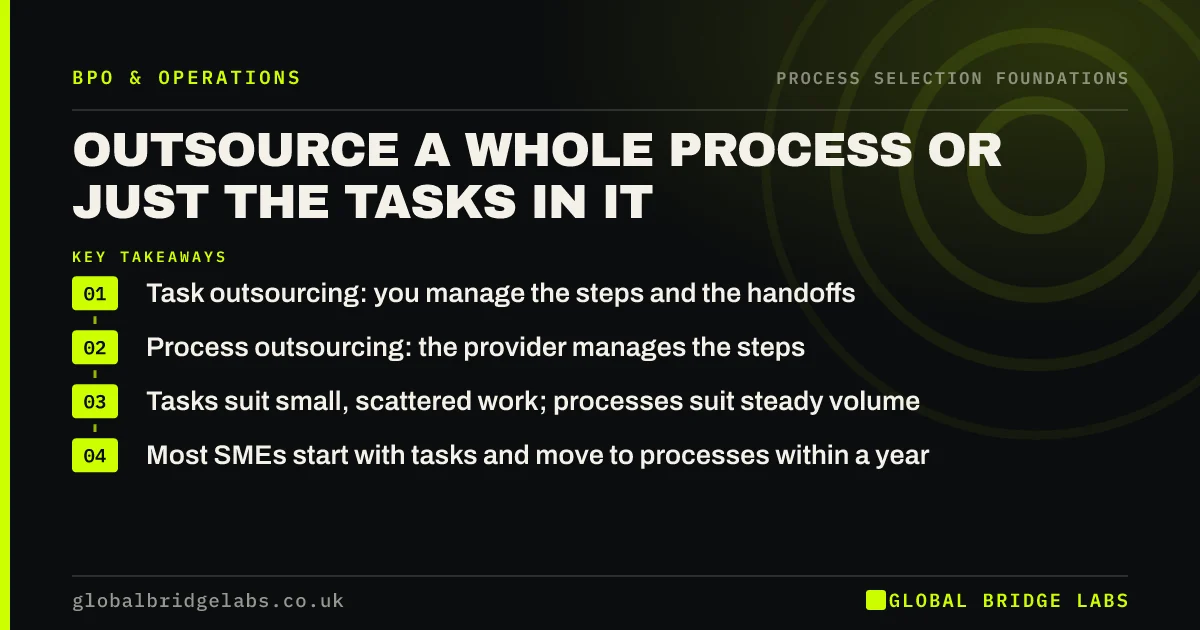
When you decide whether to outsource a process or tasks, the difference is what you hand over. Task outsourcing hands over instructions: do this step, this way. Process outsourcing hands over an outcome: supplier invoices paid accurately and on time. Process outsourcing needs more set-up but much less day-to-day management, because the provider owns the steps in between.
- Task outsourcing: you manage the steps and the handoffs.
- Process outsourcing: the provider manages the steps; you manage the outcome.
- Tasks suit small, scattered work; processes suit steady volume.
- Most SMEs start with tasks and move to processes within a year.
Not sure whether you are handing over tasks or a process? Message us on WhatsApp with what you have in mind.
Chat on WhatsApp →What is the difference between process and task outsourcing?
Task outsourcing hands a provider a defined piece of work inside a process you still run, such as keying invoices into the accounts. Process outsourcing hands over the whole sequence from trigger to output, such as receiving, checking, coding, matching and queuing invoices for payment. With tasks, you remain the joining point between steps. With a process, the provider is.
Which one costs you less management time?
Process outsourcing, once it is running. Each outsourced task creates two handoffs, one in and one out, and someone in your team has to manage both. A process with five tasks outsourced separately can mean ten handoffs a cycle. Outsourced as one process, it has one input and one output, and you review results against agreed measures instead of chasing steps.
- Count the handoffs each option creates.
- Estimate who in your team manages each one.
- Compare that time with the provider's hours.
When is task outsourcing the better choice?
Task outsourcing is better when the work is small and scattered, when the surrounding process is still changing, or when you want to test a provider before handing over more. It is also the right choice when one step needs a skill you lack, such as transcription or image editing, inside a process that otherwise works well.
What does each option cost?
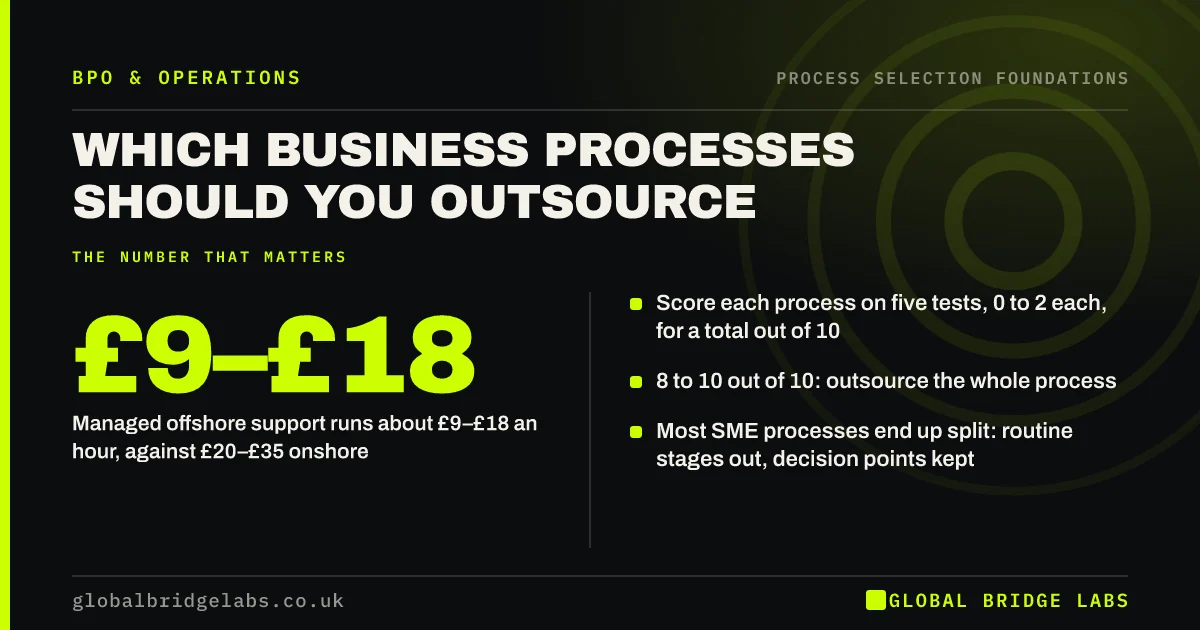
Both are usually priced by the hour or by the item. Indicative managed offshore rates run about £9–£18 an hour. In an illustrative example, five invoice tasks outsourced separately take 12 provider hours and 4 hours of your manager's time a week. The same work as one process takes 11 provider hours and 1 hour of review. The provider bill is similar; the management saving is the difference.
Want to compare both options for one of your processes? Message us on WhatsApp.
Chat on WhatsApp →What does this look like in practice?
A pattern we see: a firm outsources data entry, then invoice chasing, then reconciliations, each to a different freelancer. Within months the owner is the only person who knows how they fit together. Re-scoping the three tasks as one process with one owner usually fixes that.
Process or task: a quick checklist
Choose process outsourcing when most of these are true.
- The work runs every week in steady volume.
- The steps follow each other without your input.
- You can define the output and check it.
- One provider can access every system needed.
- You want to manage results, not steps.
Next step
Tell us which tasks you are outsourcing today or plan to. We will show you whether they form a process worth handing over as one, and what that would change in your week.
Message us on WhatsApp, or book a 30-minute consultation.
Chat on WhatsApp →Sources and further reading
- The Sourcing and Consultancy Playbooks · Cabinet Office
- Labour productivity · Office for National Statistics
Frequently asked questions
Is it better to outsource tasks or processes?
Processes, once the work has steady volume and a clear output, because the provider manages the steps and you manage results. Tasks are better for small, scattered work, for a step needing a specialist skill, or for testing a provider before handing over more.
Can you start with tasks and move to a whole process later?
Yes, and many SMEs do. Start with the most time-consuming task, check the quality for a few weeks, then add the steps before and after it until the provider owns the whole sequence. Agree new measures each time the scope grows so you review outcomes rather than steps.
Why does task outsourcing create more management work?
Because each outsourced task adds a handoff in and a handoff out, and someone in your team has to manage both. Several separately outsourced tasks can create more coordination than the work they remove. Outsourcing the whole process cuts that to one input and one output.
Written by

Global Bridge Labs (GBL) is a UK–Sri Lanka partner for social media, websites and BPO. Everything here comes from client delivery, not theory.