On this page
- 01Key takeaways
- 02Why do small businesses overpay for software?
- 03What does a licence management routine look like?
- 04Which parts can be outsourced?
- 05When is a licence routine not worth it?
- 06What does this look like in practice?
- 07Licence management checklist
- 08Next step
- 09Sources and further reading
- 10Frequently asked questions
Key takeaways
Software licence management means knowing which subscriptions you pay for, who uses them and when they renew. Small firms often pay for seats belonging to leavers and tools nobody opens. A monthly routine, matching licences to current staff and usage, outsources easily and usually pays for itself. Choosing tools stays with you.
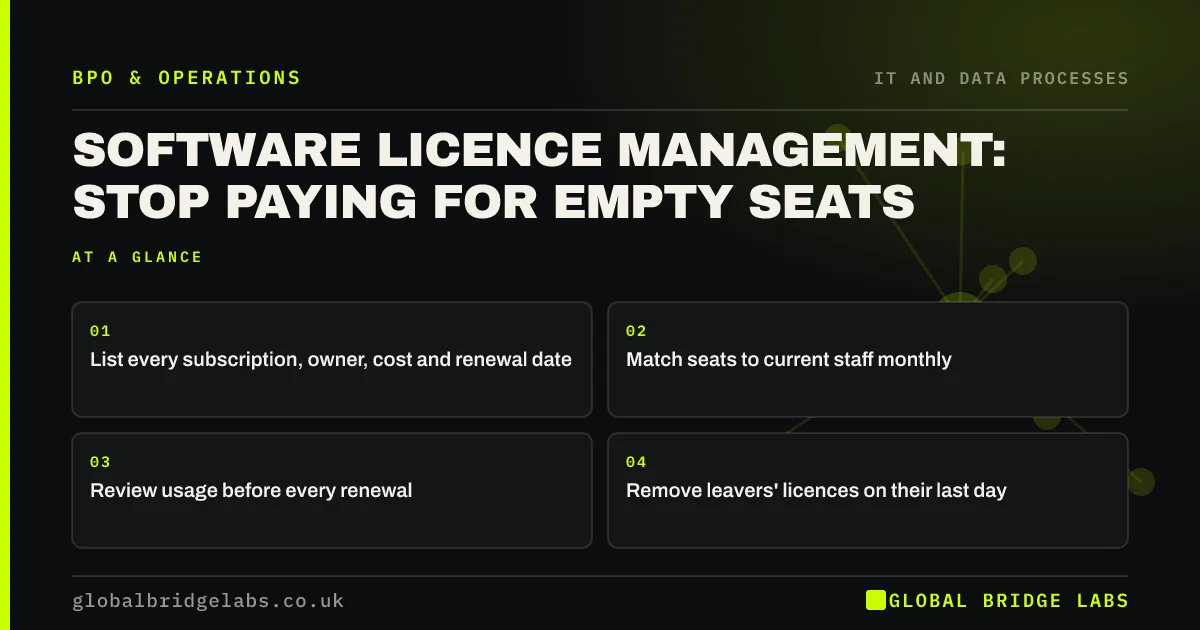
- List every subscription, owner, cost and renewal date.
- Match seats to current staff monthly.
- Review usage before every renewal.
- Remove leavers' licences on their last day.
Want a software subscription register template? Message us on WhatsApp.
Chat on WhatsApp →Why do small businesses overpay for software?
Subscriptions are easy to start and easy to forget. Staff sign up for tools on a card, leavers keep seats, free trials roll into paid plans, and annual renewals arrive unnoticed. Without a register, nobody can see the total or what is no longer used.
What does a licence management routine look like?
Keep a register of every subscription with its owner, cost, seats and renewal date. Each month, match seats to the current staff list and remove leavers. Thirty days before each renewal, check usage and ask the owner whether to renew, downgrade or cancel.
- Monthly: match seats to staff.
- Monthly: reconcile card and invoice charges.
- 30 days before renewal: usage check.
- Leavers: remove access and seats on day one.
Which parts can be outsourced?
Building and keeping the register, matching seats to staff, reconciling charges, flagging renewals and preparing usage summaries. The business owner or tool owner decides what to keep, change or cancel, and approves new purchases.
Want a one-off subscription audit? Message us on WhatsApp.
Chat on WhatsApp →When is a licence routine not worth it?
When you use a handful of tools and the owner sees every bill, a quarterly check may be enough. A monthly routine pays off once you have more than about 15 subscriptions or staff turnover is frequent.
What does this look like in practice?
A pattern we see: the first subscription audit finds tools nobody remembers buying and seats for people who left months ago. Ongoing monthly checks stop it building up again.
Licence management checklist
Keep these current.
- Register of all subscriptions.
- Owner named for each tool.
- Renewal dates in a shared calendar.
- Monthly seat check against staff.
- Approval rule for new subscriptions.
Next step
Send us a list of the software you pay for, or your card statements if you have no list. We will tell you what a licence routine would involve.
Message us on WhatsApp, or book a 30-minute consultation.
Chat on WhatsApp →Sources and further reading
- Shadow IT · National Cyber Security Centre
- Small organisations guide to cyber security · National Cyber Security Centre
Frequently asked questions
What is software licence management?
Software licence management is keeping track of the software subscriptions a business pays for, who uses each seat, what it costs and when it renews, so unused seats are removed and renewals are reviewed before they are paid.
How do you find unused software subscriptions?
Build a register from card statements and invoices, match seats to your current staff list, check usage reports in each tool's admin area, and ask each tool's owner whether it is still needed. Review again 30 days before every renewal.
Can software licence admin be outsourced?
Yes. Keeping the register, matching seats to staff, reconciling charges and flagging renewals are routine tasks for a managed team. The business decides which tools to keep, downgrade or cancel, and approves new purchases.
Written by

Global Bridge Labs (GBL) is a UK–Sri Lanka partner for social media, websites and BPO. Everything here comes from client delivery, not theory.