On this page
- 01Key takeaways
- 02Which operations processes outsource best?
- 03Which operations processes should be split?
- 04Which operations decisions stay in-house?
- 05What does outsourcing operations processes cost?
- 06What does this look like in practice?
- 07Operations process checklist
- 08Next step
- 09Sources and further reading
- 10Frequently asked questions
Key takeaways
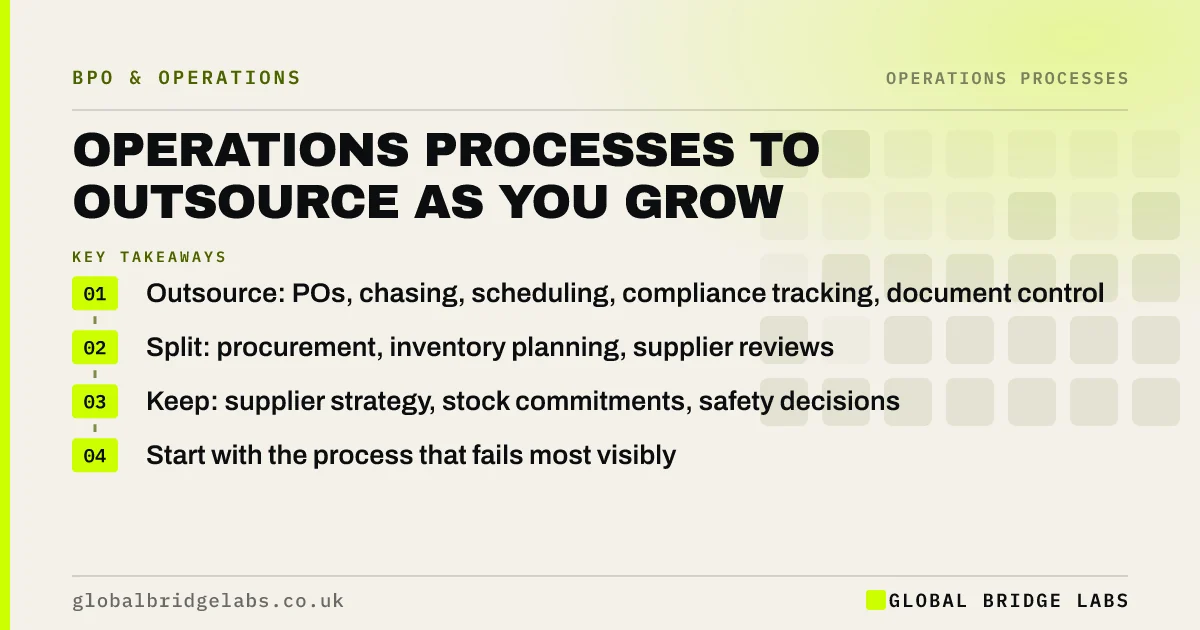
The operations processes to outsource are the tracking, booking and paperwork that keep a business supplied and compliant: purchase orders, supplier chasing, maintenance scheduling, facilities admin, compliance monitoring, document control and project admin. Supplier strategy, stock commitments and safety decisions stay in-house. Most operations processes end up split.
- Outsource: POs, chasing, scheduling, compliance tracking, document control.
- Split: procurement, inventory planning, supplier reviews.
- Keep: supplier strategy, stock commitments, safety decisions.
- Start with the process that fails most visibly.
Want verdicts for your operations processes? Message us on WhatsApp.
Chat on WhatsApp →Which operations processes outsource best?
Calendar-driven and record-keeping processes: maintenance and inspection scheduling, facilities admin, compliance monitoring, document control, purchase order processing, delivery chasing and project admin. They need discipline and follow-through rather than judgement, which is exactly what slips in a busy small business.
Which operations processes should be split?
Processes where routine work leads to a commercial decision. Procurement: quotes and orders out, key supplier choices in. Inventory planning: reorder checks out, safety stock and range in. Supplier reviews: scorecards out, conversations in.
- Procurement: tactical out, strategic in.
- Inventory: routine out, commitments in.
- Supplier reviews: data out, relationship in.
Which operations decisions stay in-house?
Which suppliers to depend on, how much cash to commit to stock, how premises and equipment are kept safe, and how service is delivered to customers. These shape cost, risk and reputation, and some carry legal duties that cannot be transferred.
- Supplier relationships: why the owner keeps the key ones
- Health and safety admin: what you can hand over
Want help drawing the line for your operations? Message us on WhatsApp.
Chat on WhatsApp →What does outsourcing operations processes cost?
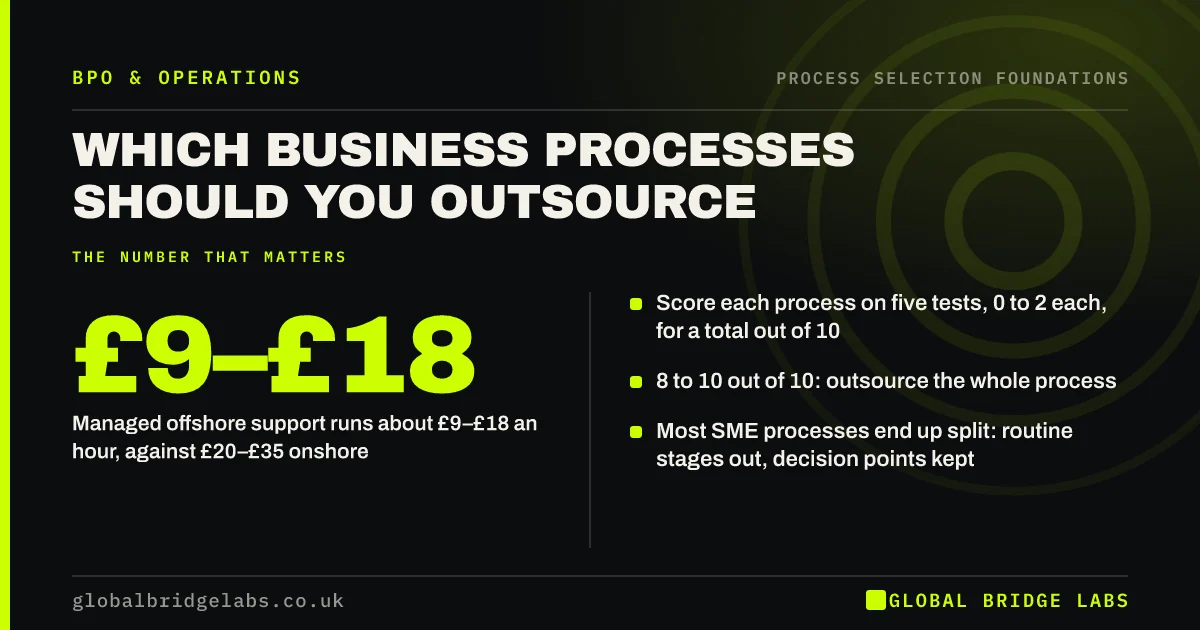
Indicative managed offshore rates run about £9–£18 an hour. In an illustrative example, 12 hours a week of purchase orders, delivery chasing and maintenance booking would cost roughly £108–£216 a week offshore, against about £238 at £19.81 per worked hour for an employee on £30,000. These are market ranges, not a GBL price.
What does this look like in practice?
A pattern we see: operations admin is spread across several people, each doing a little, and none doing it consistently. Grouping it into one outsourced process with one owner makes it visible and reliable.
Operations process checklist
Work through these in order.
- List operations processes and current owners.
- Note failures, near misses and penalties.
- Mark routine and decision stages.
- Score the high-hours processes.
- Move the most failure-prone one first.
- Review after 30 days.
Next step
Tell us which operations tasks keep slipping. We will give you a verdict for each process and suggest where to start.
Message us on WhatsApp, or book a 30-minute consultation.
Chat on WhatsApp →Sources and further reading
- Health and safety basics for your business · Health and Safety Executive
- The Sourcing and Consultancy Playbooks · Cabinet Office
Frequently asked questions
Which operations processes can a small business outsource?
Purchase order processing, delivery chasing, maintenance and inspection scheduling, facilities admin, compliance monitoring, document control and project admin. Procurement, inventory planning and supplier reviews usually split, with decisions kept in-house.
Which operations decisions should not be outsourced?
Which suppliers to depend on, how much cash to commit to stock, how premises and equipment are kept safe, and how service is delivered to customers. These carry cost, risk and sometimes legal duties that stay with the business.
Where should a business start outsourcing operations?
With the process that fails most visibly or carries a penalty when missed, such as compliance deadlines, maintenance bookings or supplier chasing. Once it runs reliably for a month, add the next process on your list.
Written by

Global Bridge Labs (GBL) is a UK–Sri Lanka partner for social media, websites and BPO. Everything here comes from client delivery, not theory.