On this page
Key takeaways
Employee survey outsourcing helps small firms because staff answer more honestly when someone outside the business collects and summarises responses. A managed team can set up the survey, send reminders, protect anonymity and produce themed results. Acting on the results, and telling staff what changed, stays with leaders.
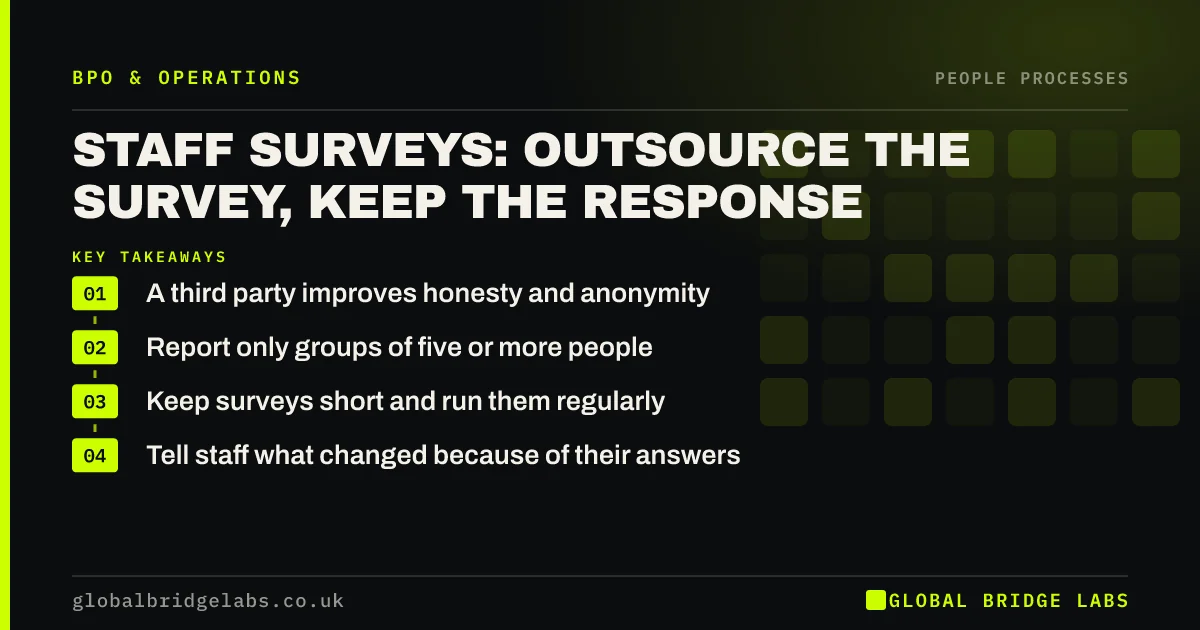
- A third party improves honesty and anonymity.
- Report only groups of five or more people.
- Keep surveys short and run them regularly.
- Tell staff what changed because of their answers.
Want a staff survey run for your team? Message us on WhatsApp.
Chat on WhatsApp →Why use a third party for staff surveys?
In a firm of 15 or 30 people, staff worry that the owner can tell who said what. A third party that collects responses and reports only grouped themes makes honest answers more likely. It also removes the admin from managers who are already stretched.
Which survey work can be outsourced?
Setting up the survey, sending invitations and reminders, protecting anonymity, coding open comments into themes, and producing a short report. The provider should suppress results for any group smaller than five, so individuals cannot be identified.
- Survey set-up and invitations.
- Reminders and response tracking.
- Anonymity rules and suppression.
- Themed comments and a short report.
What makes a staff survey useful?
A short survey, eight to twelve questions, run on a regular rhythm so you can see trends. Ask about workload, clarity, support and whether people would recommend the business as a place to work, plus one open question. Most important, share the results and what you will change within a month.
- Small team burning out? Capacity is the fix
- Can you measure it? The test every outsourced process needs
Want a short staff survey question set? Message us on WhatsApp.
Chat on WhatsApp →When is a staff survey a bad idea?
When nobody will act on it. Asking and then doing nothing damages trust more than not asking. In very small teams, under about eight people, anonymity is hard to protect, and regular one-to-one conversations may work better.
What does this look like in practice?
A pattern we see: the first survey surfaces the same two or three issues the owner half-knew about. Acting visibly on one of them does more for the next response rate than any reminder.
Staff survey checklist
Agree these before launch.
- Eight to twelve questions plus one open question.
- Minimum group size of five for reporting.
- Privacy notice for staff.
- Two reminders, no more.
- Results shared within a month.
- One visible action agreed.
Next step
Tell us how many staff you have and what you want to learn. We will suggest a survey design and how we would protect anonymity.
Message us on WhatsApp, or book a 30-minute consultation.
Chat on WhatsApp →Sources and further reading
- Employment information · Information Commissioner's Office
- What are the Management Standards for work-related stress? · Health and Safety Executive
Frequently asked questions
Should a small business outsource its staff survey?
Often yes, because staff answer more honestly when a third party collects and summarises responses. A managed team can set up the survey, protect anonymity and report themes. Leaders should still own the questions, the response and the changes made as a result.
How do you keep a staff survey anonymous in a small firm?
Use a third party to collect responses, report only groups of five or more people, avoid demographic questions that identify individuals, and summarise open comments into themes rather than quoting them word for word.
How often should staff surveys be run?
A short survey once or twice a year works for most small firms, with the same core questions each time so trends are visible. Some firms add a very short quarterly pulse. Running surveys more often than you can act on them reduces trust.
Written by

Global Bridge Labs (GBL) is a UK–Sri Lanka partner for social media, websites and BPO. Everything here comes from client delivery, not theory.