On this page
- 01Key takeaways
- 02What should an employee record contain?
- 03How long should employee records be kept?
- 04Which records work can be outsourced?
- 05What data protection rules apply?
- 06What does this look like in practice?
- 07Employee records checklist
- 08Next step
- 09Sources and further reading
- 10Frequently asked questions
Key takeaways
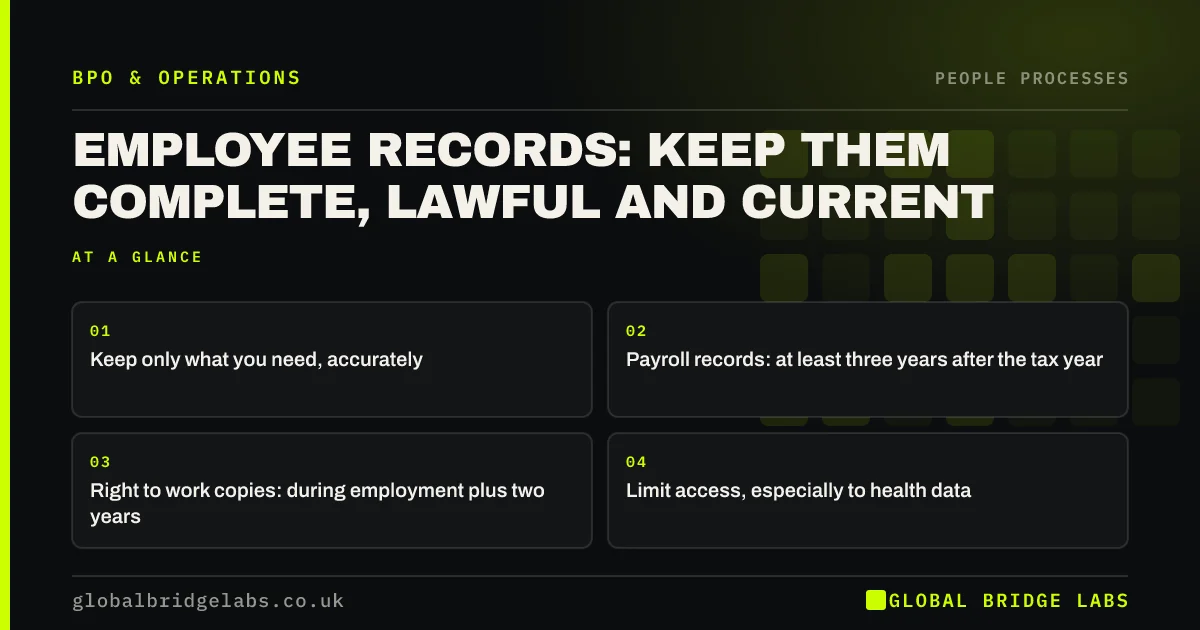
Employee records management means keeping the right information about each employee, accurate and secure, for as long as you need it and no longer. Records upkeep is routine and outsources well. Retention rules vary: PAYE records must be kept for at least three years after the end of the tax year, and right to work copies for the employment plus two years.
- Keep only what you need, accurately.
- Payroll records: at least three years after the tax year.
- Right to work copies: during employment plus two years.
- Limit access, especially to health data.
Want a records retention schedule for your business? Message us on WhatsApp.
Chat on WhatsApp →What should an employee record contain?
Contact and emergency details, the contract and any changes, right to work evidence, pay and tax information, holiday and absence records, training and qualifications, and records of formal meetings. Keep health and other sensitive details separately, with tighter access.
How long should employee records be kept?
Keep each type only as long as there is a reason. HMRC requires PAYE records for at least three years after the end of the tax year they relate to. The Home Office expects copies of right to work documents during employment and for two years after. Many employers keep core personnel files for six years after employment ends, matching the time limit for most contract claims.
- Payroll: at least three years after the tax year.
- Right to work: employment plus two years.
- Core personnel file: often six years after leaving.
- Unsuccessful applicants: a short, set period.
Which records work can be outsourced?
Setting up files for starters, updating changes such as address, pay or hours, filing documents, running retention reviews and deleting expired records, and answering subject access requests from the file. The employer decides the retention schedule and approves anything unusual.
- Subject access requests: a routine for small firms
- Document control: one current version of everything
Want help running a records retention review? Message us on WhatsApp.
Chat on WhatsApp →What data protection rules apply?
UK GDPR requires employee data to be accurate, kept no longer than necessary and secure. Health and similar details are special category data. The ICO's employment guidance covers these duties. Any provider handling records needs a processor contract and access limited to what its role needs.
What does this look like in practice?
A pattern we see: small firms keep everything forever, in several places. A single file per employee and an annual retention review cut both the risk and the clutter.
Employee records checklist
Review these once a year.
- One file per employee, in one system.
- A written retention schedule.
- Sensitive data stored separately.
- Access limited by role.
- Expired records deleted on schedule.
- Changes logged within a week.
Next step
Tell us where your employee records live today. We will suggest a structure and a retention schedule, and say what upkeep we could run.
Message us on WhatsApp, or book a 30-minute consultation.
Chat on WhatsApp →Sources and further reading
- Employment information · Information Commissioner's Office
- Check a job applicant's right to work · GOV.UK
- Running payroll · GOV.UK
Frequently asked questions
How long should a UK employer keep employee records?
It depends on the record. PAYE records must be kept for at least three years after the end of the tax year. Right to work copies should be kept during employment and for two years after. Many employers keep core personnel files for six years after employment ends.
Can employee records admin be outsourced?
Yes. Setting up files, updating changes, filing documents, running retention reviews and helping with subject access requests can be done by a managed team under a processor contract. The employer sets the retention schedule and controls who can see sensitive data.
Where should health information about employees be kept?
Separately from the general personnel file, with tighter access controls. Health information is special category data under UK GDPR, so record only what is needed, limit access to those who must see it, and review it as part of your retention schedule.
Written by

Global Bridge Labs (GBL) is a UK–Sri Lanka partner for social media, websites and BPO. Everything here comes from client delivery, not theory.