On this page
- 01Key takeaways
- 02What are primary, support and management processes?
- 03Why are support processes easier to outsource?
- 04Can you outsource part of a primary process?
- 05Which support processes should stay in-house?
- 06What does this look like in practice?
- 07Sorting checklist
- 08Next step
- 09Sources and further reading
- 10Frequently asked questions
Key takeaways
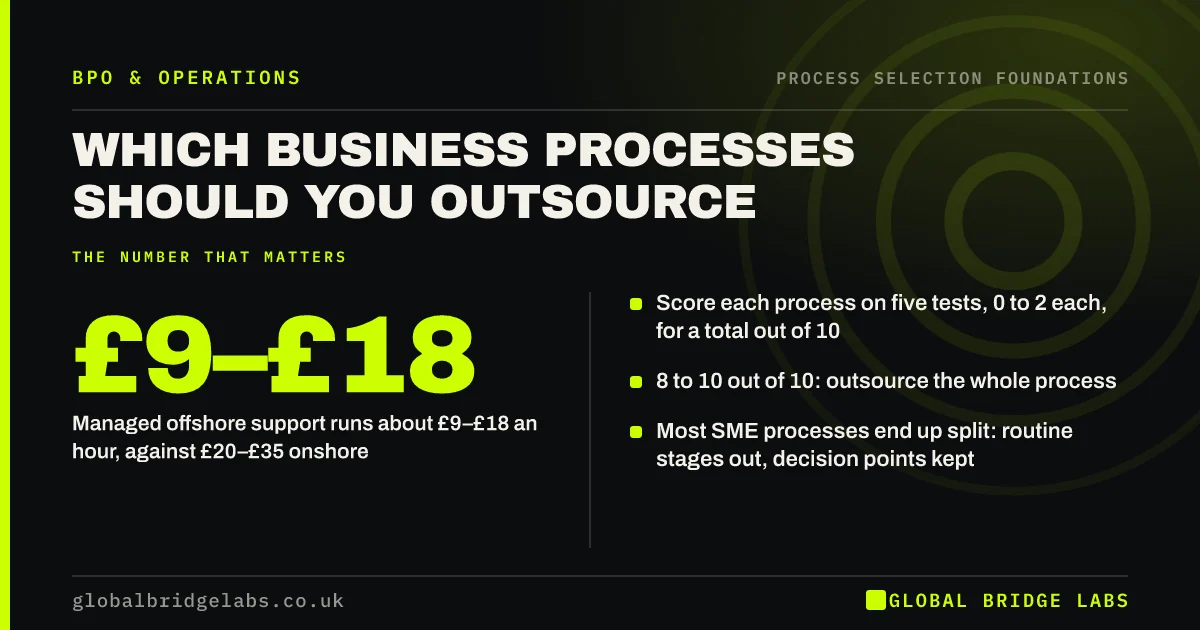
Primary vs support processes is the oldest way to sort business work. Primary processes create and deliver what customers pay for. Support processes keep the business running: finance, HR, IT and admin. Management processes set direction. Support processes are usually the easiest to outsource, but the line is not absolute in either direction.
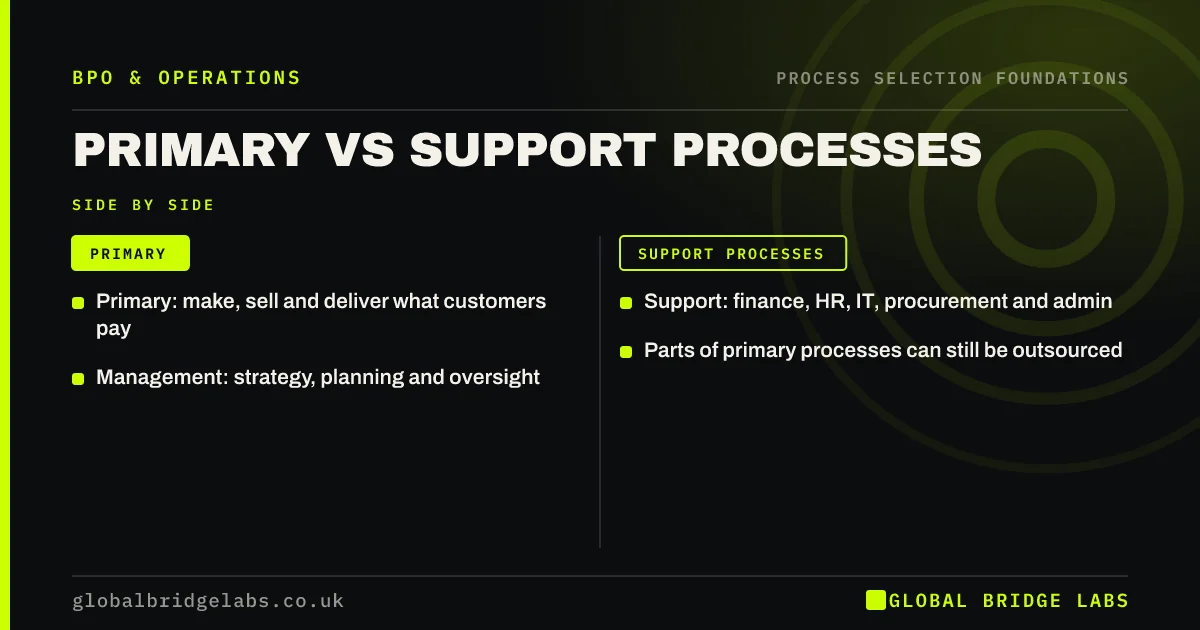
- Primary: make, sell and deliver what customers pay for.
- Support: finance, HR, IT, procurement and admin.
- Management: strategy, planning and oversight. These stay in-house.
- Parts of primary processes can still be outsourced.
Want help sorting your processes into these three types? Message us on WhatsApp.
Chat on WhatsApp →What are primary, support and management processes?
The distinction comes from Michael Porter's value chain (1985), which split a firm's activities into primary and support. Primary processes are the ones a customer would recognise: winning orders, delivering the service, fulfilling the product, after-sales support. Support processes enable them. Management processes, a later addition in process frameworks, cover strategy, planning, risk and performance review.
Why are support processes easier to outsource?
Support processes tend to follow common rules, use standard systems and look much the same from one business to the next. A provider that runs payroll or supplier payments for many firms already knows the method. Customers rarely see support processes, so a change in who runs them carries less risk to the relationship.
Can you outsource part of a primary process?
Yes, and many SMEs do. Customer service, order processing and after-sales admin are primary processes, yet their routine stages outsource well. What matters is the stage, not the label: the routine handling of an order can move, while the relationship with a key customer and the decision on a disputed order stay with you.
Which support processes should stay in-house?
A support process should stay in-house when it carries personal accountability or sensitive judgement. Final payment approval, disciplinary decisions and hiring choices are support processes that stay with the employer, even when the admin around them moves.
- Disciplinary and grievance: what you can hand over
- Supplier payment runs: outsource the prep, keep approval
Want to check which of your support processes could move? Message us on WhatsApp.
Chat on WhatsApp →What does this look like in practice?
A pattern we see: firms start with support processes, gain confidence, then move the routine stages of a primary process such as order handling. The second move often saves more time than the first, because primary processes run in higher volume.
Sorting checklist
Use these questions to sort each process.
- Would a customer recognise this process?
- Does it directly create or deliver what they pay for?
- Does it set direction or allocate resources?
- Which stages are routine and which need judgement?
- Who is personally accountable for the outcome?
Next step
Sort your process list into primary, support and management, then send us the support processes with the most hours. We will tell you which are ready to move.
Message us on WhatsApp, or book a 30-minute consultation.
Chat on WhatsApp →Sources and further reading
- The Sourcing and Consultancy Playbooks · Cabinet Office
- Labour productivity · Office for National Statistics
Frequently asked questions
What is the difference between primary and support processes?
Primary processes create and deliver what customers pay for, such as selling, delivering a service or fulfilling orders. Support processes keep the business running behind the scenes, such as finance, HR, IT and procurement. Management processes, such as strategy and planning, are often treated as a third type.
What are examples of support processes?
Examples include supplier payments, payroll, recruitment admin, IT support, licence management, procurement, document control and compliance monitoring. They are needed in almost every business, follow similar rules from firm to firm and are rarely visible to customers, which is why they are often outsourced first.
Should primary processes ever be outsourced?
Parts of them, yes. The routine stages of customer service, order processing and after-sales admin outsource well. The stages that shape the customer relationship or depend on your expertise, such as key account decisions and service design, should stay in-house.
Written by

Global Bridge Labs (GBL) is a UK–Sri Lanka partner for social media, websites and BPO. Everything here comes from client delivery, not theory.