On this page
- 01Key takeaways
- 02Which customer service processes outsource best?
- 03Which customer processes should be split?
- 04Which customer processes should stay in-house?
- 05What does outsourcing customer service cost?
- 06What does this look like in practice?
- 07Customer service process checklist
- 08Next step
- 09Sources and further reading
- 10Frequently asked questions
Key takeaways
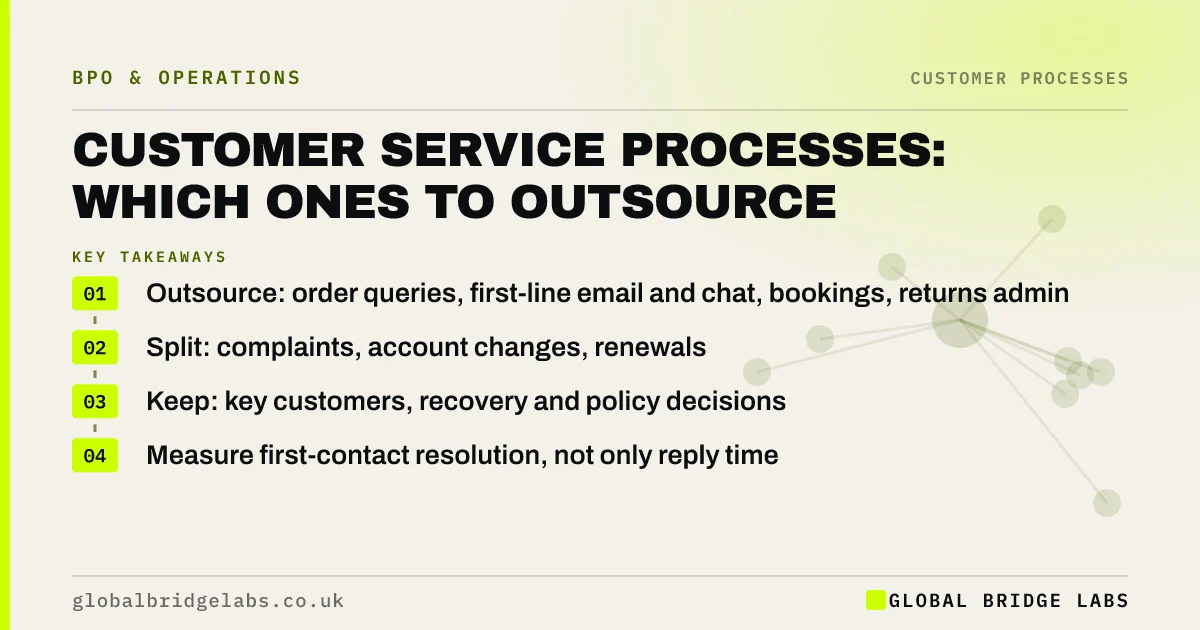
The customer service processes to outsource first are the high-volume, answerable ones: order and delivery queries, first-line email and chat, bookings, returns admin and renewal reminders. Complaints and account changes usually split. Key relationships, service recovery and policy decisions stay in-house. Measure by resolution, not just speed.
- Outsource: order queries, first-line email and chat, bookings, returns admin.
- Split: complaints, account changes, renewals.
- Keep: key customers, recovery and policy decisions.
- Measure first-contact resolution, not only reply time.
Want verdicts for your customer service processes? Message us on WhatsApp.
Chat on WhatsApp →Which customer service processes outsource best?
Processes with high volume, predictable questions and approved answers. Where-is-my-order queries, appointment bookings and changes, first-line email and chat, returns authorisation within policy, and callback handling all fit. They also benefit most from longer hours and cover, which a managed team provides more cheaply than a small in-house team.
Which customer processes should be split?
Processes where routine handling leads to a decision. Complaints split at the escalation line. Account changes split at verification and high-risk changes. Renewals split at pricing and key accounts. The managed team runs the routine stages and passes the decision with the facts gathered.
- Complaints: routine fixes out, serious cases in.
- Account changes: routine out, high-risk changes checked in.
- Renewals: reminders out, pricing and key accounts in.
Which customer processes should stay in-house?
Relationships with your most valuable customers, recovery after serious failures, changes to service policy, and any contact where your expertise is what the customer is paying for. A managed team can prepare these conversations, but your people should have them.
- Should you outsource account management?
- Does this process win you customers? The differentiation test
Want help drawing the line for your team? Message us on WhatsApp.
Chat on WhatsApp →What does outsourcing customer service cost?
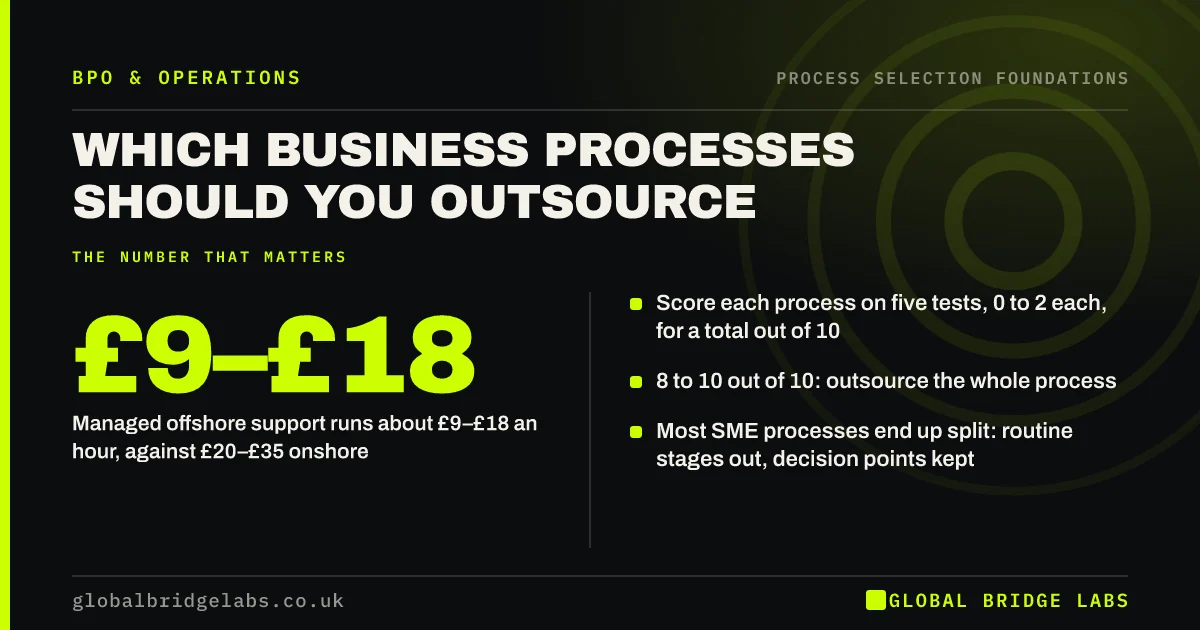
Indicative managed offshore rates run about £9–£18 an hour, with onshore outsourced support at about £20–£35. In an illustrative example, 25 hours a week of first-line email and order queries would cost roughly £225–£450 a week offshore. Cost per resolved contact is a better comparison than hourly rates. These are market ranges, not a GBL price.
What does this look like in practice?
A pattern we see: around half of incoming contacts in an SME are the same five questions. Answering those well, quickly and at any hour, changes how customers rate the whole service.
Customer service process checklist
Work through these for each process.
- Count contacts by type for four weeks.
- Mark which have approved answers.
- Set the escalation line for each process.
- Write tone and verification rules.
- Agree resolution and response measures.
- Review a weekly sample of contacts.
Next step
Send us four weeks of contacts by type. We will give you a verdict for each process and suggest where to start.
Message us on WhatsApp, or book a 30-minute consultation.
Chat on WhatsApp →Sources and further reading
- UK Customer Satisfaction Index · Institute of Customer Service
- Stop trying to delight your customers (Dixon, Freeman and Toman, 2010) · Harvard Business Review
Frequently asked questions
Which customer service processes can be outsourced?
High-volume processes with predictable questions and approved answers: order and delivery queries, first-line email and chat, bookings, returns within policy and callback handling. Complaints, account changes and renewals usually split, with routine stages outsourced and decisions kept in-house.
Which customer service work should stay in-house?
Relationships with your most valuable customers, recovery after serious service failures, changes to service policy and any contact that depends on your specialist expertise. An outsourced team can prepare these conversations, but your own people should have them.
How do you measure outsourced customer service?
Track first-contact resolution, response time, customer satisfaction or effort, escalation rate and repeat contacts. Resolution matters more than speed: a fast reply that does not fix the problem creates another contact and a less happy customer.
Written by

Global Bridge Labs (GBL) is a UK–Sri Lanka partner for social media, websites and BPO. Everything here comes from client delivery, not theory.