On this page
- 01Key takeaways
- 02What makes a process's data sensitive?
- 03What does UK GDPR require when you outsource?
- 04What controls should a sensitive process have?
- 05When should sensitivity keep a process in-house?
- 06What does this look like in practice?
- 07Sensitive process checklist
- 08Next step
- 09Sources and further reading
- 10Frequently asked questions
Key takeaways
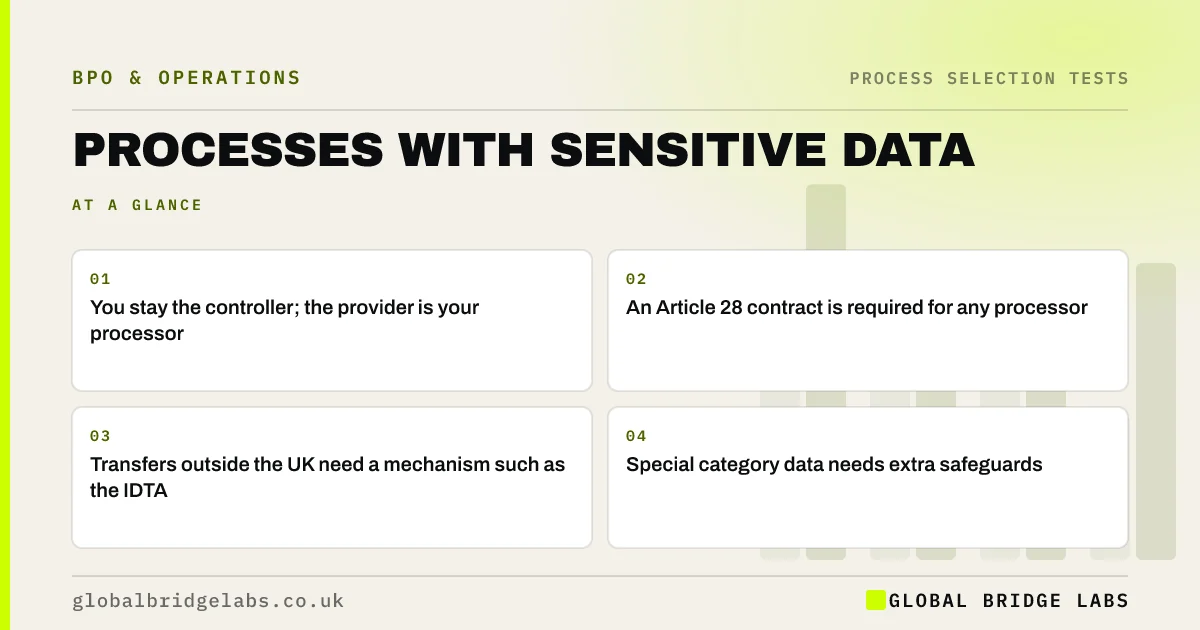
Outsourcing processes with sensitive data is lawful under UK GDPR if you have a processor contract, a valid transfer mechanism for any data leaving the UK, and controls that match the risk. Special category data, such as health information, needs extra care. Sensitivity is a reason to control a process tightly, not automatically a reason to keep it.
- You stay the controller; the provider is your processor.
- An Article 28 contract is required for any processor.
- Transfers outside the UK need a mechanism such as the IDTA.
- Special category data needs extra safeguards.
Want to check whether a sensitive process can move? Message us on WhatsApp.
Chat on WhatsApp →What makes a process's data sensitive?
Under UK GDPR, special category data includes health, ethnicity, religion, trade union membership, biometrics and sex life or orientation. Criminal offence data has its own rules. Beyond the legal categories, financial details, salaries and commercially confidential information are sensitive in practice. List which of these each process touches before scoring it.
What does UK GDPR require when you outsource?
You remain the controller and must use processors that give sufficient guarantees about security. The contract must cover the points in Article 28, including acting only on your instructions, confidentiality and helping you meet data subject rights. If data goes to a country without UK adequacy, such as Sri Lanka, you need a transfer mechanism such as the International Data Transfer Agreement and a transfer risk assessment.
What controls should a sensitive process have?
Give access only to the data each step needs, use named accounts with multi-factor authentication, keep data inside your systems rather than copied to the provider's, and log who accessed what. Review access monthly. For special category data, consider masking fields the provider does not need to see.
- Least-privilege access for each step.
- Named accounts with multi-factor authentication.
- Data kept in your systems, not exported.
- Monthly access review.
- Masking for fields not needed.
Want a control checklist for a sensitive process? Message us on WhatsApp.
Chat on WhatsApp →When should sensitivity keep a process in-house?
Keep it when you cannot meet the transfer rules, when a sector regulator or customer contract forbids offshore access, or when the provider cannot show the controls above. Some NHS-linked work, for example, requires the Data Security and Protection Toolkit. Splitting the process so only non-sensitive stages move is often a workable middle path.
What does this look like in practice?
A pattern we see: a process looks too sensitive to move until someone checks which steps actually need the sensitive fields. Often only one step does, and the rest can move with that data masked.
Sensitive process checklist
Confirm these before any sensitive process moves.
- List the data categories the process uses.
- Sign an Article 28 processor contract.
- Put a transfer mechanism in place if data leaves the UK.
- Limit access to what each step needs.
- Record the decision in your data protection records.
Next step
Tell us which sensitive process you are considering and what data it uses. We will tell you which steps could move, which should stay, and what the contract and controls would need to cover.
Message us on WhatsApp, or book a 30-minute consultation.
Chat on WhatsApp →Sources and further reading
- Special category data · Information Commissioner's Office
- International transfers of personal data · Information Commissioner's Office
- Contracts and liabilities between controllers and processors · Information Commissioner's Office
- Data Security and Protection Toolkit · NHS England
Frequently asked questions
Can you outsource processes that use personal data?
Yes. UK GDPR allows controllers to use processors, provided there is a contract meeting Article 28, the processor gives sufficient security guarantees, and any transfer outside the UK has a valid mechanism. You remain responsible as controller for how the data is used.
Can special category data be processed offshore?
It can, with a lawful basis and an Article 9 condition for processing, an Article 28 contract, a transfer mechanism such as the IDTA, a transfer risk assessment and strong access controls. Check any sector rules too, as some health and public sector work restricts offshore access.
How do you reduce data risk when outsourcing a process?
Give each step access only to the data it needs, use named accounts with multi-factor authentication, keep data in your own systems rather than exporting it, log and review access monthly, and mask fields the provider does not need to see.
Written by

Global Bridge Labs (GBL) is a UK–Sri Lanka partner for social media, websites and BPO. Everything here comes from client delivery, not theory.