On this page
Key takeaways
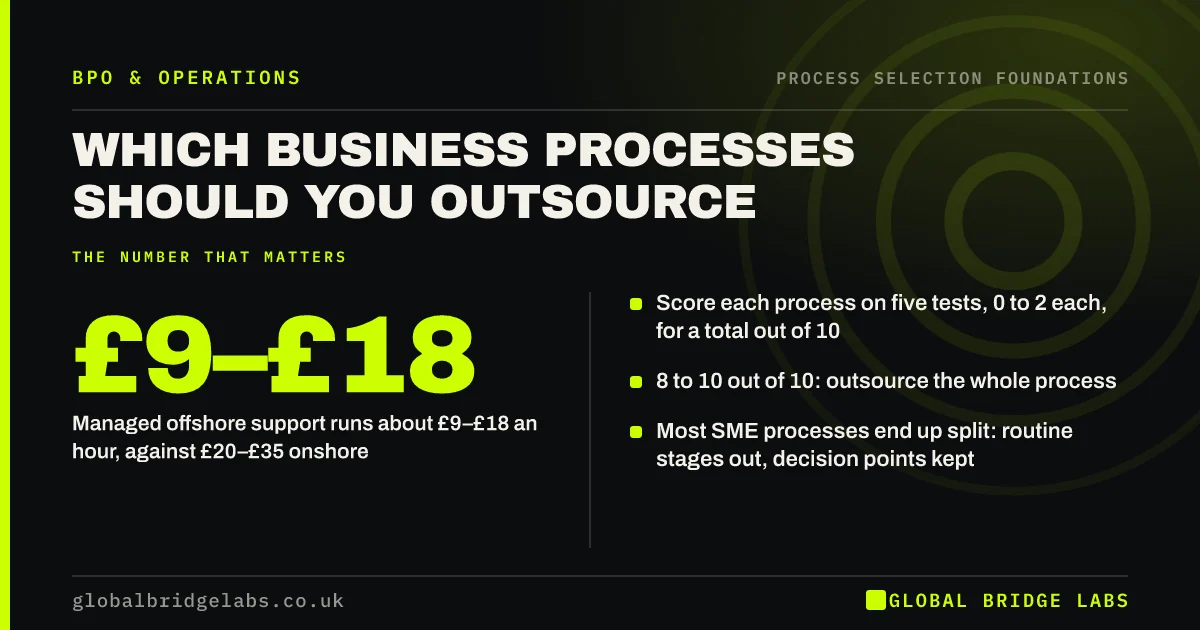
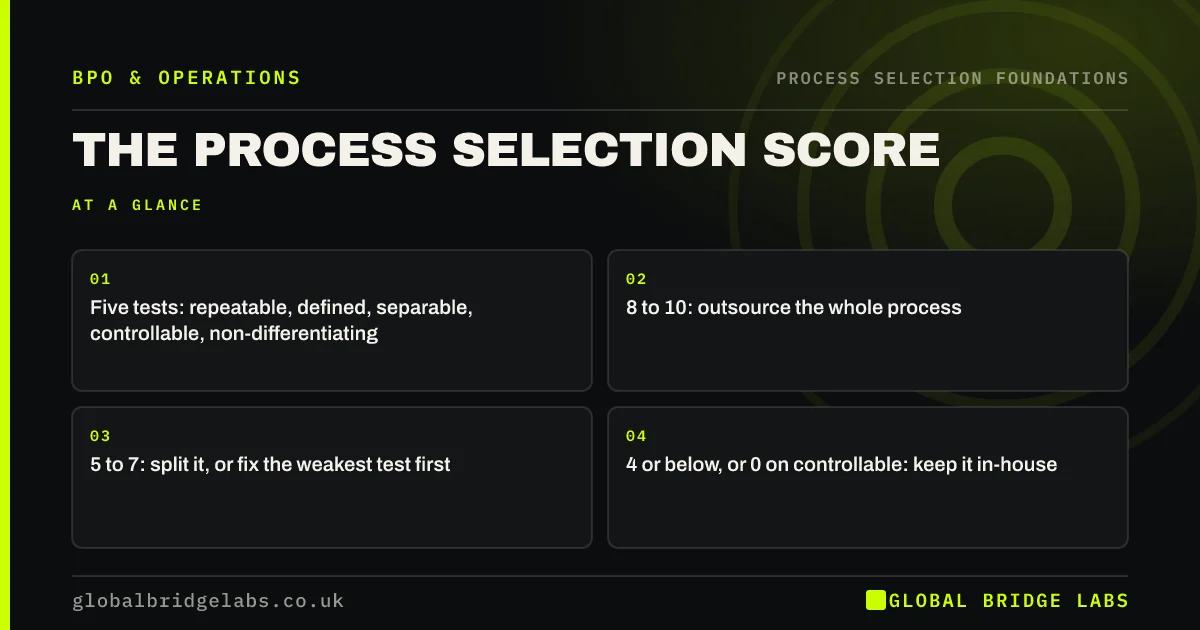
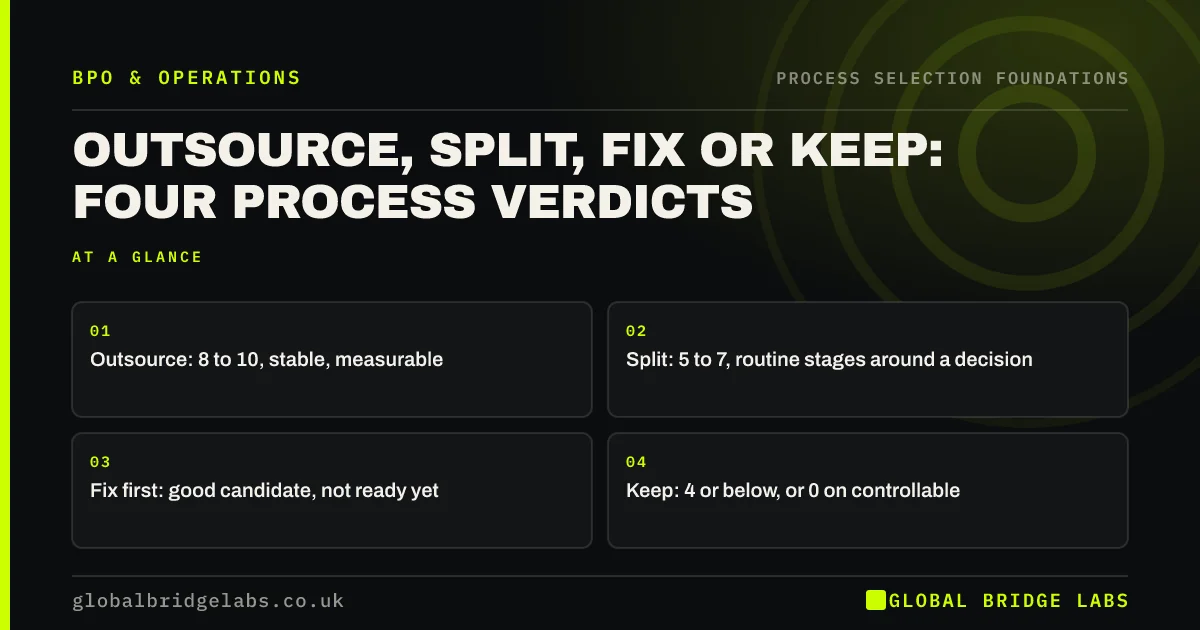
Your process outsourcing options come down to four verdicts. Outsource the whole process when it scores 8 to 10. Split it when it scores 5 to 7 and has clear judgement points. Fix it first when it would score well but is undocumented or changing. Keep it when it scores 4 or below or cannot be controlled.
- Outsource: 8 to 10, stable, measurable.
- Split: 5 to 7, routine stages around a decision.
- Fix first: good candidate, not ready yet.
- Keep: 4 or below, or 0 on controllable.
Want a verdict on one of your processes? Message us on WhatsApp with what it involves.
Chat on WhatsApp →When should the verdict be outsource?
Outsource the whole process when it runs in steady volume, the method is written, the output is measurable and the risk is controllable. Supplier invoice processing and first-line email support often reach this verdict. You still review results and keep any approval step.
How do you split a process well?
Draw the process as a line of steps and mark each step routine or judgement. Give the provider runs of routine steps, and keep the judgement steps in-house, so work crosses between you as few times as possible. A good split has one or two crossing points, not five.
- Mark each step routine or judgement.
- Group routine steps into runs.
- Keep crossing points to one or two.
- Agree turnaround at each crossing point.
What does fix first mean?
Fix first means the process would suit outsourcing but is not ready: it is undocumented, changing or full of exceptions. Write the method, remove unnecessary steps and settle the exception rules, then score it again. Most fix-first processes are ready within four to eight weeks.
- Should you fix a process before you outsource it?
- Process maturity: is your process ready to hand over?
Want help getting a fix-first process ready? Message us on WhatsApp.
Chat on WhatsApp →When is keep the right verdict?
Keep a process when it sets direction, carries personal accountability, differentiates you or carries risk you cannot contain. Keep does not mean forever. Review kept processes once a year, because volume, rules and your business all change.
What does this look like in practice?
A pattern we see: when an SME gives verdicts to its ten busiest processes, around two land on outsource, four on split, two on fix first and two on keep. Split is the most common verdict by a distance.
Verdict checklist
Record these for every process.
- The score and the weakest test.
- The verdict and the reason.
- For split: the crossing points.
- For fix first: what to fix and by when.
- For keep: the date of the next review.
Next step
Send us your list of processes with your verdicts. We will challenge the ones we would decide differently and suggest a split for any process that sits on the line.
Message us on WhatsApp, or book a 30-minute consultation.
Chat on WhatsApp →Sources and further reading
- The Sourcing and Consultancy Playbooks · Cabinet Office
- The Green Book: appraisal and evaluation in central government · HM Treasury
Frequently asked questions
What are the options when deciding whether to outsource a process?
There are four: outsource the whole process, split it so routine stages move and decisions stay, fix it first if it is undocumented or changing, or keep it in-house. The choice depends on how repeatable, defined, separable, controllable and non-differentiating the process is.
What does it mean to split a process?
Splitting a process means a provider runs the routine stages while your team keeps the judgement stages. For example, the provider prepares a supplier payment run and your finance lead approves it. A good split keeps the number of handoffs between you to one or two.
How often should process verdicts be reviewed?
Review outsourced and split processes at least quarterly against agreed measures, and review kept and fix-first processes once a year. Volumes, rules, technology and the business itself change, so a process kept in-house last year may suit outsourcing this year.
Written by

Global Bridge Labs (GBL) is a UK–Sri Lanka partner for social media, websites and BPO. Everything here comes from client delivery, not theory.