On this page
- 01Key takeaways
- 02Which documents need control?
- 03What does a document control process include?
- 04Which document control work can be outsourced?
- 05When is formal document control overkill?
- 06What does this look like in practice?
- 07Document control checklist
- 08Next step
- 09Sources and further reading
- 10Frequently asked questions
Key takeaways
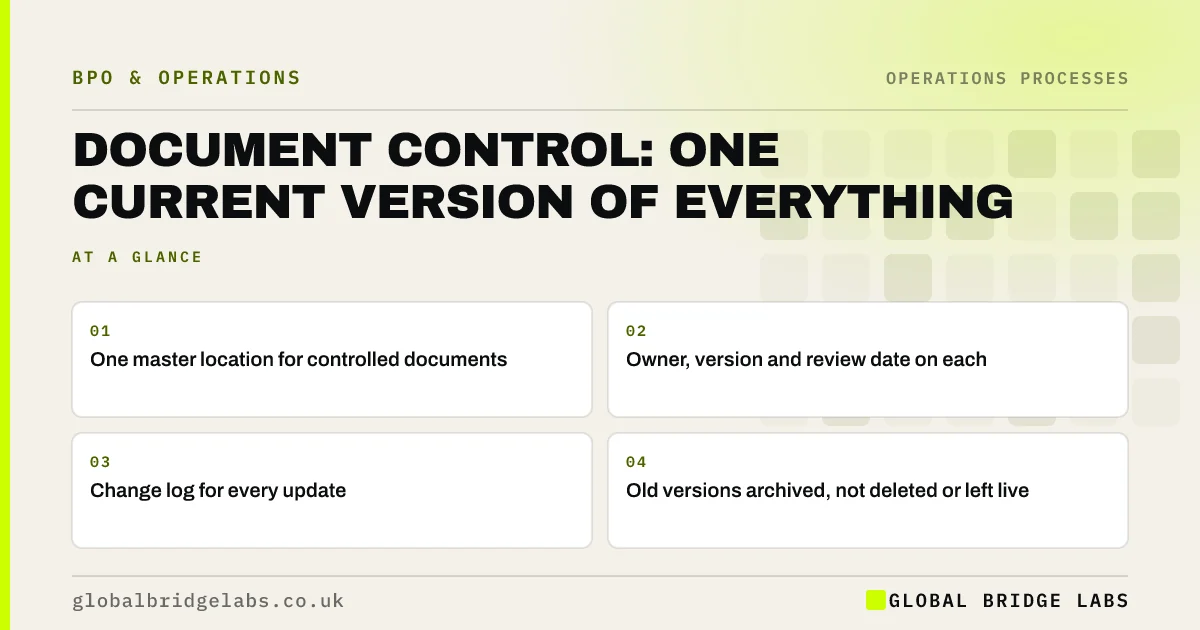
A document control process makes sure everyone uses the current version of your policies, procedures, templates and forms. Each controlled document has an owner, a version number, a review date and a change log, and old versions are archived. The admin outsources well. Approving content stays with the document owner.
- One master location for controlled documents.
- Owner, version and review date on each.
- Change log for every update.
- Old versions archived, not deleted or left live.
Want a document register template? Message us on WhatsApp.
Chat on WhatsApp →Which documents need control?
Anything people follow or rely on: policies, procedures, work instructions, templates, forms, price lists, contracts and checklists. Outsourced teams depend on these heavily, so an out-of-date procedure leads directly to errors in outsourced work.
What does a document control process include?
A register listing every controlled document with its owner, version and review date. One master location, so copies on desktops are not trusted. A change request route, an approval step by the owner, a change log, and archiving of old versions. Reviews happen on schedule, not only when something goes wrong.
- Register of controlled documents.
- Single master location.
- Change request and approval.
- Version numbers and change log.
- Scheduled reviews.
Which document control work can be outsourced?
Keeping the register, formatting and publishing approved changes, archiving old versions, sending review reminders to owners and checking links between documents. The owner decides what the document says and approves each change.
- Document formatting support: proposals that look right
- Internal knowledge base: answers your team can find fast
Want your procedures brought under control? Message us on WhatsApp.
Chat on WhatsApp →When is formal document control overkill?
When a business has a handful of documents and one person maintains them. It becomes essential once several teams, sites or outsourced providers follow the same procedures, or when customers and auditors ask to see controlled versions.
What does this look like in practice?
A pattern we see: three versions of the same procedure exist, and each team follows a different one. Errors get blamed on people when the real cause is the documents.
Document control checklist
Set these up and review annually.
- Register of controlled documents.
- Owner for each document.
- Version number on every page.
- Review date and reminder.
- Change log kept.
- Old versions archived.
Next step
Tell us where your procedures and templates live today. We will suggest a register and the routine to keep it current.
Message us on WhatsApp, or book a 30-minute consultation.
Chat on WhatsApp →Sources and further reading
- Running a limited company: company and accounting records · GOV.UK
- Principle (d): Accuracy · Information Commissioner's Office
Frequently asked questions
What is document control?
Document control is the process of making sure everyone uses the current, approved version of key documents such as policies, procedures, templates and forms. Each controlled document has an owner, version number, review date and change log, and old versions are archived.
How do you control document versions in a small business?
Keep one master location, list every controlled document in a register, put a version number and review date on each, require the owner to approve changes, keep a change log and archive old versions so they cannot be used by mistake.
Can document control be outsourced?
The admin can: keeping the register, formatting and publishing approved changes, archiving old versions and reminding owners of reviews. The owner of each document should decide its content and approve every change.
Written by

Global Bridge Labs (GBL) is a UK–Sri Lanka partner for social media, websites and BPO. Everything here comes from client delivery, not theory.