On this page
- 01Key takeaways
- 02What is the difference between customer success and customer service?
- 03Which customer success work can be outsourced?
- 04How do you measure customer health?
- 05What should stay with your team?
- 06What does this look like in practice?
- 07Customer success checklist
- 08Next step
- 09Sources and further reading
- 10Frequently asked questions
Key takeaways
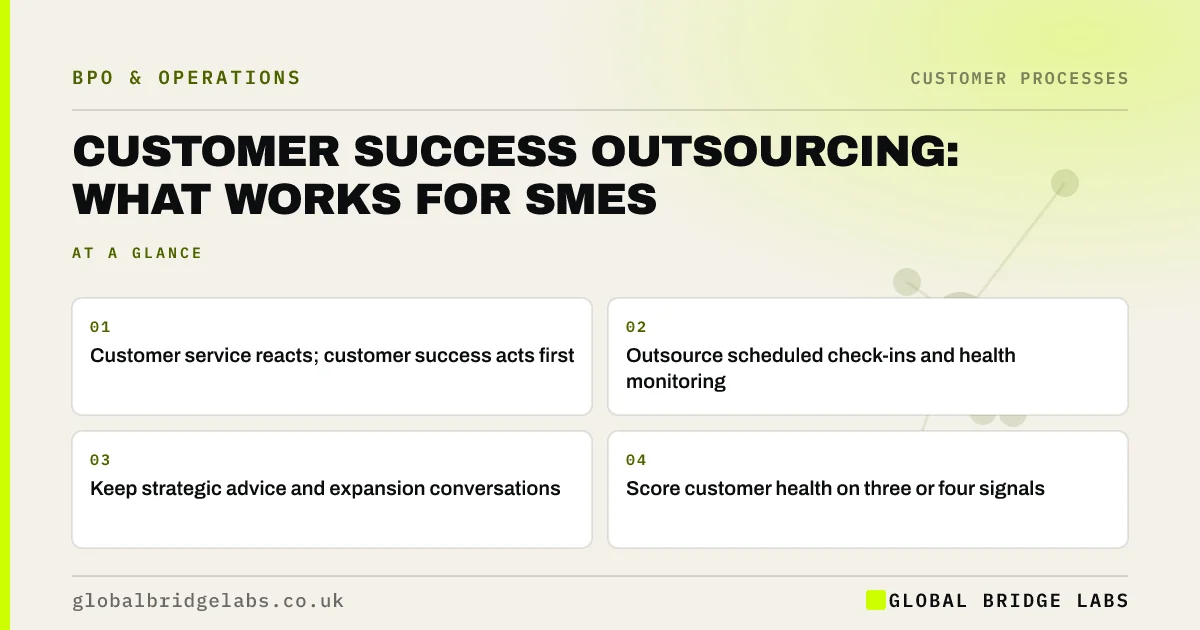
Customer success outsourcing suits the scheduled, measurable parts of customer success: onboarding check-ins, usage monitoring, health checks and renewal preparation. Strategic advice, expansion conversations and recovering unhappy key customers stay with your team. Customer success differs from customer service by being proactive: it acts before the customer asks.
- Customer service reacts; customer success acts first.
- Outsource scheduled check-ins and health monitoring.
- Keep strategic advice and expansion conversations.
- Score customer health on three or four signals.
Want a customer success routine for your accounts? Message us on WhatsApp.
Chat on WhatsApp →What is the difference between customer success and customer service?
Customer service answers questions and fixes problems when customers contact you. Customer success contacts customers first, to make sure they get the value they paid for, so they stay and buy more. In a small business the same people often do both, and proactive work loses out to the inbox.
Which customer success work can be outsourced?
Work that runs on a schedule or a signal. Check-in calls at set points after onboarding, monitoring usage or order patterns, running health checks, sending tips and reminders, preparing renewal histories and flagging at-risk accounts to your team. These are easy to measure and easy to skip when you are busy.
- Check-ins at 7, 30 and 90 days.
- Usage or order monitoring.
- Health scoring and at-risk flags.
- Renewal history preparation.
How do you measure customer health?
Pick three or four signals you can see: usage or order frequency, support tickets, survey score and payment behaviour. Score each green, amber or red. A customer with two ambers or one red gets a call from your team. Keep the rules simple enough that the managed team can apply them without judgement calls.
- Customer surveys: outsource the asking, keep the acting
- Can you measure it? The test every outsourced process needs
Want a simple health score for your customers? Message us on WhatsApp.
Chat on WhatsApp →What should stay with your team?
Strategic advice on how customers use your product, expansion and upsell conversations, and recovery of unhappy key accounts. These need expertise and authority. The managed team's job is to make sure your people spend their time on the right customers at the right moment.
What does this look like in practice?
A pattern we see: customers who leave rarely complain first; they simply use the service less. Usage monitoring with a call at the first amber signal catches many of them in time.
Customer success checklist
Set these up before handing over.
- Check-in schedule after onboarding.
- Three or four health signals.
- Green, amber and red rules.
- Escalation route for at-risk accounts.
- Monthly health report to the owner.
Next step
Tell us how you keep in touch with customers between purchases today. We will suggest a customer success routine and tell you what we would run.
Message us on WhatsApp, or book a 30-minute consultation.
Chat on WhatsApp →Sources and further reading
- Stop trying to delight your customers (Dixon, Freeman and Toman, 2010) · Harvard Business Review
- UK Customer Satisfaction Index · Institute of Customer Service
Frequently asked questions
What is customer success in a small business?
Customer success is proactive work to make sure customers get the value they paid for, so they stay and buy more. It includes onboarding check-ins, monitoring usage, health checks and renewal preparation. Unlike customer service, it starts the conversation rather than waiting for the customer.
Can customer success be outsourced?
The scheduled and signal-driven parts can: check-in calls, usage monitoring, health scoring and renewal preparation. Strategic advice, expansion conversations and recovering unhappy key customers need your team's expertise and authority, so keep those in-house.
How do you know a customer is at risk of leaving?
Watch for falling usage or order frequency, a rise in support tickets, a lower survey score or slower payment. Score each signal green, amber or red, and call any customer with two ambers or a red. Customers who leave often reduce usage before they complain.
Written by

Global Bridge Labs (GBL) is a UK–Sri Lanka partner for social media, websites and BPO. Everything here comes from client delivery, not theory.