On this page
- 01Key takeaways
- 02What health and safety admin does a small firm have?
- 03Which parts can be outsourced?
- 04Which duties stay with the employer?
- 05When is outsourced admin not enough?
- 06What does this look like in practice?
- 07Health and safety admin checklist
- 08Next step
- 09Sources and further reading
- 10Frequently asked questions
Key takeaways
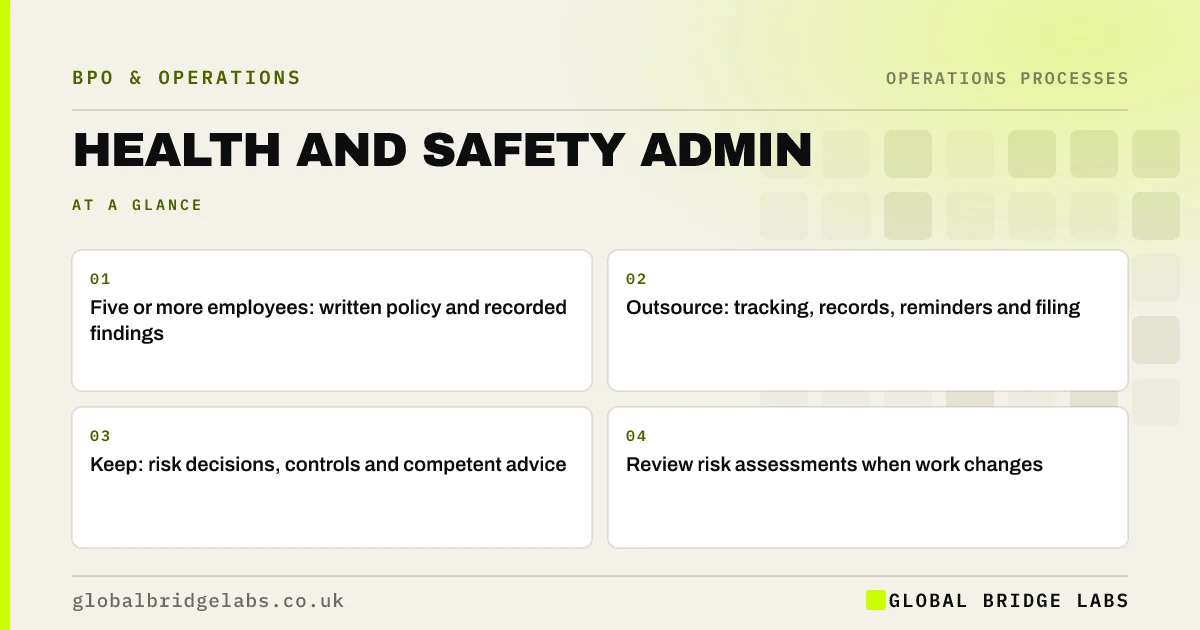
Health and safety admin support can take the paperwork off a small employer: tracking risk assessment reviews, training records, inspections, accident records and contractor documents. The duties themselves stay with the employer. HSE guidance says businesses with five or more employees must write down their health and safety policy and the significant findings of risk assessments.
- Five or more employees: written policy and recorded findings.
- Outsource: tracking, records, reminders and filing.
- Keep: risk decisions, controls and competent advice.
- Review risk assessments when work changes.
Want your health and safety records organised? Message us on WhatsApp.
Chat on WhatsApp →What health and safety admin does a small firm have?
Keeping the policy and risk assessments current, recording training and refreshers, scheduling inspections and equipment checks, recording accidents and reporting certain incidents under RIDDOR, collecting contractor insurance and method statements, and filing everything so it can be shown to an inspector or insurer.
Which parts can be outsourced?
The tracking and records: review reminders for risk assessments, training records and expiry alerts, inspection scheduling, filing accident records, preparing RIDDOR reports for the employer to check and submit, and collecting contractor documents. These are rule-based and easy to fall behind on.
- Review reminders and schedules.
- Training records and expiry alerts.
- Accident record filing.
- Contractor document collection.
Which duties stay with the employer?
Assessing risks and deciding controls, consulting employees, making sure work is done safely and appointing competent help. HSE expects employers to have access to competent advice, which can be an external consultant, but responsibility stays with the employer. Admin support makes the duties easier to meet; it does not take them on.
- Regulated processes: outsource the work, keep the duty
- Facilities admin: contractors, checks and renewals
Want a list of the records your business should keep? Message us on WhatsApp.
Chat on WhatsApp →When is outsourced admin not enough?
In higher-risk work, such as construction, manufacturing or care, you need competent health and safety advice as well as admin support. Admin keeps records current; it cannot judge whether a control is adequate.
What does this look like in practice?
A pattern we see: risk assessments are written once and never reviewed, while training certificates expire unnoticed. A simple tracker with review dates and expiry alerts keeps both current.
Health and safety admin checklist
Keep these current.
- Written policy if five or more employees.
- Risk assessments with review dates.
- Training records with expiry alerts.
- Inspection and equipment check schedule.
- Accident book and RIDDOR records.
- Contractor insurance and method statements.
Next step
Tell us your sector and how health and safety records are kept today. We will suggest a tracker and the admin we could run.
Message us on WhatsApp, or book a 30-minute consultation.
Chat on WhatsApp →Sources and further reading
- Health and safety basics for your business · Health and Safety Executive
- Managing risks and risk assessment at work · Health and Safety Executive
Frequently asked questions
What health and safety paperwork does a small business need?
Businesses with five or more employees must have a written health and safety policy and record the significant findings of their risk assessments. All employers should keep training records, accident records and reports of certain incidents under RIDDOR, plus records of inspections and equipment checks.
Can health and safety be outsourced?
Admin can be outsourced, and competent advice can come from an external consultant. Legal responsibility stays with the employer, including assessing risks, deciding controls, consulting employees and making sure work is carried out safely.
How often should risk assessments be reviewed?
There is no fixed legal interval. Review them when work, equipment, people or premises change, after an accident or near miss, and at a regular interval you set, often annually. Record each review and any changes made.
Written by

Global Bridge Labs (GBL) is a UK–Sri Lanka partner for social media, websites and BPO. Everything here comes from client delivery, not theory.