On this page
- 01Key takeaways
- 02What should founders and micro businesses outsource?
- 03What changes at 10 to 20 staff?
- 04What changes at 20 to 50 staff?
- 05What stays in-house at every stage?
- 06What does this look like in practice?
- 07Growth stage checklist
- 08Next step
- 09Sources and further reading
- 10Frequently asked questions
Key takeaways
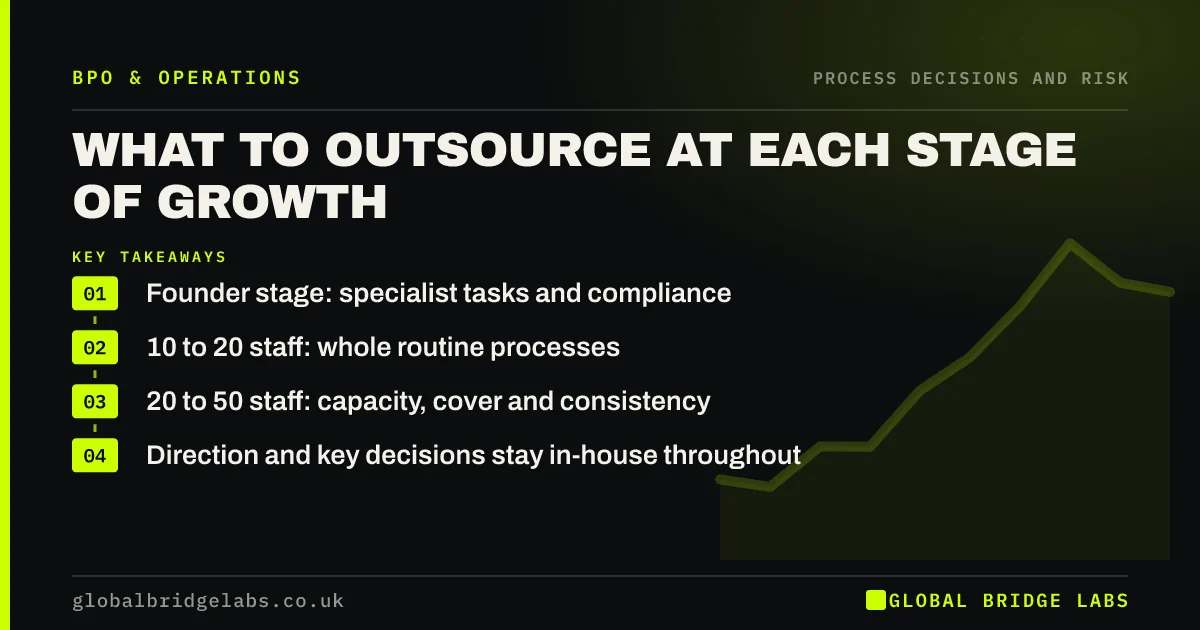
What to outsource as a business grows changes with each stage. Founders outsource specialist tasks they cannot do. Firms of 10 to 20 outsource whole routine processes that have outgrown one person. Firms of 20 to 50 outsource to add capacity and cover without building departments. What stays in-house at every stage: direction, decisions and the work customers buy.
- Founder stage: specialist tasks and compliance.
- 10 to 20 staff: whole routine processes.
- 20 to 50 staff: capacity, cover and consistency.
- Direction and key decisions stay in-house throughout.
Want to know what fits your stage? Message us on WhatsApp.
Chat on WhatsApp →What should founders and micro businesses outsource?
Specialist and compliance work the founder cannot do well: bookkeeping, payroll, tax, website build and IT security basics. Volume is too low for whole processes, so outsourcing is task-based. The aim is to protect the founder's time for selling and delivering.
What changes at 10 to 20 staff?
Routine processes outgrow the person who started doing them. Supplier invoices, billing, customer email, HR admin and scheduling now take hours every day. This is often the best time to outsource whole processes, before an admin team forms around them. UK government figures show most private sector businesses are small, and many stall around this size.
- Finance processing.
- First-line customer service.
- HR and payroll admin.
- Scheduling and bookings.
What changes at 20 to 50 staff?
The questions become capacity, cover and consistency across teams or sites. Outsourcing adds evening and weekend cover, handles peaks, and runs processes to one standard. Reporting, compliance monitoring and IT processes often move at this stage, as complexity grows faster than headcount.
- Operations processes to outsource as you grow
- IT processes to outsource in a small business
- Scaling back-office operations as order volume grows
Growing past 20 staff? Message us on WhatsApp about what to move next.
Chat on WhatsApp →What stays in-house at every stage?
Direction, pricing, key relationships, product and service design, and the decisions that carry accountability. These grow in importance as the business grows, which is exactly why routine processes should not crowd them out.
What does this look like in practice?
A pattern we see: the processes that should have moved at 12 staff are still in-house at 30, now spread across three people. Moving them later is harder because more people and habits depend on them.
Growth stage checklist
Ask these at each stage.
- Which processes has one person outgrown?
- Which need cover we do not have?
- Which run differently in each team?
- Which decisions are being crowded out?
- What would the next hire spend their time on?
Next step
Tell us your headcount and which processes feel stretched. We will tell you what typically moves at your stage and what we would start with.
Message us on WhatsApp, or book a 30-minute consultation.
Chat on WhatsApp →Sources and further reading
- Business population estimates for the UK and regions 2025 · Department for Business and Trade
- Vacancies and jobs in the UK (latest bulletin) · Office for National Statistics
Frequently asked questions
What should a startup outsource first?
Specialist and compliance tasks the founder cannot do well, such as bookkeeping, payroll, tax filings, website build and basic IT security. Volume is usually too low to outsource whole processes, so outsourcing is task-based and aimed at protecting the founder's time.
When should a growing business outsource whole processes?
Often at around 10 to 20 staff, when routine processes such as finance processing, customer email and HR admin have outgrown one person but before a dedicated admin team has formed. Moving them then is easier than unpicking an in-house team later.
What should never be outsourced as a business grows?
Direction, pricing, key customer and supplier relationships, product and service design, and decisions that carry legal or personal accountability. These become more important as the business grows, which is why routine processes should not crowd them out.
Written by

Global Bridge Labs (GBL) is a UK–Sri Lanka partner for social media, websites and BPO. Everything here comes from client delivery, not theory.