On this page
- 01Key takeaways
- 02What is a hybrid outsourcing model?
- 03Why is hybrid often the most cost-effective model?
- 04How do you split work between in-house and outsourced?
- 05What does a hybrid model cost?
- 06What makes a hybrid model fail?
- 07How do you manage a hybrid team?
- 08What does the hand-off between teams look like?
- 09What does this look like in practice?
- 10Hybrid model checklist
- 11Next step
- 12Sources and further reading
- 13Frequently asked questions
Key takeaways
A hybrid outsourcing model keeps core, relationship and judgement work in-house and outsources repeatable volume, overflow and extended-hours cover. For most UK SMEs it is the most cost-effective option, because the in-house team stays fully used and the outsourced team absorbs peaks. The key is a clean hand-off between the two.
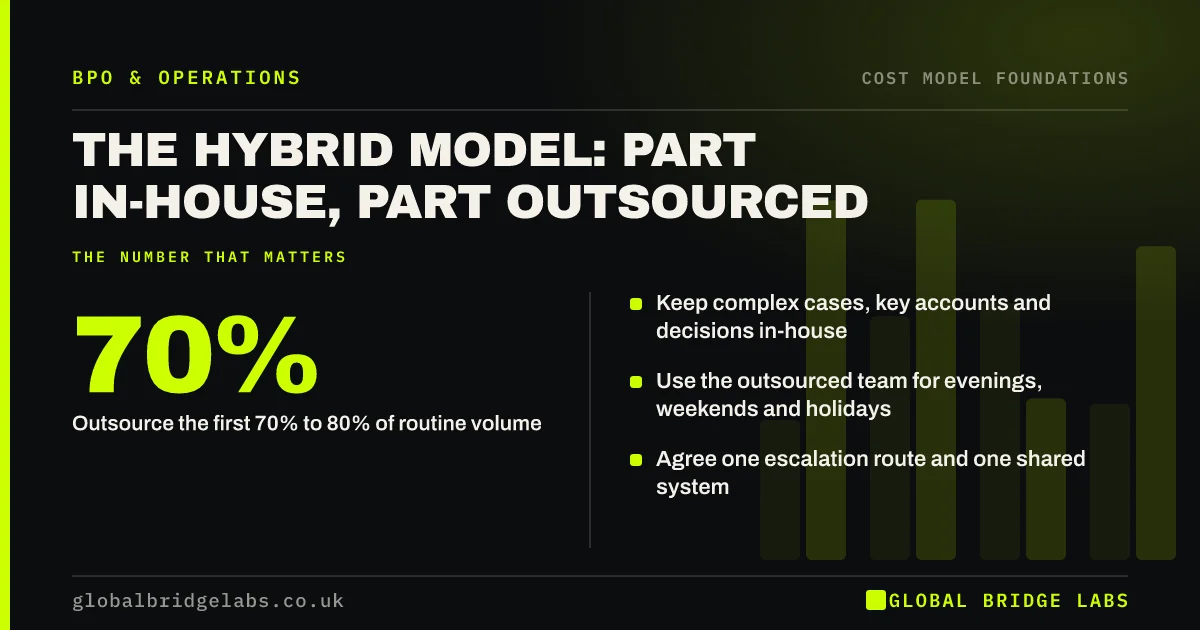
- Keep complex cases, key accounts and decisions in-house.
- Outsource the first 70% to 80% of routine volume.
- Use the outsourced team for evenings, weekends and holidays.
- Agree one escalation route and one shared system.
Want to see how a hybrid split would work for your team? Message us on WhatsApp.
Chat on WhatsApp →What is a hybrid outsourcing model?
A hybrid outsourcing model is an operating model where an in-house team and an outsourced provider share one function, each doing the part it is best at. The in-house team owns complex work and decisions; the provider handles defined, repeatable tasks and cover. It sits between full in-house and full outsourcing.
Why is hybrid often the most cost-effective model?
Hybrid removes the biggest in-house cost, paid idle time, without handing over the work that needs context. You size the in-house team for the steady, complex core so it stays busy, and buy the variable volume by the hour. No one is hired for a peak that lasts two months.
How do you split work between in-house and outsourced?
Split by complexity and timing. Simple, rules-based cases and anything out of hours go to the outsourced team; complex, sensitive or high-value cases escalate to in-house. Write the split down as a short routing rule so both teams know who owns what.
- Tier 1 (outsourced): routine questions, updates, bookings, data entry.
- Tier 2 (in-house): complaints, exceptions, refunds above a limit.
- Out of hours (outsourced): cover to agreed service levels.
- Key accounts (in-house): named contacts stay with your team.
What does a hybrid model cost?
Take a function with 70 hours a week of work. Fully in-house needs two full-time hires, about £64,200 a year at £28,000 salaries before overheads. Hybrid keeps one hire for 38 hours of complex work, about £32,100, and outsources 32 hours at an indicative £12 per hour, about £20,000. The saving is roughly £12,000 a year, with cover included.
Want a hybrid cost model built for your hours? Send them to us on WhatsApp.
Chat on WhatsApp →What makes a hybrid model fail?
Hybrid models fail when the hand-off is vague. If both teams can pick up any case, work falls between them or gets done twice. Separate systems, unclear escalation and an in-house team that feels threatened by the provider are the common causes.
- No written rule for who handles what.
- Two systems instead of one shared inbox or CRM.
- No named owner for escalations.
- The in-house team not told why the provider is there.
How do you manage a hybrid team?
Manage it as one service with one scorecard. Track response time, resolution and quality across both teams, hold a short weekly review with the provider's team lead, and use escalations as training material so more cases can be handled at tier 1 over time.
What does the hand-off between teams look like?
A good hand-off is written down in one page. It says which cases the outsourced team handles, how it escalates the rest, what information it passes on, and how quickly the in-house team responds to escalations. Both teams use the same shared inbox, ticketing system or CRM, so nothing is copied between tools.
- Routing rule: which case types each team owns.
- Escalation form: the details the in-house team needs to act.
- Response time for escalations, in hours.
- One shared system and one set of templates.
What does this look like in practice?
A pattern we see in UK healthcare clinics: in-house reception handles patients in the building and clinical queries, while a managed team answers overflow calls, books appointments and handles email. Patients get answered faster, and reception is no longer choosing between the phone and the person at the desk.
Hybrid model checklist
Use these steps to set one up.
- Measure the steady and variable parts of the workload.
- Size the in-house team for the steady, complex core.
- Write the routing rule for tier 1, tier 2 and out of hours.
- Use one shared system for both teams.
- Name an escalation owner in-house.
- Review one combined scorecard every month.
Next step
Tell us how your workload splits between routine and complex work. We will sketch a hybrid model and cost it against your current team in a 30-minute call.
Message us on WhatsApp to plan a hybrid model, or book a 30-minute consultation.
Chat on WhatsApp →Sources and further reading
- Rates and thresholds for employers 2026 to 2027 · HM Revenue & Customs
- Workplace pensions: what you, your employer and the government pay · GOV.UK
- Contracts and liabilities between controllers and processors · Information Commissioner's Office
Frequently asked questions
What is a hybrid outsourcing model?
A model where an in-house team and an outsourced provider share one function. The in-house team handles complex, sensitive and high-value work; the provider handles defined, repeatable tasks, overflow and extended-hours cover. Both teams work in one shared system under a written routing rule.
Is a hybrid model cheaper than fully in-house?
Usually, because the in-house team is sized for the steady, complex core and stays busy, while variable volume is bought by the hour. It avoids hiring for peaks and paying for idle time, and it adds holiday, sickness and out-of-hours cover that a small in-house team cannot give.
What work should stay in-house in a hybrid model?
Complaints and exceptions above an agreed limit, key accounts, decisions that need judgement, and anything that depends on context that cannot be written down. Routine questions, updates, bookings, data entry and out-of-hours contacts are the usual candidates to move to the outsourced team.
How do you stop work falling between two teams?
Write a one-page routing rule, use one shared system, and name an in-house owner for escalations. Review unresolved and duplicated cases weekly for the first month. Most gaps come from vague rules or separate tools, and both are fixed quickly once they are visible.
Written by

Global Bridge Labs (GBL) is a UK–Sri Lanka partner for social media, websites and BPO. Everything here comes from client delivery, not theory.