On this page
- 01Key takeaways
- 02What are the steps in a supplier payment run?
- 03Which stages can a provider prepare?
- 04Why do approval and bank detail changes stay in-house?
- 05When should the whole run stay in-house?
- 06What does this look like in practice?
- 07Payment run checklist
- 08Next step
- 09Sources and further reading
- 10Frequently asked questions
Key takeaways
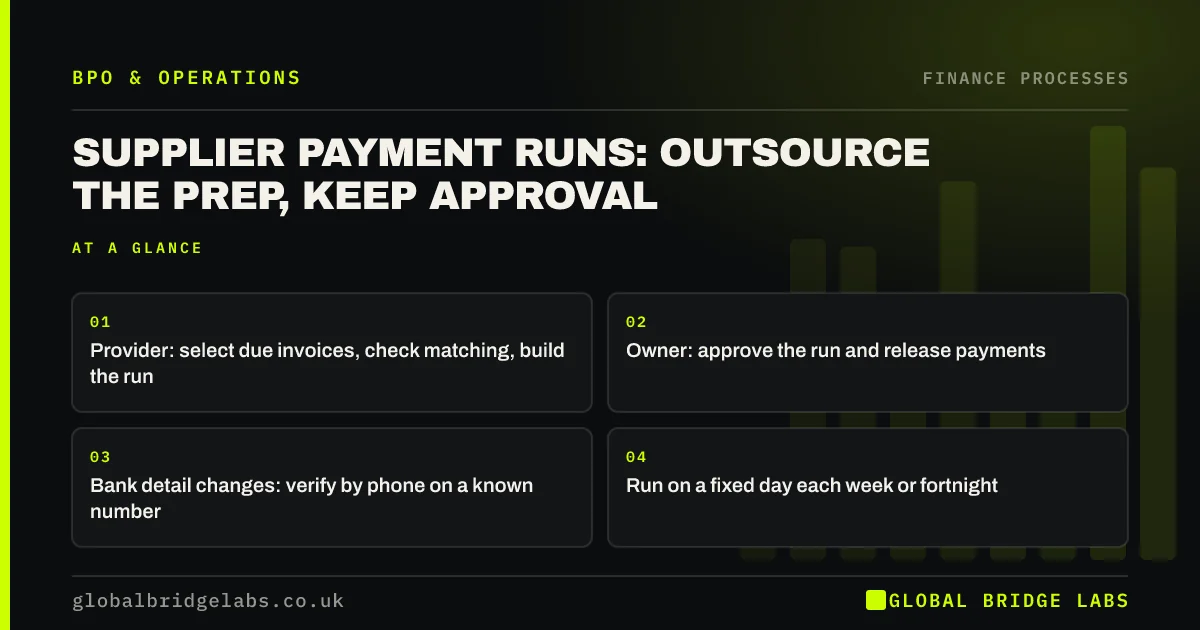
The supplier payment run process is a textbook split. A provider can prepare the run: select due invoices, check they are approved and matched, and build the payment file. Approval of the run, release of payments and any change to supplier bank details stay in-house, because that is where fraud and errors cost real money.
- Provider: select due invoices, check matching, build the run.
- Owner: approve the run and release payments.
- Bank detail changes: verify by phone on a known number.
- Run on a fixed day each week or fortnight.
Want a payment run control checklist? Message us on WhatsApp.
Chat on WhatsApp →What are the steps in a supplier payment run?
A payment run picks up approved invoices due by the run date, checks them against orders and deliveries, nets off any credits, builds a payment file for the bank, gets approval, releases the payments and sends remittances. A fixed weekly or fortnightly day keeps suppliers informed and cuts ad hoc requests.
Which stages can a provider prepare?
Selecting due invoices, checking approvals and three-way matching, applying credits, flagging anything unusual and building the payment file or bank upload. The provider should send the run with a short exceptions list: new suppliers, changed bank details, unusually large amounts and anything paid early.
Why do approval and bank detail changes stay in-house?
Because they are where money leaves the business. Mandate fraud, where a fake email asks you to update a supplier's bank details, is one of the most common frauds against UK businesses. The control is simple: verify any change by calling the supplier on a number you already hold, not one in the email. A named person approves the run and releases the payment.
Want help setting approval limits for your payment runs? Message us on WhatsApp.
Chat on WhatsApp →When should the whole run stay in-house?
When you pay only a handful of suppliers a month, the preparation is too small to outsource on its own; bundle it with invoice processing or keep it. Also keep it if your banking set-up cannot give a provider preparation access without payment rights.
What does this look like in practice?
A pattern we see: once payment runs move to a fixed day with a prepared pack, supplier chasing calls drop because suppliers know when they will be paid. The owner's time on payments falls to a short approval.
Payment run checklist
Confirm these every run.
- Only approved, matched invoices included.
- Credits applied before payment.
- New suppliers and changed details flagged.
- Bank detail changes verified by phone.
- Run approved by a named person.
- Remittances sent after release.
Next step
Tell us how often you pay suppliers and who prepares the run. We will show you how we would split it and which controls to add.
Message us on WhatsApp, or book a 30-minute consultation.
Chat on WhatsApp →Sources and further reading
- Late commercial payments: charging interest and debt recovery · GOV.UK
- Small Business Guide: cyber security · National Cyber Security Centre
Frequently asked questions
What is a supplier payment run?
A supplier payment run is a scheduled batch payment of approved supplier invoices that fall due by a set date. It involves selecting invoices, checking they are approved and matched, applying credits, building a payment file, getting approval, releasing payments and sending remittance advice.
Can supplier payments be outsourced safely?
The preparation can. A provider can select due invoices, check matching and build the payment file. Keep approval of the run, release of payments and verification of bank detail changes in-house, because those are the points where errors and fraud cause direct losses.
How do you prevent payment fraud in a payment run?
Verify any change to supplier bank details by calling the supplier on a number you already hold, never one from the request. Flag new suppliers and large or early payments, separate preparation from approval, and have a named person release each run.
Written by

Global Bridge Labs (GBL) is a UK–Sri Lanka partner for social media, websites and BPO. Everything here comes from client delivery, not theory.