On this page
- 01Key takeaways
- 02What is TUPE?
- 03When does TUPE apply to outsourcing?
- 04Who transfers under TUPE?
- 05Does TUPE apply if work moves offshore?
- 06What are the employer's duties?
- 07How does TUPE affect cost and contracts?
- 08When is TUPE unlikely to be an issue?
- 09What does this look like in practice?
- 10Checklist: TUPE before outsourcing
- 11Next step
- 12Sources and further reading
- 13Frequently asked questions
Key takeaways
TUPE outsourcing rules matter when you move work that UK employees currently do to a provider. The Transfer of Undertakings (Protection of Employment) Regulations protect employees in a service provision change: employees clearly assigned to the outsourced activity may transfer to the provider on their existing terms. Take advice before announcing any change.
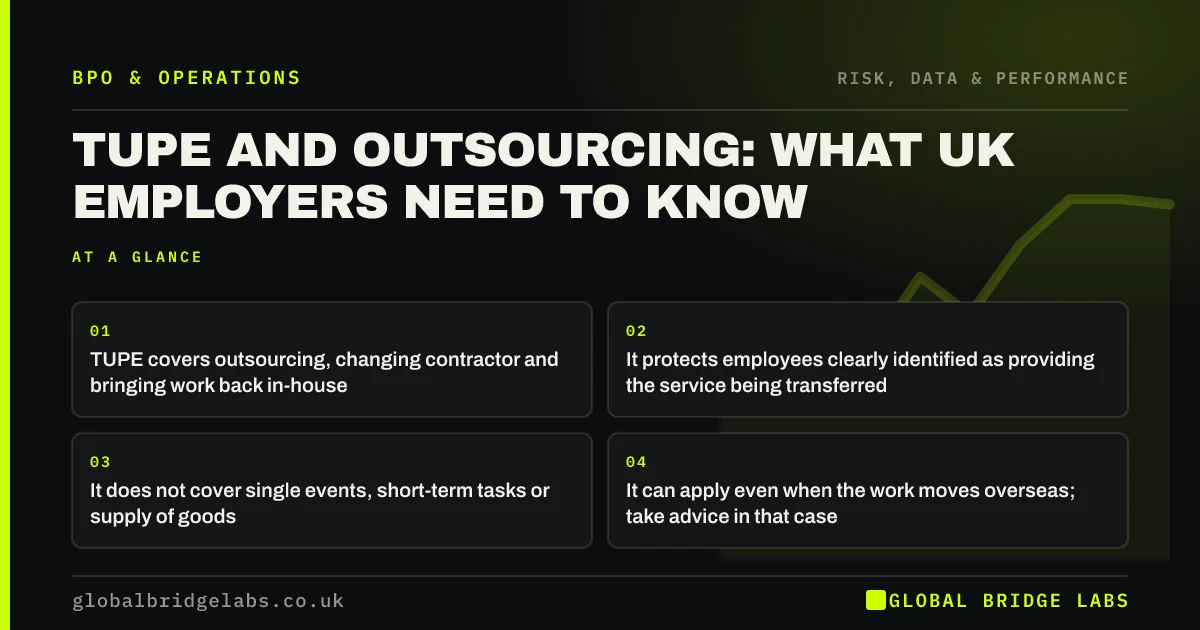
- TUPE covers outsourcing, changing contractor and bringing work back in-house.
- It protects employees clearly identified as providing the service being transferred.
- It does not cover single events, short-term tasks or supply of goods.
- It can apply even when the work moves overseas; take advice in that case.
- Employers must inform, and where measures are proposed consult, affected staff.
Planning to outsource work your staff currently do? Message us on WhatsApp and we will explain how we approach it with clients.
Chat on WhatsApp →What is TUPE?
TUPE, the Transfer of Undertakings (Protection of Employment) Regulations 2006, is UK employment law that protects employees when the business or service they work in moves to a new employer. Their jobs, terms and conditions and continuity of employment transfer with the work.
This article is general information, not legal advice. TUPE is technical and fact-specific; take employment law advice before acting.
When does TUPE apply to outsourcing?
GOV.UK guidance says TUPE applies to service provision changes: when in-house services are outsourced to a contractor, when a contract ends and moves to a new contractor, and when work is brought back in-house. It applies to both business transfers and these service changes.
It does not apply where the contract is for the supply of goods for the company's use, or covers a single event or short-term task. Only employees clearly identified as providing the service being transferred are protected.
- Outsourcing: work done by your staff moves to a BPO provider.
- Retendering: work moves from one provider to another.
- Insourcing: work moves from a provider back to you.
Who transfers under TUPE?
Employees who are assigned to an organised grouping whose principal purpose is carrying out the activity being outsourced. Someone who spends most of their time on customer support in a dedicated support team is likely to be in scope; someone who answers the occasional call alongside a sales role is less likely to be.
If an employee objects to transferring, their employment usually ends without a dismissal, with limited exceptions. This is an area where advice matters.
Does TUPE apply if work moves offshore?
It can. Tribunals have found that TUPE can apply to a service provision change even when the service moves outside the UK. In practice, employees rarely relocate abroad, so the question often becomes one of redundancy, consultation and potential liability.
This is the area where getting specialist advice early is most valuable. The right approach depends on the facts, and handling it badly can lead to claims.
What are the employer's duties?
Under TUPE, the outgoing employer must inform representatives of affected employees about the transfer, and consult them if any measures are proposed. It must also give the incoming employer information about the transferring employees. Dismissals because of the transfer are automatically unfair unless there is an economic, technical or organisational reason entailing changes in the workforce.
Timing matters: information must be given early enough for meaningful consultation. Plan the transfer timeline around these duties.
How does TUPE affect cost and contracts?
TUPE affects who bears the cost of transferring employees, redundancies and any claims. BPO contracts often include TUPE clauses and indemnities allocating that risk between client and provider, both at the start and at exit. Read them carefully.
Many SMEs avoid TUPE issues entirely by outsourcing work that is new, growing or currently done by the owner, or by redeploying staff to other roles, rather than replacing an existing dedicated team.
Want to plan outsourcing around your existing team rather than replacing it? Tell us your situation on WhatsApp and we will discuss your requirements.
Chat on WhatsApp →When is TUPE unlikely to be an issue?
TUPE is unlikely to be an issue when no employee currently does the work as their main role, such as when the owner does it, when it is new work, or when the outsourced team handles overflow and extended hours while existing staff keep their roles. It is also unlikely for one-off projects. Check anyway if in doubt.
What does this look like in practice?
Most of our UK clients outsource work that was falling on the owner or piling up unassigned, or add a team alongside existing staff to extend hours and absorb growth. In those cases staff roles often become more focused rather than disappearing. Where a change could affect an existing dedicated team, we recommend clients take employment law advice before planning the transition.
Checklist: TUPE before outsourcing
Work through these before announcing changes.
- Identify who currently does the work and how much of their time it takes.
- Decide whether an organised grouping is dedicated to the activity.
- Take employment law advice if anyone may be in scope.
- Plan information and consultation into the timeline.
- Read TUPE clauses and indemnities in the BPO contract.
- Consider redeployment or an alongside model.
Next step
If you want to outsource without disrupting your team, talk to us about models that work alongside your staff. 30 minutes, no pitch.
Message us on WhatsApp to talk it through, or book a 30-minute consultation.
Chat on WhatsApp →Sources and further reading
- Business transfers, takeovers and TUPE · GOV.UK
- The Sourcing and Consultancy Playbooks · Cabinet Office
- Contracts and liabilities between controllers and processors · Information Commissioner's Office
Frequently asked questions
Does TUPE apply when outsourcing?
It can. TUPE covers service provision changes, including when in-house services are outsourced to a contractor. Employees clearly assigned to the activity may transfer to the provider on their existing terms. It does not cover single events, short-term tasks or the supply of goods.
Does TUPE apply to offshore outsourcing?
It can, even where the work moves outside the UK, although employees rarely relocate. That often raises questions of redundancy, consultation and liability. This is fact-specific, so take employment law advice before outsourcing work currently done by a dedicated UK team.
What is a service provision change?
A service provision change is when an activity moves from a business to a contractor, from one contractor to another, or from a contractor back in-house. Under TUPE, employees assigned to that activity can transfer with it, keeping their terms and continuity of employment.
Do I have to consult employees about outsourcing?
If TUPE applies, you must inform representatives of affected employees and consult them about any proposed measures, early enough for consultation to be meaningful. Redundancy consultation rules may also apply. Take advice on timing and process.
Written by

Global Bridge Labs (GBL) is a UK–Sri Lanka partner for social media, websites and BPO. Everything here comes from client delivery, not theory.