
On this page
- 01Key takeaways
- 02Why not just outsource the mess?
- 03What should you fix first?
- 04What can a provider improve for you?
- 05How long does fixing the basics take?
- 06When should you outsource before fixing?
- 07When is the process not worth fixing at all?
- 08What does this look like in practice?
- 09Process readiness checklist
- 10Next step
- 11Sources and further reading
- 12Frequently asked questions
Key takeaways
You should fix the basics of a process before outsourcing it: remove steps nobody needs, write down the method and the common exceptions, and agree what done looks like. You do not need a perfect process. A provider can improve speed and accuracy once it is running, but it cannot guess decisions you have never made.
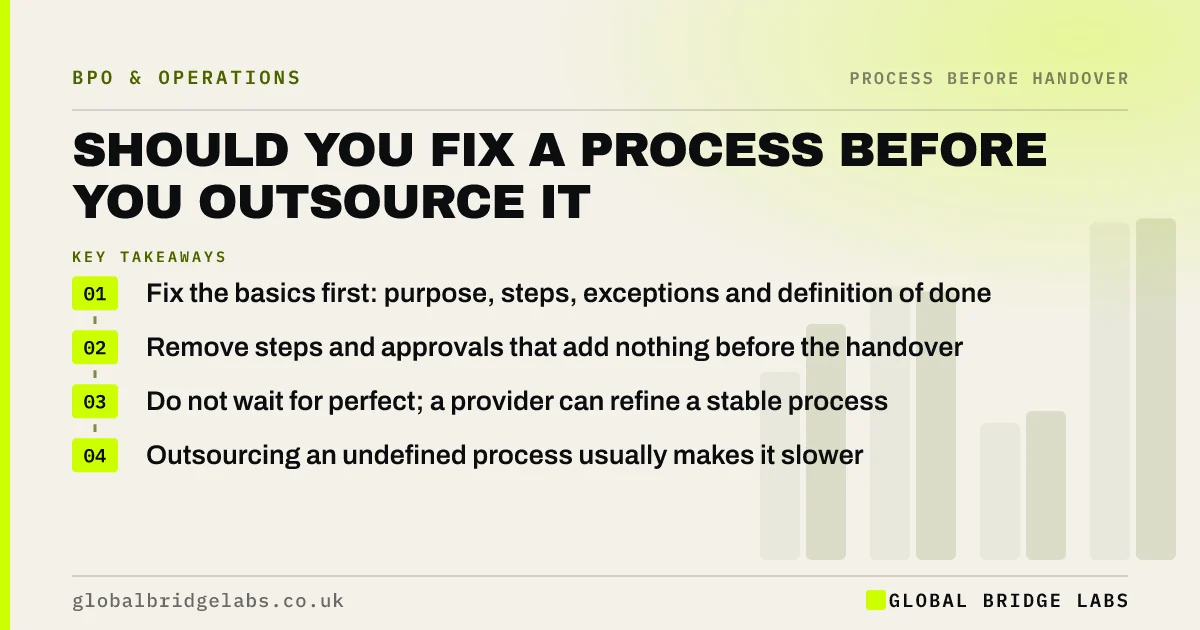
- Fix the basics first: purpose, steps, exceptions and definition of done.
- Remove steps and approvals that add nothing before the handover.
- Do not wait for perfect; a provider can refine a stable process.
- Outsourcing an undefined process usually makes it slower.
Not sure if your process is ready to hand over? Message us on WhatsApp and describe it.
Chat on WhatsApp →Why not just outsource the mess?
Outsourcing a messy process moves the mess and adds a handover. If the steps are unclear, the team asks questions. If exceptions are undefined, they come back to you. If nobody agrees what done means, work bounces. Each of those adds waiting, so lead time rises even if the hourly rate falls.
What should you fix first?
Fix four things first. Confirm the purpose and who uses the output. Remove steps, approvals and copies that add nothing. Write the method, including the ten most common exceptions and what to do for each. Agree acceptance criteria so everyone knows when an item is finished.
- 1. Purpose: who uses the output and why.
- 2. Simplify: cut steps, approvals and duplicate entry.
- 3. Write: the method and the top ten exceptions.
- 4. Define done: acceptance criteria for each item.
What can a provider improve for you?
A good provider can improve a stable process faster than most small teams can, because it does the same kind of work daily. It can tighten templates, add checks, spot repeat errors and propose automation. What it cannot do is decide your pricing, your refund policy or your service standards. Those decisions must come from you.
How long does fixing the basics take?
For a typical admin process, fixing the basics takes a few hours spread over one or two weeks. In an illustrative example, an owner spends two hours listing the steps, an hour removing two approvals and a duplicate entry, and two hours writing the exceptions with a colleague. That is five hours to save weeks of questions later. Example figures only.
- Process maturity: is your process ready to hand over?
- Work instructions vs SOPs: which one does your team need?
Want help working through the basics for one process? Send it to us on WhatsApp.
Chat on WhatsApp →When should you outsource before fixing?
Outsource before fixing when the backlog is so large that nobody has time to fix anything, or when the provider is engaged specifically to map and redesign the process. In both cases agree that the first weeks are discovery, with a written process as a deliverable, and expect efficiency gains to come later.
When is the process not worth fixing at all?
Some processes should stop rather than be fixed. If nobody uses the output, or the same result can be had another way, remove it. Others are so small that fixing and handing over costs more than doing them. Spend the effort on high-volume, high-interruption work.
What does this look like in practice?
A pattern we see: a firm hands over customer onboarding with a two-line brief, and the provider sends twenty questions in the first week. Pausing for a day to write the steps and exceptions cuts the questions to a handful, and the process starts moving faster than it did in-house.
Process readiness checklist
Check these before you hand anything over.
- Purpose and output are written down.
- Unneeded steps and approvals are removed.
- The method is written step by step.
- The top ten exceptions have a rule.
- Acceptance criteria are agreed.
- One internal owner is named.
Next step
Describe the process you want to hand over. We will tell you what to fix first and what a managed team could improve once it is running.
Message us on WhatsApp about your process, or book a 30-minute consultation.
Chat on WhatsApp →Sources and further reading
- Contracts and liabilities between controllers and processors · Information Commissioner's Office
- The Sourcing and Consultancy Playbooks · Cabinet Office
Frequently asked questions
Should you fix a process before outsourcing it?
Yes, at least the basics. Confirm its purpose, remove steps that add nothing, write the method and common exceptions, and agree what done looks like. You do not need a perfect process; a good provider can refine it once it is stable and running.
What happens if you outsource a broken process?
The provider asks many questions, exceptions keep coming back to you and work bounces because done is undefined. Lead time often rises even if cost per hour falls. Fixing the basics first usually takes a few hours and saves weeks.
Can an outsourcing provider improve my process?
A good provider can improve a stable process by tightening templates, adding checks, spotting repeat errors and proposing automation. It cannot make business decisions for you, such as pricing, refund rules or service standards, so those must be written down first.
Written by

Global Bridge Labs (GBL) is a UK–Sri Lanka partner for social media, websites and BPO. Everything here comes from client delivery, not theory.


