On this page
- 01Key takeaways
- 02Can regulated firms outsource processes?
- 03Which stages of a regulated process can move?
- 04What should the contract include for regulated work?
- 05When should regulated processes stay in-house?
- 06What does this look like in practice?
- 07Regulated outsourcing checklist
- 08Next step
- 09Sources and further reading
- 10Frequently asked questions
Key takeaways
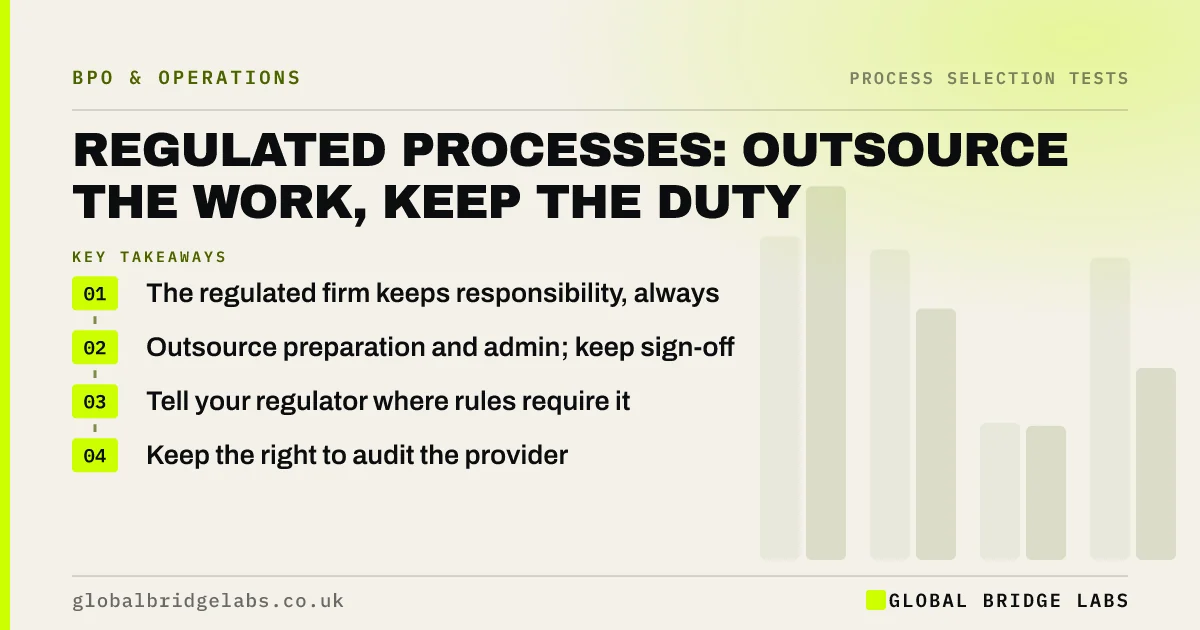
Outsourcing regulated activities is allowed in most UK sectors, but the regulated firm keeps the legal responsibility. FCA-regulated firms remain fully responsible for outsourced functions under SYSC 8. CQC-registered providers remain responsible for the care they deliver. Firms under the Money Laundering Regulations stay liable for their due diligence. Outsource the work; keep the duty and the oversight.
- The regulated firm keeps responsibility, always.
- Outsource preparation and admin; keep sign-off.
- Tell your regulator where rules require it.
- Keep the right to audit the provider.
In a regulated sector and considering outsourcing? Message us on WhatsApp.
Chat on WhatsApp →Can regulated firms outsource processes?
Yes. UK regulators generally accept outsourcing, provided the firm keeps responsibility, oversight and the ability to give the regulator access. SYSC 8 says an FCA-regulated firm must not outsource in a way that impairs its internal controls or the FCA's ability to monitor it. The same principle, outsource the work but keep control, runs through most sector rules.
Which stages of a regulated process can move?
The preparation and admin stages usually move safely, while the regulated judgement and sign-off stay. In an accountancy practice, document collection for AML checks can move; the risk assessment and acceptance decision stay. In a care provider, rota admin and records upkeep can move; care decisions stay. In a broker, renewal admin can move; advice stays.
- Move: document collection, data entry, chasing, records upkeep.
- Keep: risk decisions, advice, sign-off, regulatory filings.
- Split: drafting moves, review and approval stay.
What should the contract include for regulated work?
Beyond normal terms, include the regulator's right of access, your right to audit, notification of any incident affecting the regulated activity, continuity arrangements, and an exit plan that returns records in usable form. Record the outsourcing in your own compliance file, and check whether your regulator requires notice before you outsource a critical function.
Want a list of regulated-work contract points to check? Message us on WhatsApp.
Chat on WhatsApp →When should regulated processes stay in-house?
When the stage requires a qualified or approved person, when the regulator or a customer contract forbids it, or when you cannot oversee the provider properly. If you cannot explain to a regulator how you check the outsourced work, it is not ready to move.
What does this look like in practice?
A pattern we see: regulated firms assume nothing can move, then find that half the hours in a regulated process are admin around the regulated decision. Moving that admin frees qualified staff for the work only they can do.
Regulated outsourcing checklist
Confirm these before moving any stage.
- Identify which stages are regulated decisions.
- Keep sign-off with an authorised person.
- Include regulator access and audit rights.
- Check notification requirements.
- Record the arrangement in your compliance file.
- Review the provider at least annually.
Next step
Tell us your sector and the regulated process you are looking at. We will tell you which stages we would expect to move and which should stay with your authorised people.
Message us on WhatsApp, or book a 30-minute consultation.
Chat on WhatsApp →Sources and further reading
- FCA Handbook SYSC 8: Outsourcing · Financial Conduct Authority
- Regulations for service providers and managers · Care Quality Commission
- The Money Laundering, Terrorist Financing and Transfer of Funds Regulations 2017 · legislation.gov.uk
Frequently asked questions
Can FCA-regulated firms outsource?
Yes. Under SYSC 8, FCA-regulated firms can outsource functions, including critical or important ones, but remain fully responsible for them. Outsourcing must not impair the firm's internal controls or the FCA's ability to monitor compliance, and the contract should give the firm and the FCA access to relevant information.
Who is responsible when a regulated process is outsourced?
The regulated firm. Outsourcing transfers the work, not the legal duty. The firm must oversee the provider, keep sign-off of regulated decisions with authorised people, and be able to show the regulator how it checks the outsourced work.
What parts of a regulated process can be outsourced?
Usually the preparation and admin: document collection, data entry, chasing, scheduling and records upkeep. Regulated judgements, advice, risk decisions and formal sign-off generally stay with the firm's authorised or qualified people, although drafting work can be prepared by the provider for review.
Written by

Global Bridge Labs (GBL) is a UK–Sri Lanka partner for social media, websites and BPO. Everything here comes from client delivery, not theory.