On this page
- 01Key takeaways
- 02What is a 13-week rolling cash flow forecast?
- 03Which parts of forecasting can be outsourced?
- 04What must the owner decide?
- 05When should forecasting stay fully in-house?
- 06What does this look like in practice?
- 07Cash forecasting checklist
- 08Next step
- 09Sources and further reading
- 10Frequently asked questions
Key takeaways
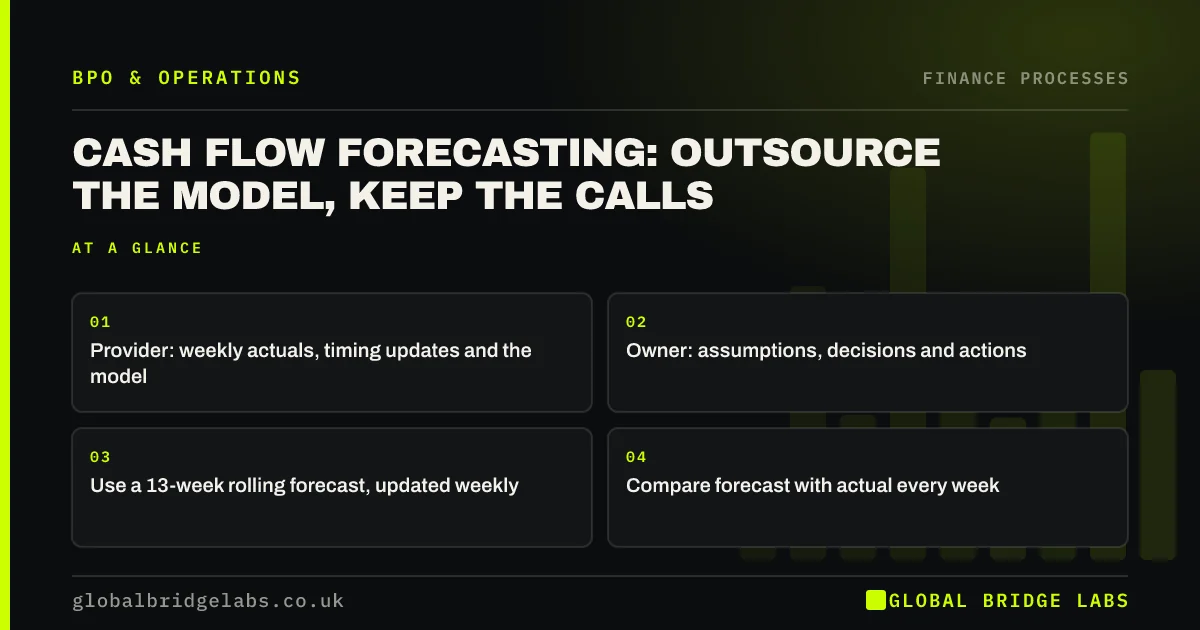
Cash flow forecasting outsourcing splits neatly: a provider keeps the model current each week, updating actuals, debtor and creditor timing and known commitments, and the owner makes the calls about what to do. A 13-week rolling forecast, updated weekly, is the format most SMEs find useful. The assumptions belong to you.
- Provider: weekly actuals, timing updates and the model.
- Owner: assumptions, decisions and actions.
- Use a 13-week rolling forecast, updated weekly.
- Compare forecast with actual every week.
Want a 13-week forecast template? Message us on WhatsApp.
Chat on WhatsApp →What is a 13-week rolling cash flow forecast?
It is a week-by-week view of cash in and cash out for the next 13 weeks, rolled forward each week so it always looks one quarter ahead. Thirteen weeks is long enough to see a squeeze coming and short enough to be reasonably accurate. It sits beside the annual budget, not instead of it.
Which parts of forecasting can be outsourced?
The maintenance. Each week the provider replaces last week's forecast with actuals from the bank, updates expected receipts from the debtor ledger, adds known payments such as payroll, VAT and supplier runs, and notes the biggest differences between forecast and actual. This is steady, rule-based work that often slips when the owner does it alone.
What must the owner decide?
The assumptions and the actions. Which customers will pay late, whether a big order will land, when to hire or invest, whether to chase harder or draw on a facility. A provider can model the effect of each choice; the choice itself carries the business's risk and stays with you.
- Budgeting: the process stays yours, the admin can move
- Management accounts: outsource the pack, keep the review
Want a weekly 20-minute cash review routine? Message us on WhatsApp.
Chat on WhatsApp →When should forecasting stay fully in-house?
When cash is so tight that daily decisions depend on it, keep it close and consider your accountant's direct help. Also when the business has very few transactions: a simple spreadsheet the owner updates monthly may be enough, and outsourcing it adds handoffs for little gain.
What does this look like in practice?
A pattern we see: forecasts that the owner maintains alone are accurate in January and abandoned by April. A weekly update someone else is responsible for keeps the forecast alive, and the owner's review becomes a 20-minute habit.
Cash forecasting checklist
Set these up before handing over the updates.
- Agree the 13-week format and categories.
- List recurring payments and their dates.
- Link expected receipts to the debtor ledger.
- Set a weekly update day.
- Review forecast against actual each week.
- Record assumptions the owner sets.
Next step
Tell us how you track cash today. We will suggest a forecast format and explain what the weekly update would involve.
Message us on WhatsApp, or book a 30-minute consultation.
Chat on WhatsApp →Sources and further reading
Frequently asked questions
Can cash flow forecasting be outsourced?
The maintenance can. A provider can update actuals, receipts and payments each week and keep a rolling forecast current. The assumptions behind it and the decisions it informs should stay with the owner, because they depend on knowledge of customers, plans and risk.
Why use a 13-week cash flow forecast?
Thirteen weeks, about a quarter, is long enough to see a cash squeeze coming and act on it, and short enough for week-by-week figures to be reasonably accurate. Rolling it forward each week keeps the view constant and shows how reliable your forecasting is.
How often should a small business update its cash flow forecast?
Weekly, if cash matters to day-to-day decisions, which it does for most SMEs. Each update should replace the past week with actual figures, adjust expected timing of receipts and payments, and note the largest differences between forecast and actual.
Written by

Global Bridge Labs (GBL) is a UK–Sri Lanka partner for social media, websites and BPO. Everything here comes from client delivery, not theory.