On this page
- 01Key takeaways
- 02Why does volume matter for outsourcing a process?
- 03How do you count the volume of a process?
- 04What can you do when volume is too small?
- 05What does volume mean for cost?
- 06What does this look like in practice?
- 07Volume checklist
- 08Next step
- 09Sources and further reading
- 10Frequently asked questions
Key takeaways
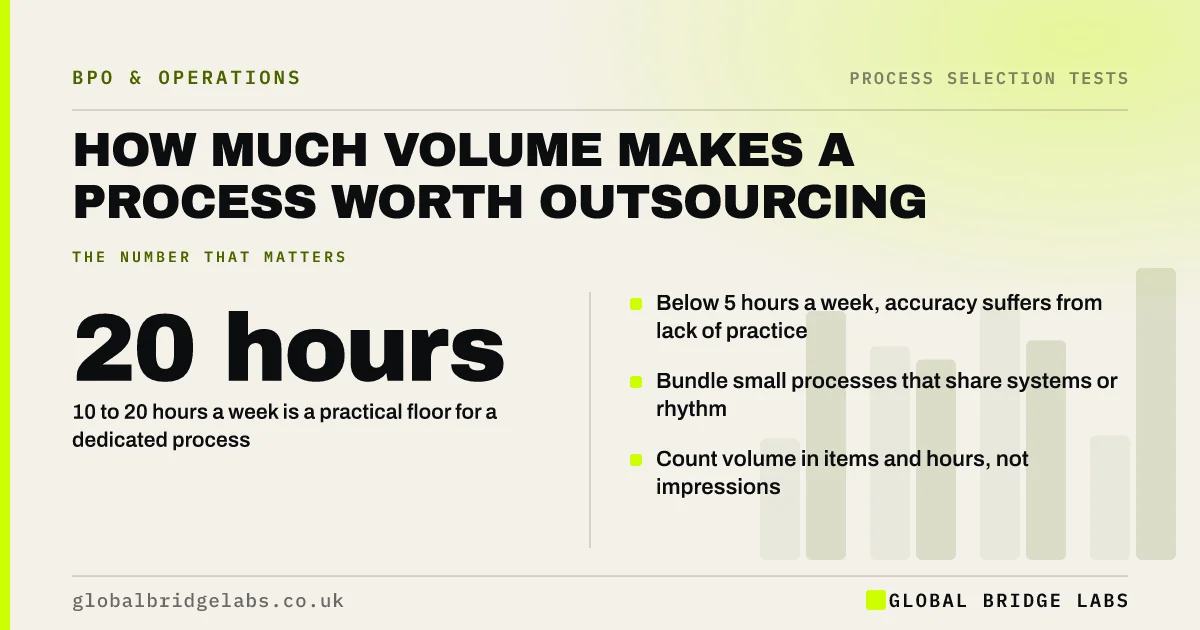
The minimum volume to outsource a process is lower than most owners think, but it is not zero. As a GBL rule of thumb, 10 to 20 hours a week of related work keeps an outsourced team practised and accurate. Below that, bundle the process with related work, outsource it as a monthly batch, or keep it.
- 10 to 20 hours a week is a practical floor for a dedicated process.
- Below 5 hours a week, accuracy suffers from lack of practice.
- Bundle small processes that share systems or rhythm.
- Count volume in items and hours, not impressions.
Not sure if your process has enough volume? Message us on WhatsApp with rough weekly numbers.
Chat on WhatsApp →Why does volume matter for outsourcing a process?
Volume decides whether the people running your process stay practised. A process done daily is remembered; one done twice a month is relearned each time, and relearning is where errors creep in. Volume also decides the economics: set-up, documentation and review cost roughly the same whether the process takes 3 hours a week or 30.
How do you count the volume of a process?
Count items and time for four weeks. Items are the units the process handles: invoices, tickets, orders, starters. Time is the hours spent, including checks and rework. Divide hours by items to get a time per item, which you will need later for pricing and for spotting improvement.
- Count items per week for four weeks.
- Record hours spent, including rework.
- Note the busiest and quietest weeks.
- Work out minutes per item.
What can you do when volume is too small?
Bundle the process with others that use the same systems or run on the same rhythm, such as billing, cash allocation and supplier statements. Or run it as a monthly batch so the volume arrives in one block. If neither works, keep it in-house and simplify it, because a small process outsourced alone usually costs more in management than it saves.
What does volume mean for cost?
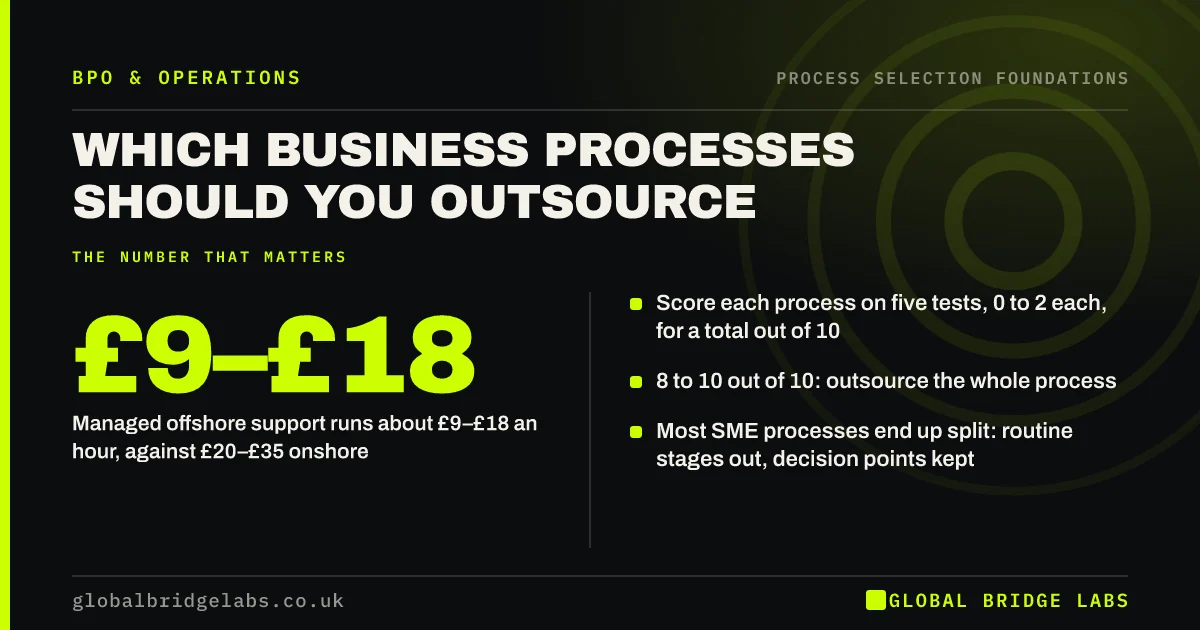
Indicative managed offshore rates run about £9–£18 an hour. In an illustrative example, a 15-hour weekly process costs about £135–£270 a week in provider time, while set-up and review take about 3 hours of your time in month one. A 4-hour process carries the same set-up for a quarter of the output, so its cost per item is far higher.
Want a cost per item for your process at different volumes? Message us on WhatsApp.
Chat on WhatsApp →What does this look like in practice?
A pattern we see: a process that looks too small in a quiet month turns out to have 15 to 20 hours a week once rework and chasing are counted. Counting properly often changes the answer.
Volume checklist
Check these before deciding volume is too low.
- Count four weeks, not one.
- Include rework and chasing time.
- Look for related processes to bundle.
- Consider a monthly batch.
- Compare set-up time with weekly hours.
Next step
Send us four weeks of volumes for the process you are considering. We will tell you whether it stands alone, needs bundling or is better kept.
Message us on WhatsApp, or book a 30-minute consultation.
Chat on WhatsApp →Sources and further reading
- Employee earnings in the UK (Annual Survey of Hours and Earnings) · Office for National Statistics
- Labour productivity · Office for National Statistics
Frequently asked questions
What is the minimum amount of work worth outsourcing?
As a rule of thumb, 10 to 20 hours a week of related work keeps an outsourced team practised and makes set-up worthwhile. Smaller processes can still be outsourced if they are bundled with related work or run as a monthly batch, but a few hours a month alone rarely pays back.
Can I outsource a process that only runs once a month?
Yes, if it is well documented and either large enough on the day or bundled with other monthly work such as reconciliations and reporting. Write a detailed checklist, because the team will not remember the steps from one month to the next, and check the first three runs closely.
How do I measure the volume of a process?
Count the items it handles, such as invoices, orders or tickets, and the hours spent on it, including checks and rework, for four weeks. Note the busiest and quietest weeks. Dividing hours by items gives a time per item, which helps with pricing and spotting improvements.
Written by

Global Bridge Labs (GBL) is a UK–Sri Lanka partner for social media, websites and BPO. Everything here comes from client delivery, not theory.