On this page
- 01Key takeaways
- 02How do reorder points work?
- 03Which inventory planning work can be outsourced?
- 04Which stock decisions stay with you?
- 05When is outsourcing inventory planning not worth it?
- 06What does this look like in practice?
- 07Inventory planning checklist
- 08Next step
- 09Sources and further reading
- 10Frequently asked questions
Key takeaways
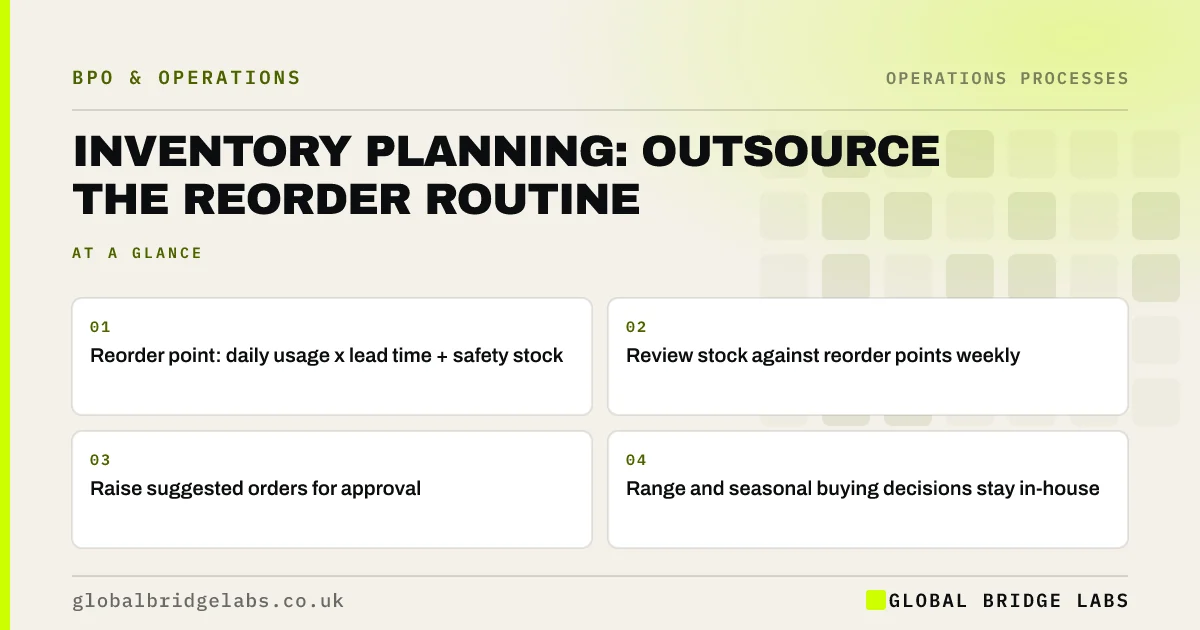
Inventory planning outsourcing hands over the weekly replenishment routine: checking stock against reorder points, raising suggested orders and chasing suppliers. The reorder point is average daily usage multiplied by supplier lead time, plus safety stock. Range decisions, safety stock levels and big seasonal buys stay with you.
- Reorder point: daily usage x lead time + safety stock.
- Review stock against reorder points weekly.
- Raise suggested orders for approval.
- Range and seasonal buying decisions stay in-house.
Want reorder points calculated for your best sellers? Message us on WhatsApp.
Chat on WhatsApp →How do reorder points work?
A reorder point tells you when to order so new stock arrives before you run out. Multiply average daily usage by the supplier's lead time in days, then add safety stock to cover variation. In an illustrative example, selling 20 units a day with a 10-day lead time and 60 units of safety stock gives a reorder point of 260 units.
Which inventory planning work can be outsourced?
Weekly checks of stock against reorder points, updating usage and lead times, preparing suggested orders for approval, raising approved purchase orders, chasing late deliveries and flagging slow-moving stock. These steps need discipline more than judgement.
- Weekly reorder point check.
- Suggested orders for approval.
- Purchase orders and chasing.
- Slow-moving stock report.
Which stock decisions stay with you?
What to range, how much safety stock to hold, large seasonal or promotional buys, and what to discontinue. These tie up cash and depend on your plans. A provider can model options; the commitment is yours.
- Cash flow forecasting: outsource the model, keep the calls
- Demand forecasting for small teams: plan capacity ahead
Want a weekly replenishment routine set up? Message us on WhatsApp.
Chat on WhatsApp →When is outsourcing inventory planning not worth it?
With a small range of slow-moving items, a monthly check by the owner is enough. It pays off when you hold hundreds of lines, sell across several channels, or regularly run out of best sellers while slow lines pile up.
What does this look like in practice?
A pattern we see: stock-outs happen on best sellers because ordering is done from memory. A weekly reorder check usually fixes best-seller availability before anyone touches the slow lines.
Inventory planning checklist
Set these up and review quarterly.
- Usage and lead time per line.
- Safety stock rule.
- Reorder points calculated.
- Weekly check day.
- Approval route for orders.
- Slow-moving stock report.
Next step
Tell us how many stock lines you hold and how you reorder today. We will suggest reorder points for your top lines and a weekly routine.
Message us on WhatsApp, or book a 30-minute consultation.
Chat on WhatsApp →Sources and further reading
- Internet sales as a percentage of total retail sales · Office for National Statistics
- Late commercial payments: charging interest and debt recovery · GOV.UK
Frequently asked questions
How do you calculate a reorder point?
Multiply average daily usage by the supplier lead time in days, then add safety stock. For example, 20 units a day with a 10-day lead time and 60 units of safety stock gives a reorder point of 260. Recalculate when usage or lead times change.
Can inventory planning be outsourced?
The routine can: checking stock against reorder points, preparing suggested orders, raising approved purchase orders, chasing deliveries and flagging slow-moving stock. Range decisions, safety stock levels and large seasonal buys should stay with the business.
How often should stock levels be reviewed?
Weekly for most SMEs, and more often for fast-moving lines or during peaks. A regular review against reorder points prevents stock-outs on best sellers and shows which lines are building up and tying up cash.
Written by

Global Bridge Labs (GBL) is a UK–Sri Lanka partner for social media, websites and BPO. Everything here comes from client delivery, not theory.