On this page
- 01Key takeaways
- 02Which charity processes outsource well?
- 03What must trustees keep?
- 04How should supporter data be protected?
- 05When should a charity keep admin in-house?
- 06What does this look like in practice?
- 07Charity outsourcing checklist
- 08Next step
- 09Sources and further reading
- 10Frequently asked questions
Key takeaways
Charity admin outsourcing lets small charities spend more of their limited staff time on their cause. Donation processing, Gift Aid admin, supporter records, finance processing, volunteer admin and membership renewals all outsource well. Trustees remain responsible for the charity, as the Charity Commission's CC3 guidance makes clear, so oversight and key decisions stay in-house.
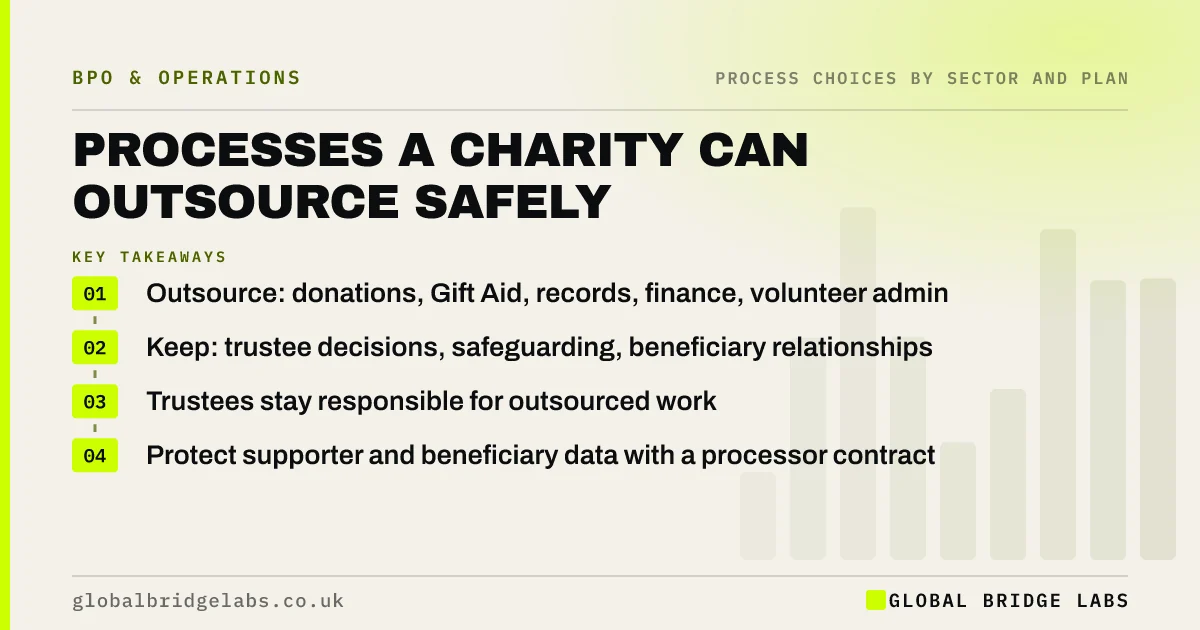
- Outsource: donations, Gift Aid, records, finance, volunteer admin.
- Keep: trustee decisions, safeguarding, beneficiary relationships.
- Trustees stay responsible for outsourced work.
- Protect supporter and beneficiary data with a processor contract.
Running a small charity? Message us on WhatsApp about your admin.
Chat on WhatsApp →Which charity processes outsource well?
Processing donations and sending thank-yous, Gift Aid declarations and claims, supporter database upkeep, finance processing and reconciliations, volunteer rota and records admin, membership renewals and event registrations. These are routine, measurable and often done by staff or volunteers who would rather be delivering services.
What must trustees keep?
Trustees remain collectively responsible for the charity, including work done by contractors. They should approve the decision to outsource, set the controls, receive reports and keep decisions on strategy, spending, safeguarding and beneficiary services. Safeguarding processes, in particular, should stay under direct charity control.
- Decision to outsource and controls.
- Strategy and spending.
- Safeguarding.
- Beneficiary services and relationships.
How should supporter data be protected?
Supporter and beneficiary data often includes sensitive details. Use a processor contract, limit access to what each process needs, follow PECR for fundraising emails and calls, and check transfer rules before any data goes offshore. Beneficiary health or welfare information is special category data and needs extra care.
- Processes with sensitive data: can they be outsourced?
- Email marketing outsourcing: what to hand over
Want a data protection checklist for charity outsourcing? Message us on WhatsApp.
Chat on WhatsApp →When should a charity keep admin in-house?
When volunteers enjoy and do the work reliably, when volumes are very low, or when funders restrict how grant money is spent on support costs. Check funding terms before moving any process paid for by a restricted grant.
What does this look like in practice?
A pattern we see: Gift Aid goes unclaimed because nobody has time to match declarations to donations. A monthly claim routine often recovers money the charity did not know it was owed.
Charity outsourcing checklist
Confirm these with your trustees.
- Trustee approval of the decision.
- Processor contract in place.
- Access limited by process.
- Safeguarding kept in-house.
- Funding terms checked.
- Regular report to trustees.
Next step
Tell us which admin takes your team's time. We will suggest which processes to move and how to report to trustees.
Message us on WhatsApp, or book a 30-minute consultation.
Chat on WhatsApp →Sources and further reading
- The essential trustee: what you need to know, what you need to do (CC3) · Charity Commission
- Claiming Gift Aid as a charity or CASC: how to claim · HM Revenue & Customs
- Electronic and telephone marketing under PECR · Information Commissioner's Office
Frequently asked questions
What can a charity outsource?
Donation processing, Gift Aid admin, supporter database upkeep, finance processing, volunteer and membership admin, and event registrations outsource well. Strategy, spending decisions, safeguarding and direct beneficiary services should stay under the charity's control.
Are trustees responsible for outsourced work?
Yes. Trustees remain collectively responsible for the charity, including work carried out by contractors. They should approve outsourcing decisions, make sure appropriate controls are in place and receive regular reports on performance and risk.
How should charities protect supporter data when outsourcing?
Use a processor contract, limit access to what each process needs, follow PECR for fundraising contact, check transfer rules for offshore teams and treat beneficiary health or welfare information as special category data with extra safeguards.
Written by

Global Bridge Labs (GBL) is a UK–Sri Lanka partner for social media, websites and BPO. Everything here comes from client delivery, not theory.