On this page
- 01Key takeaways
- 02What are upstream and downstream processes?
- 03How do you map process dependencies?
- 04What do many dependencies mean for outsourcing?
- 05What hidden dependencies catch owners out?
- 06What does this look like in practice?
- 07Dependency mapping checklist
- 08Next step
- 09Sources and further reading
- 10Frequently asked questions
Key takeaways
Process dependency mapping shows what each process needs from others (upstream) and what others need from it (downstream). Before outsourcing a process, map its dependencies so the handover does not break a neighbour. A simple map takes about an hour: one box per process, an arrow for each input and output.
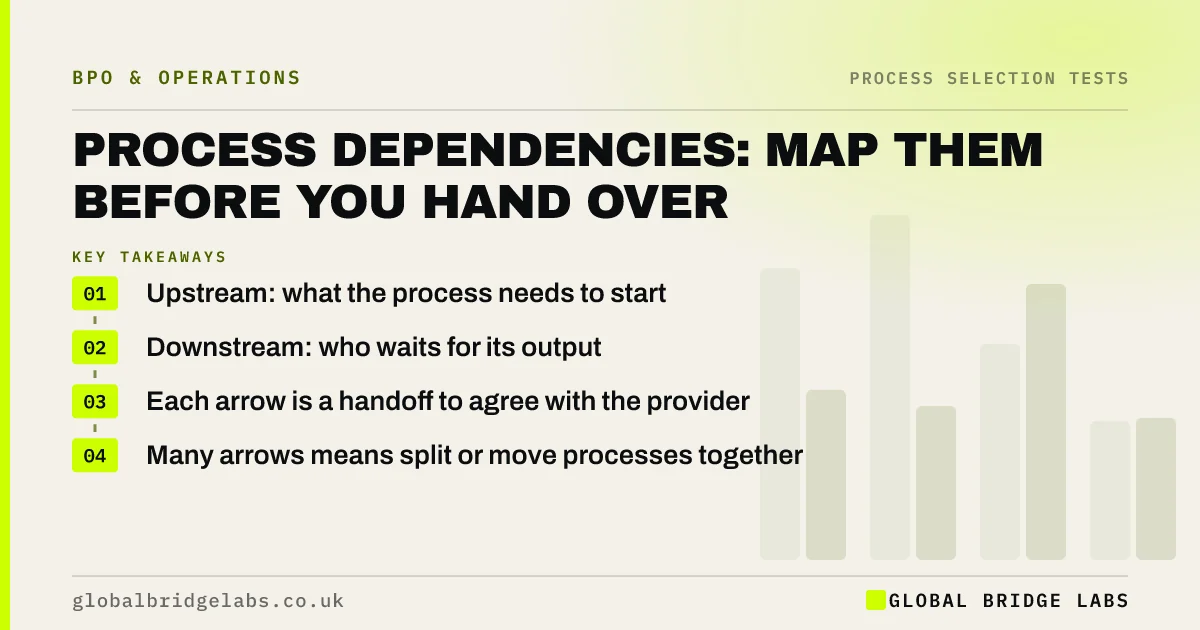
- Upstream: what the process needs to start.
- Downstream: who waits for its output.
- Each arrow is a handoff to agree with the provider.
- Many arrows means split or move processes together.
Want help mapping dependencies for one process? Message us on WhatsApp.
Chat on WhatsApp →What are upstream and downstream processes?
Upstream processes supply inputs: sales creates the order that billing needs. Downstream processes use outputs: credit control relies on the invoices billing produces. When a process moves to a provider, every upstream and downstream link becomes a handoff between two organisations, with its own timing and format to agree.
How do you map process dependencies?
Put the candidate process in the middle of a page. Draw boxes for each process that feeds it and each that relies on it. Label each arrow with what passes along it and when it is needed. Then mark which arrows would cross into the provider. Each of those needs an agreed format, timing and owner.
- Draw the candidate process in the centre.
- Add every feeding and receiving process.
- Label each arrow with what and when.
- Mark arrows that would cross to the provider.
What do many dependencies mean for outsourcing?
A process with many crossing arrows is costly to outsource alone, because every handoff adds delay and a chance of error. Either move the tightly linked processes together, such as billing with cash allocation, or split the process so the crossing points sit where work naturally pauses, such as at an approval.
- Linked processes: outsource them together or apart?
- Order-to-cash process: shorten the road from sale to cash
Want a view on whether to move linked processes together? Message us on WhatsApp.
Chat on WhatsApp →What hidden dependencies catch owners out?
The ones nobody wrote down: a spreadsheet someone updates as a side effect, a report that draws on a process's output, or a customer who expects a call at a certain point. Ask the person who runs the process what else they do while they are in there. That question finds most hidden dependencies.
What does this look like in practice?
A pattern we see: a process is outsourced and, a month later, a report stops working because it relied on a spreadsheet the old process kept up to date. A dependency map catches this before go-live.
Dependency mapping checklist
Complete these before a process moves.
- List every upstream and downstream process.
- Label what passes on each link, and when.
- Ask what else is updated as a side effect.
- Agree format and timing for each crossing link.
- Name an owner for each crossing link.
Next step
Draw the dependency map for your candidate process and send us a photo. We will point out the links most likely to cause trouble after handover.
Message us on WhatsApp, or book a 30-minute consultation.
Chat on WhatsApp →Sources and further reading
- The Sourcing and Consultancy Playbooks · Cabinet Office
- Small organisations guide to cyber security · National Cyber Security Centre
Frequently asked questions
What is process dependency mapping?
Process dependency mapping is drawing which processes supply inputs to a given process and which rely on its outputs, with what passes between them and when. It shows where handoffs sit, which helps avoid breaking neighbouring processes when one is changed, automated or outsourced.
Why map dependencies before outsourcing?
Because every link between an outsourced process and your remaining processes becomes a handoff between two organisations. Mapping them first lets you agree formats, timing and owners in advance, move tightly linked processes together, and find hidden side effects before go-live.
How long does it take to map process dependencies?
For one process, about an hour with the person who runs it. Draw the process in the centre, add every feeding and receiving process, label each link, and ask what else gets updated along the way. That last question finds most of the dependencies nobody wrote down.
Written by

Global Bridge Labs (GBL) is a UK–Sri Lanka partner for social media, websites and BPO. Everything here comes from client delivery, not theory.