On this page
Key takeaways
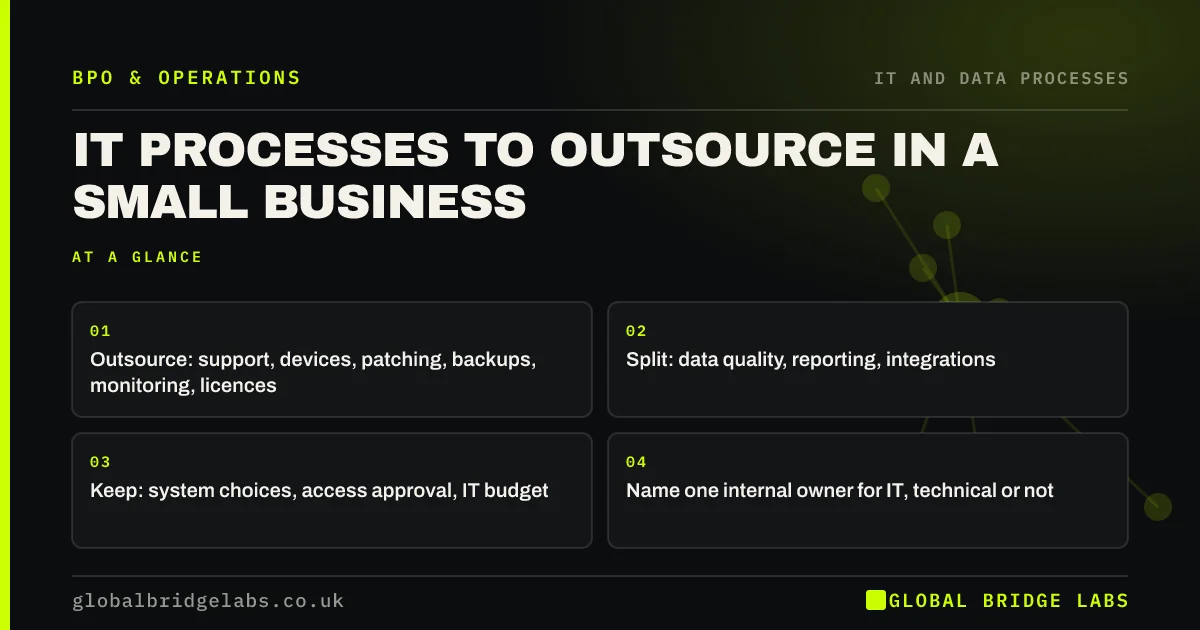
The IT processes to outsource in a small business are the routine, technical ones: first-line support, device management, patching, backup checks, security monitoring and licence admin. Data upkeep and reporting usually split. Choosing systems, approving access to sensitive data and owning the IT budget stay in-house, even when nobody in the business is technical.
- Outsource: support, devices, patching, backups, monitoring, licences.
- Split: data quality, reporting, integrations.
- Keep: system choices, access approval, IT budget.
- Name one internal owner for IT, technical or not.
Want verdicts for your IT processes? Message us on WhatsApp.
Chat on WhatsApp →Which IT processes outsource best?
Processes with clear standards and steady volume: answering IT requests, setting up and recovering devices, applying updates, monitoring alerts, checking backups and managing software licences. These are the processes that fall behind in a business with an accidental IT manager.
Which IT processes should be split?
Data and integration work, where routine checks move and rule-setting stays. Reporting, where refresh moves and questions stay. System changes, where a provider configures and you approve.
- Data quality: checks out, rules in.
- Integrations: monitoring out, changes approved in.
- Reporting: refresh out, decisions in.
Which IT decisions stay in-house?
Which systems to buy, who can access sensitive data, how much to spend and how much risk to accept. These shape how the business works and carry accountability under UK GDPR. A provider advises; a named person in the business decides. That person does not need to be technical, but must own the decisions.
- Build vs buy software: the small business view
- Processes with sensitive data: can they be outsourced?
Want help naming an internal IT owner and their role? Message us on WhatsApp.
Chat on WhatsApp →How do you start outsourcing IT processes?
List your IT processes, note who does each today and how often things go wrong. Start with the process that fails most, often patching or backups, then add support and device management. Check the provider meets Cyber Essentials standards and has a processor contract for any personal data.
What does this look like in practice?
A pattern we see: IT in a small firm is done by whoever is most comfortable with computers, on top of their real job. Handing the routine processes to a provider gives that person their time back and gives the business consistent standards.
IT process checklist
Work through these in order.
- List IT processes and current owners.
- Note failures and near misses.
- Name one internal IT owner.
- Move the most failure-prone process first.
- Agree standards and response times.
- Review monthly for the first quarter.
Next step
Tell us who handles IT today and what goes wrong most often. We will give you a verdict for each process and suggest where to start.
Message us on WhatsApp, or book a 30-minute consultation.
Chat on WhatsApp →Sources and further reading
- Cyber Essentials overview · National Cyber Security Centre
- Small organisations guide to cyber security · National Cyber Security Centre
Frequently asked questions
Which IT processes can a small business outsource?
First-line IT support, device set-up and recovery, patching and updates, security monitoring, backup checks and software licence admin. Data quality checks, integration monitoring and report refreshes can also move, with rules and decisions kept in-house.
What IT should a small business keep in-house?
Decisions: which systems to use, who can access sensitive data, the IT budget and the level of risk to accept. A named person should own these, even if they are not technical, because the business remains accountable for its data and systems.
Where should a small business start with outsourced IT?
With the process that fails most often or carries the most risk, which is often patching or backups. Once that runs reliably, add first-line support and device management. Check that the provider meets Cyber Essentials standards.
Written by

Global Bridge Labs (GBL) is a UK–Sri Lanka partner for social media, websites and BPO. Everything here comes from client delivery, not theory.