On this page
Key takeaways
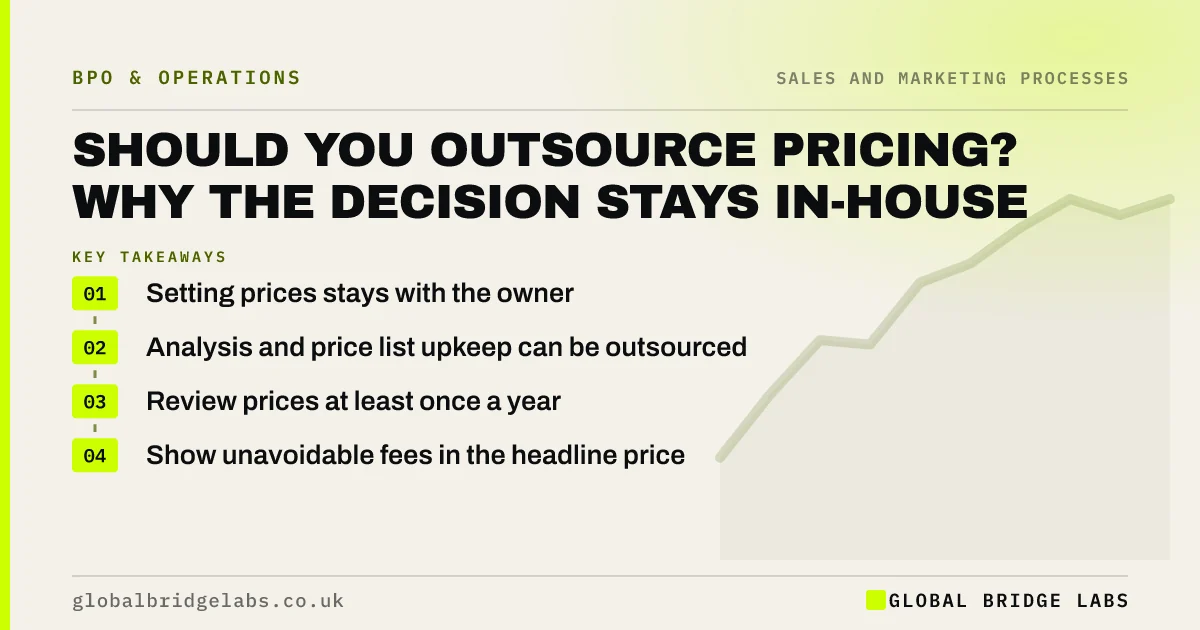
Should you outsource pricing strategy? Keep the decision. Price is the most direct lever on profit, and it expresses your positioning. The analysis behind it outsources well: margin by product, competitor price checks, discount tracking and price list maintenance. Make sure prices you show meet UK rules, including showing unavoidable fees upfront.
- Setting prices stays with the owner.
- Analysis and price list upkeep can be outsourced.
- Review prices at least once a year.
- Show unavoidable fees in the headline price.
Want a price review pack prepared for you? Message us on WhatsApp.
Chat on WhatsApp →Why does pricing stay in-house?
Because a small change in price usually moves profit more than the same change in volume or cost, and because price signals who you are for. Pricing decisions need knowledge of customers, competitors and your own costs and plans. A provider can supply the evidence; the call is yours.
Which pricing work can be outsourced?
Preparing the evidence and running the admin. Margin by product or service, discount levels by customer and salesperson, competitor price checks, cost changes from suppliers, and keeping price lists, quote templates and websites consistent once a decision is made.
- Margin by product or service.
- Discount tracking.
- Competitor price checks.
- Price list and quote template updates.
What rules apply to showing prices?
Prices must not mislead consumers. Under the Digital Markets, Competition and Consumers Act 2024, unavoidable fees should be included in the headline price rather than added later in the purchase. Price comparisons and sale claims must be genuine. Check prices on your website and materials whenever they change.
Want a price consistency check across your channels? Message us on WhatsApp.
Chat on WhatsApp →How should a price review run?
Once a year at least, and whenever costs move sharply. A provider prepares a pack: margins, discounts, competitor prices and cost changes. The owner and sales lead decide changes. The provider then updates every price list, template and website page on the same day.
What does this look like in practice?
A pattern we see: prices drift out of line across the website, quotes and sales materials because updates are done piecemeal. One update routine after each price decision fixes it.
Pricing process checklist
Run these at each review.
- Margin by product prepared.
- Discount levels reviewed.
- Competitor prices checked.
- Decision made and recorded by the owner.
- All price lists updated the same day.
- Headline prices include unavoidable fees.
Next step
Tell us when you last reviewed your prices. We will tell you what a review pack would contain and how we would keep prices consistent afterwards.
Message us on WhatsApp, or book a 30-minute consultation.
Chat on WhatsApp →Sources and further reading
- Digital Markets, Competition and Consumers Act 2024 · legislation.gov.uk
- Unfair commercial practices guidance (CMA207) · Competition and Markets Authority
Frequently asked questions
Should a small business outsource its pricing?
Not the decision. Setting prices affects profit and positioning directly and needs knowledge of customers, competitors and costs. The analysis behind it, such as margins, discounts and competitor checks, and the admin of updating price lists can be outsourced.
How often should a small business review its prices?
At least once a year, and whenever costs change significantly. A review should look at margins by product, discount levels, competitor prices and cost changes, then update every price list, quote template and web page at the same time.
What are the UK rules on showing prices?
Prices must not mislead consumers. Under the Digital Markets, Competition and Consumers Act 2024, unavoidable fees should be included in the headline price. Price comparisons and sale claims must be genuine. Check the CMA's current guidance when you change how prices are shown.
Written by

Global Bridge Labs (GBL) is a UK–Sri Lanka partner for social media, websites and BPO. Everything here comes from client delivery, not theory.