On this page
- 01Key takeaways
- 02What is a make or buy decision?
- 03Which factors decide make or buy?
- 04How do you cost a make or buy decision?
- 05What does a worked example look like?
- 06When should you make rather than buy?
- 07When should you buy rather than make?
- 08Is there a middle option?
- 09What mistakes skew a make or buy decision?
- 10What does this look like in practice?
- 11Make or buy checklist
- 12Next step
- 13Sources and further reading
- 14Frequently asked questions
Key takeaways
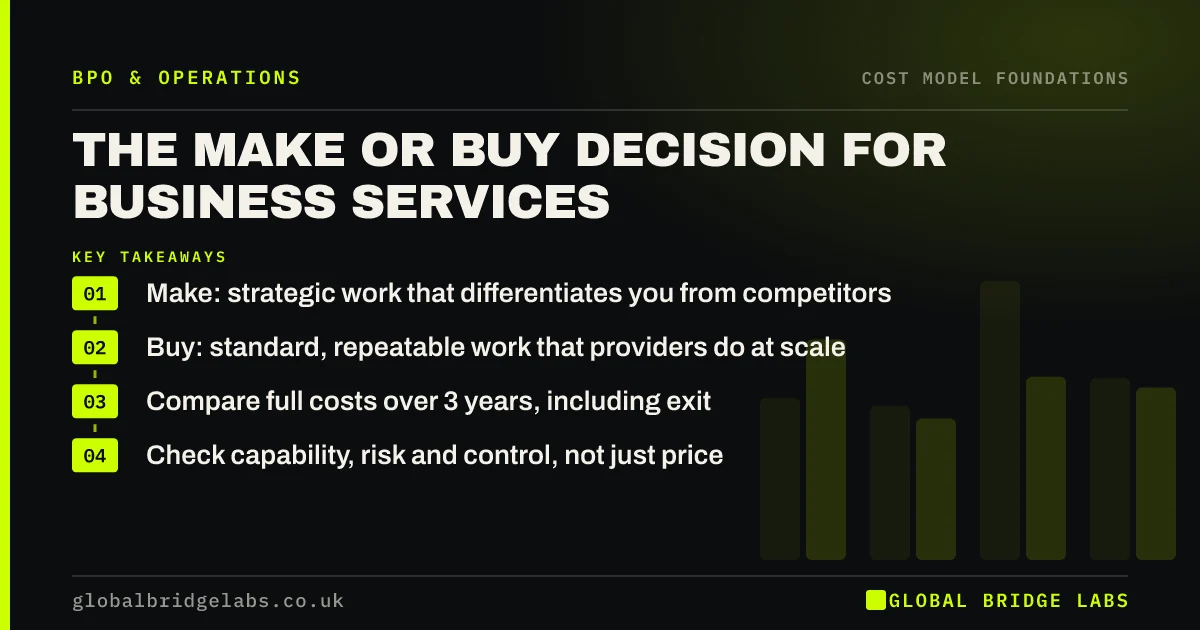
The make or buy decision asks whether to produce a service with your own people (make) or buy it from a provider (buy). For business services, make what is strategic or needs deep context, and buy what is standard, measurable and cheaper to source. Compare full costs over 3 years, not the first month.
- Make: strategic work that differentiates you from competitors.
- Buy: standard, repeatable work that providers do at scale.
- Compare full costs over 3 years, including exit.
- Check capability, risk and control, not just price.
Facing a make or buy decision on one function? Message us on WhatsApp and we will cost both routes.
Chat on WhatsApp →What is a make or buy decision?
A make or buy decision is a choice between producing a product or service internally and buying it from an external supplier. In manufacturing it applies to components; in services it applies to functions such as customer support, finance admin, marketing or software. The UK Government's Sourcing Playbook uses the same logic for public services.
Which factors decide make or buy?
Five factors decide most make or buy choices for SMEs: strategic importance, cost, capability, volume and risk. Price alone is a poor guide, because a cheaper purchase can create dependency on a provider for work that should be yours.
- Strategic importance: does it make you different?
- Cost: full in-house cost against full purchase cost.
- Capability: can you do it well, and keep doing it well?
- Volume: is there enough to keep an internal team busy?
- Risk: what happens if the person or provider fails?
How do you cost a make or buy decision?
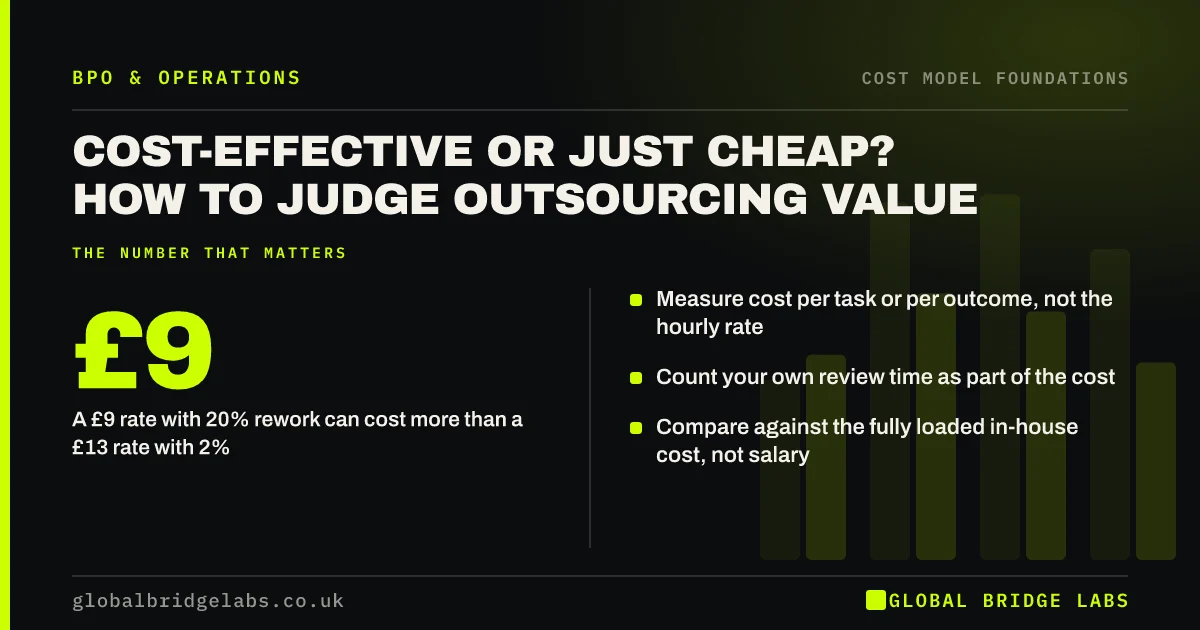
Cost the make option at the fully loaded rate: salary, employer National Insurance at 15% above £5,000, pension, holiday, recruitment, training, equipment and management. Cost the buy option at the provider price plus setup, your oversight and exit terms. Compare both over three years so one-off costs are spread fairly.
Want both options costed over three years? Send the details on WhatsApp.
Chat on WhatsApp →What does a worked example look like?
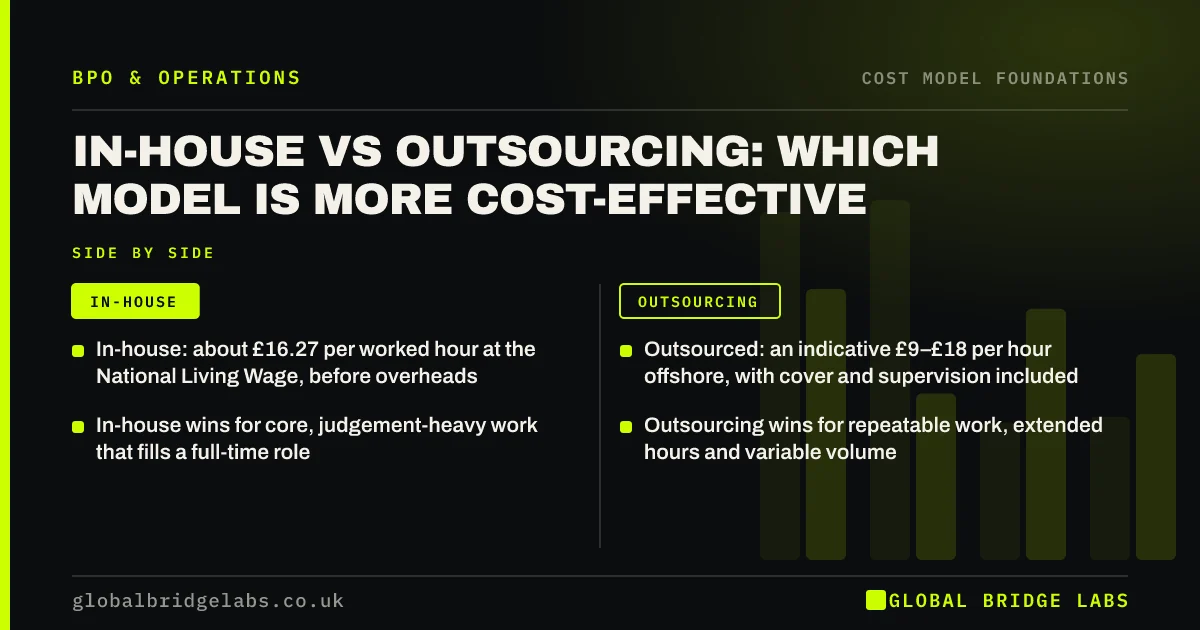
An SME needs first-line customer support for 50 hours a week. Make: two part-time hires at a combined £40,000 salary cost about £45,300 a year after employer costs, plus about £4,000 in overheads and a recruitment cost each time someone leaves. Buy: 50 hours at an indicative £12 per hour is about £31,200 a year, with cover included.
Over three years, make costs about £148,000 and buy about £94,000 plus setup. Buy wins on cost; make wins only if support is a key differentiator.
When should you make rather than buy?
Make when the work is your competitive edge, when it needs judgement built over years, when volume keeps a team fully busy, or when no provider can meet the standard. Also make when the knowledge involved is so sensitive or specific that writing it down for someone else would be risky or impractical.
When should you buy rather than make?
Buy when the work is standard across businesses, can be documented and measured, fluctuates in volume, or needs cover you cannot staff economically. Buying also makes sense for skills you need occasionally but cannot justify full-time.
Is there a middle option?
Yes. Co-sourcing keeps a small internal team working alongside a provider, and a hybrid model keeps core work in-house while buying the volume. These options give control and cost savings together, and let you move the balance over time.
What mistakes skew a make or buy decision?
Most poor make or buy decisions come from comparing incomplete numbers or from treating a strategic question as a purchasing one. Checking for these mistakes takes minutes and often changes the answer.
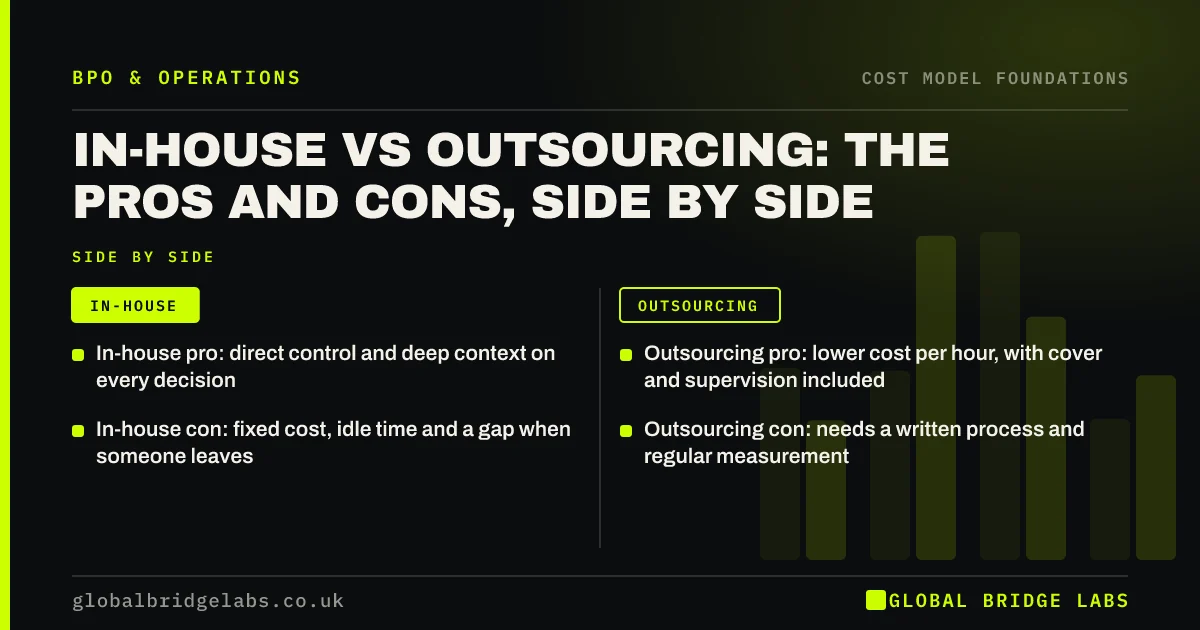
- Comparing salary with a provider price, ignoring employer costs and overheads.
- Ignoring idle time in the make option.
- Ignoring your own oversight time in the buy option.
- Buying work that is actually your competitive advantage.
- Deciding once and never reviewing as volumes change.
What does this look like in practice?
A pattern we see in UK trades businesses: the owner makes quotes and surveys in-house, because pricing judgement is the business, and buys call answering, booking and invoice chasing. The make or buy line sits exactly where judgement stops and process starts.
Make or buy checklist
Work through these for each function.
- Rate strategic importance from low to high.
- Cost the make option fully loaded over 3 years.
- Cost the buy option with setup, oversight and exit.
- Check capability and quality on both sides.
- Assess the risk if the person or provider fails.
- Decide, then review after 6 months.
Next step
Tell us the function you are deciding on. We will cost make and buy side by side over three years in a 30-minute call.
Message us on WhatsApp for a make or buy costing, or book a 30-minute consultation.
Chat on WhatsApp →Sources and further reading
- The Sourcing and Consultancy Playbooks · Cabinet Office
- Rates and thresholds for employers 2026 to 2027 · HM Revenue & Customs
- Workplace pensions: what you, your employer and the government pay · GOV.UK
Frequently asked questions
What factors affect a make or buy decision?
Strategic importance, full cost on both sides, internal capability, volume and risk. For services, also consider how easily the work can be documented and measured, how often volume changes, and what it would cost to exit either choice if the business changes direction later.
Is make or buy the same as in-house vs outsourcing?
In services, largely yes. Make means doing the work in-house with your own employees; buy means outsourcing it to a provider. The make or buy framing is useful because it forces a full cost comparison and a strategic view of the function, not just a price check on a quote.
Over what period should a make or buy decision be costed?
Three years is a sensible period for SMEs. It spreads one-off costs such as recruitment, setup and training fairly, and captures likely turnover on the in-house side and a contract renewal on the outsourced side. Shorter periods tend to flatter whichever option has lower start-up costs.
Who should be involved in a make or buy decision?
The owner or director accountable for the function, the manager who runs it day to day, and whoever holds the budget. Involve the people doing the work early, because they know the exceptions and volumes. Their input makes the cost comparison more accurate and the eventual change smoother.
Written by

Global Bridge Labs (GBL) is a UK–Sri Lanka partner for social media, websites and BPO. Everything here comes from client delivery, not theory.