On this page
- 01Key takeaways
- 02Which finance processes are commonly outsourced?
- 03Which customer processes are commonly outsourced?
- 04Which people, data and operations processes move?
- 05Why do these examples tend to work?
- 06What does this look like in practice?
- 07Use the examples: a checklist
- 08Next step
- 09Sources and further reading
- 10Frequently asked questions
Key takeaways
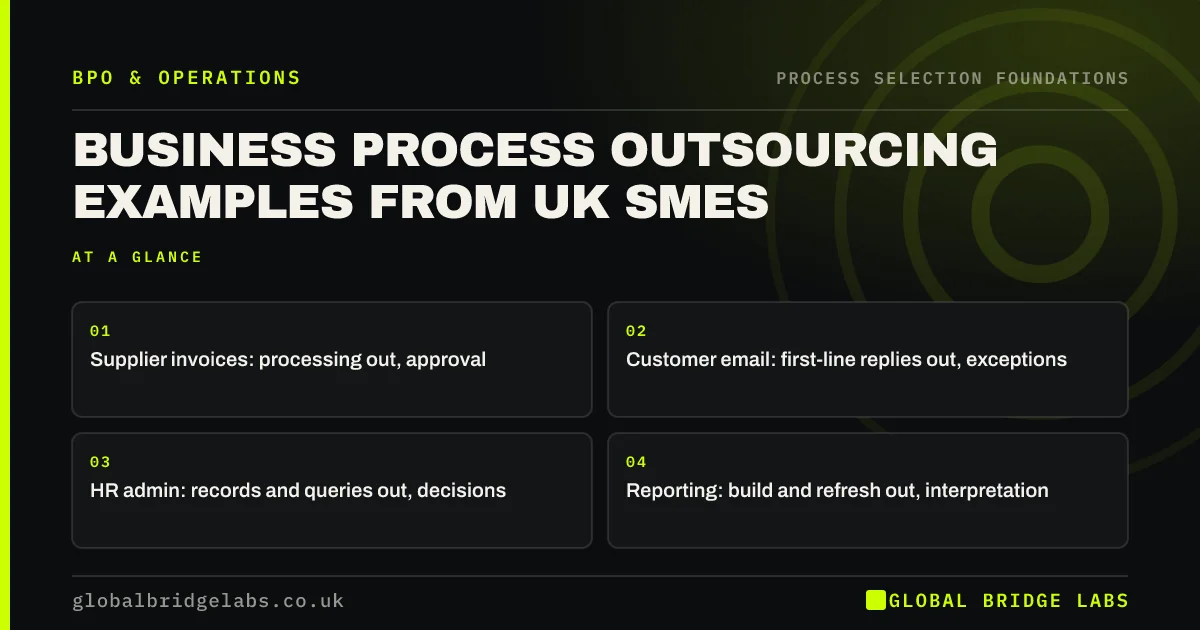
These business process outsourcing examples show the processes UK SMEs hand over most often and how they are split. In each case the routine, rule-based stages move to a managed team and the decisions stay with the business. The examples are patterns, not case studies, and the right split for your firm depends on volume and risk.
- Supplier invoices: processing out, approval in.
- Customer email: first-line replies out, exceptions in.
- HR admin: records and queries out, decisions in.
- Reporting: build and refresh out, interpretation in.
Want to know which of these fits your business? Message us on WhatsApp.
Chat on WhatsApp →Which finance processes are commonly outsourced?
Supplier invoice processing, billing, reconciliations and payment run preparation are the most common. The provider receives, checks, codes and matches documents and prepares payments; an owner or finance lead approves them. These work because the rules are clear and the output can be checked line by line.
Which customer processes are commonly outsourced?
First-line email and chat, order queries, complaint logging and routine replies, renewal reminders and satisfaction surveys. The provider answers within agreed times using approved responses; anything outside the rules escalates to your team. These work when you have a knowledge base and a clear escalation path.
Which people, data and operations processes move?
HR helpdesk queries, absence recording, employee records and pension admin are common people examples. On the data side, data quality checks, report refreshes and CRM upkeep. In operations, procurement admin, document control and maintenance scheduling. Each has a steady trigger, a written method and an output someone can check.
- People: HR queries, absence admin, records, pension admin.
- Data: quality checks, report refreshes, CRM upkeep.
- Operations: purchase orders, document control, maintenance bookings.
Why do these examples tend to work?
They share four features: steady volume, written rules, a measurable output and a natural decision point that can stay in-house. When one of those is missing, the same process often fails. A complaint process with no escalation rules, for example, sends every case back to the owner and saves nothing.
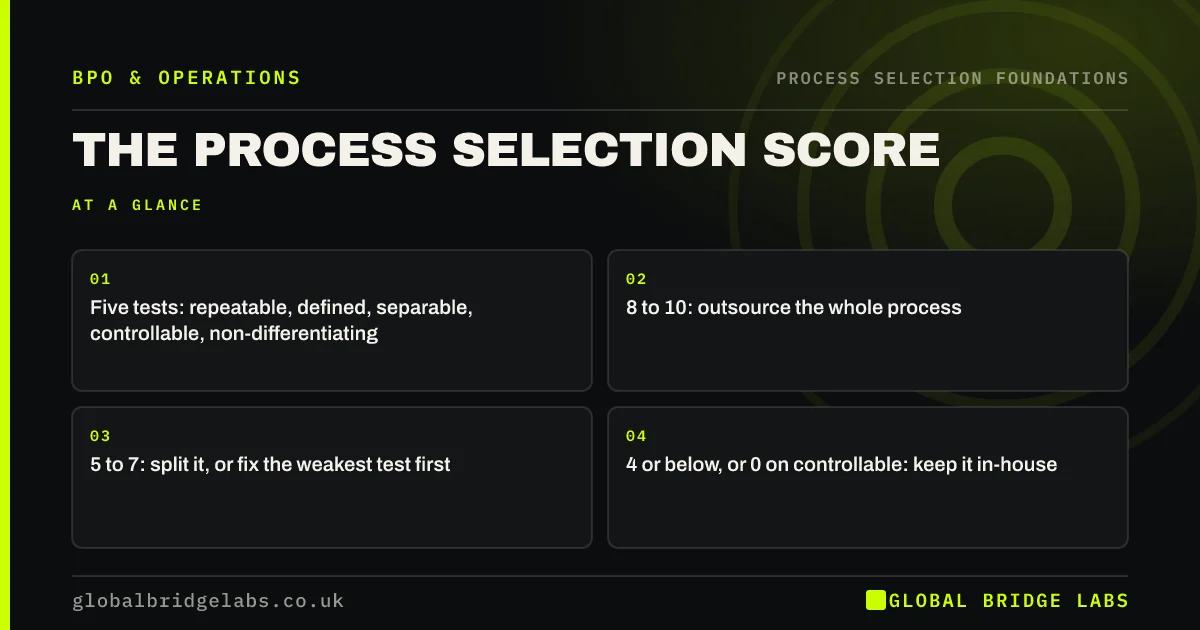
- The process selection score: outsource, split or keep?
- Can you measure it? The test every outsourced process needs
Want us to check one of your processes against these features? Message us on WhatsApp.
Chat on WhatsApp →What does this look like in practice?
A pattern we see: the first process a firm outsources is rarely the one that saves the most. It is the one that proves the method. The bigger saving usually comes from the second and third processes, once the review routine is working.
Use the examples: a checklist
Use these checks to compare your processes with the examples.
- Find the closest example to your process.
- Mark which stages are routine and which need judgement.
- Check you have written rules for the routine stages.
- Decide where the in-house decision point sits.
- Agree how the output will be checked.
Next step
Send us the process you think matches one of these examples. We will tell you how we would split it and what you would need to prepare.
Message us on WhatsApp, or book a 30-minute consultation.
Chat on WhatsApp →Sources and further reading
- Business population estimates for the UK and regions 2025 · Department for Business and Trade
- Contracts and liabilities between controllers and processors · Information Commissioner's Office
Frequently asked questions
What are examples of business process outsourcing?
Common examples include supplier invoice processing, billing, payroll, first-line customer service, complaint logging, HR admin, data entry and quality checks, report production, procurement admin and IT support. In each, the routine stages move to a provider while the business keeps approvals and decisions.
What processes do small businesses outsource most?
Finance processing and first-line customer service are the most common, followed by data upkeep, HR admin and IT support. These processes are rule-based, run in steady volume and produce outputs that can be checked, which makes them easier to hand over safely.
Are these examples suitable for every business?
No. They are common patterns, not a rule. Whether a process suits outsourcing depends on its volume, how well it is defined, how separable it is, the data and regulatory risk and whether it differentiates you. Score each process before deciding.
Written by

Global Bridge Labs (GBL) is a UK–Sri Lanka partner for social media, websites and BPO. Everything here comes from client delivery, not theory.