On this page
- 01Key takeaways
- 02What does the process selection score measure?
- 03How do you score each of the five tests?
- 04What does a worked score look like?
- 05How is this different from the other GBL scorecards?
- 06When should you not trust the score?
- 07What does this look like in practice?
- 08Process selection score checklist
- 09Next step
- 10Sources and further reading
- 11Frequently asked questions
Key takeaways
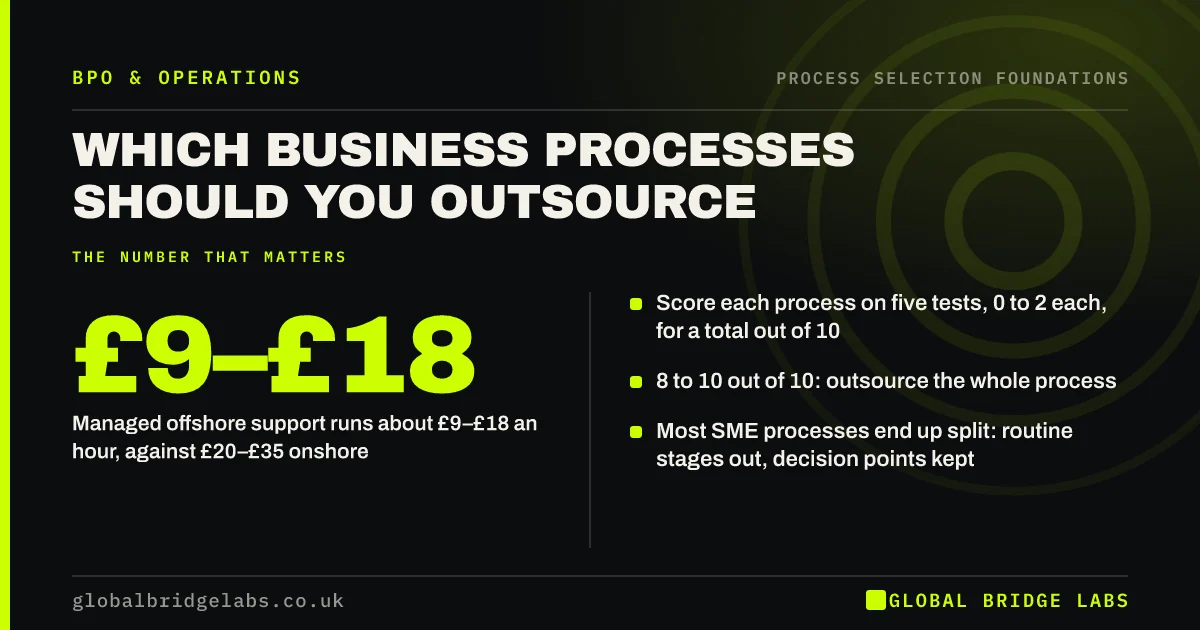
The GBL Process Selection Score is a process outsourcing assessment that rates one business process on five tests, each scored 0 to 2, for a total out of 10. It tells you whether to outsource the process whole, split it between your team and a provider, or keep it. Scoring one process takes about 15 minutes with the person who runs it.
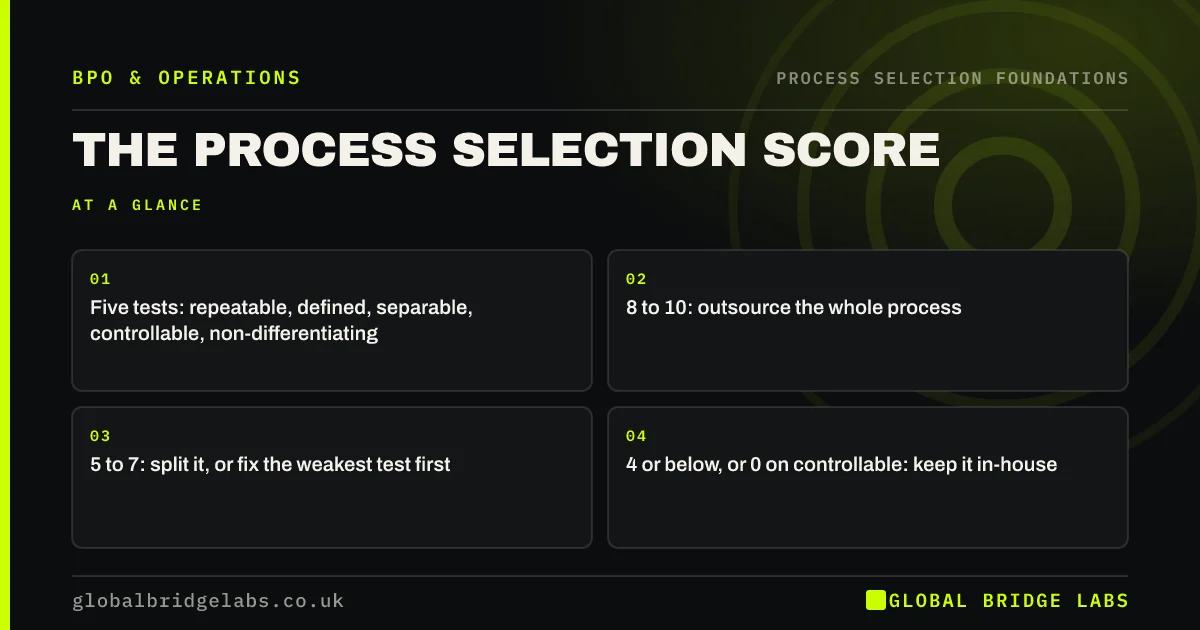
- Five tests: repeatable, defined, separable, controllable, non-differentiating.
- 8 to 10: outsource the whole process.
- 5 to 7: split it, or fix the weakest test first.
- 4 or below, or 0 on controllable: keep it in-house.
Want a second opinion on a score? Send us the process and your marks on WhatsApp.
Chat on WhatsApp →What does the process selection score measure?
The score measures how well a whole process will travel to a managed team, not whether outsourcing is worth it for your business in general. It looks at the process as a unit, from trigger to output, and asks whether someone outside your business could run it to a standard you can check, without dragging your team into every step.
How do you score each of the five tests?
Score each test 0, 1 or 2 with the person who runs the process today. Use the evidence you have, such as volumes, error logs and written steps, rather than impressions. When two people disagree, take the lower score.
- Repeatable: 0 if it runs a few times a month, 1 if weekly, 2 if daily or in steady volume.
- Defined: 0 if it lives in one head, 1 if partly written, 2 if written with rules and a quality check.
- Separable: 0 if it is tangled with other work, 1 if it has a few handoffs, 2 if it has a clean start and end.
- Controllable: 0 if the risk cannot be contained, 1 if it needs extra controls, 2 if access and contracts cover it.
- Non-differentiating: 0 if customers buy because of it, 1 if it shapes their experience, 2 if they never notice it.
What does a worked score look like?
In an illustrative example, a 20-person distributor scores three processes. Supplier payment runs score 2, 2, 1, 2, 2 for 9: outsource the preparation, keep the approval. Complaints handling scores 2, 1, 1, 1, 1 for 6: split it, so routine logging and replies move and resolution decisions stay. Pricing reviews score 0, 1, 1, 2, 0 for 4: keep them. These are example scores, not a benchmark for your business.
- Supplier payment runs: outsource the prep, keep approval
- Complaints handling: what to outsource and what to own
- Should you outsource pricing? Why the decision stays in-house
Want us to score your top three processes with you? Message us on WhatsApp.
Chat on WhatsApp →How is this different from the other GBL scorecards?
Each scorecard answers a different question. The outsourcing trigger scorecard asks whether your business needs to outsource now. The repetitive task fit score asks whether one small task is ready to hand over. The process selection score sits between them: once you know you will outsource, it tells you which whole processes to move and how to split them.
When should you not trust the score?
Treat the score as a guide, not a verdict, when the process is about to change, when one person scored it alone, or when a regulator or major customer has rules about who does the work. A high score on a process you are redesigning next quarter is a reason to wait, not to move.
What does this look like in practice?
A pattern we see: owners score their own processes higher on defined than the people who run them. Scoring with the person who does the work usually drops one or two processes from outsource to fix first, which saves a messy handover later.
Process selection score checklist
Use this list each time you score a process.
- Name the process by its trigger and output.
- Score it with the person who runs it.
- Use volumes and error logs as evidence.
- Take the lower score when people disagree.
- Apply the override for 0 on controllable.
- Write the verdict and the weakest test.
Next step
Score your three busiest processes and send us the marks. We will tell you which verdict we would reach and why, including where we think the score is too generous.
Message us on WhatsApp with your scores, or book a 30-minute consultation.
Chat on WhatsApp →Sources and further reading
- The Sourcing and Consultancy Playbooks · Cabinet Office
- The Green Book: appraisal and evaluation in central government · HM Treasury
Frequently asked questions
What are the five tests in the process selection score?
Repeatable (enough volume to stay practised), defined (written steps and a checkable output), separable (a clean start and end), controllable (data and regulatory risk can be contained) and non-differentiating (customers do not choose you because of it). Each is scored 0, 1 or 2.
What score means a process should be outsourced?
A total of 8 to 10 out of 10 suggests outsourcing the whole process. A total of 5 to 7 usually means split it, keeping the decision points in-house, or fix its weakest test first. A total of 4 or below, or any 0 on controllable, means keep it in-house for now.
Who should score a business process?
The person who runs the process day to day, with the owner or manager responsible for its results. Owners alone tend to overrate how well defined a process is. Use evidence such as volumes, error logs and written steps, and take the lower score when the two disagree.
Written by

Global Bridge Labs (GBL) is a UK–Sri Lanka partner for social media, websites and BPO. Everything here comes from client delivery, not theory.