On this page
- 01Key takeaways
- 02Which security processes can be outsourced?
- 03What must the owner keep?
- 04What is a sensible security baseline?
- 05When is managed security more than you need?
- 06What does this look like in practice?
- 07Managed security checklist
- 08Next step
- 09Sources and further reading
- 10Frequently asked questions
Key takeaways
Managed security services let a small business outsource the security processes it cannot staff: device management, patching, monitoring alerts, backup checks and user access. The owner still decides risk appetite, approves access and leads the response to a serious incident. Cyber Essentials is a sensible baseline for most UK SMEs.
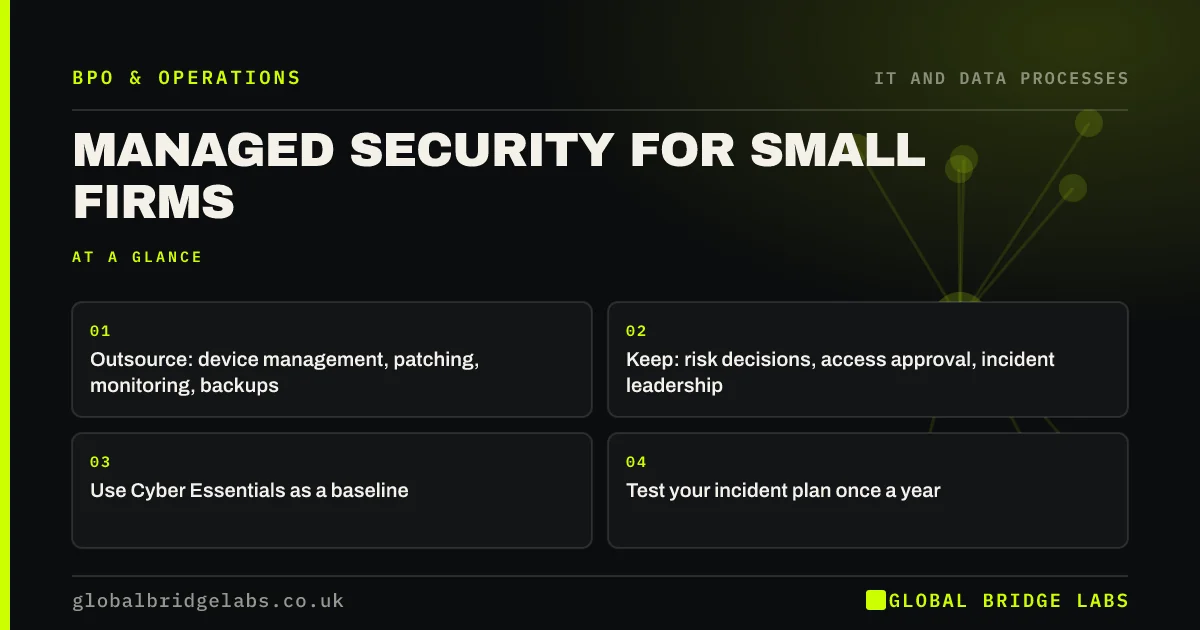
- Outsource: device management, patching, monitoring, backups.
- Keep: risk decisions, access approval, incident leadership.
- Use Cyber Essentials as a baseline.
- Test your incident plan once a year.
Want to know which security processes you could hand over? Message us on WhatsApp.
Chat on WhatsApp →Which security processes can be outsourced?
Routine, technical processes with clear standards: managing laptops and phones, applying updates, monitoring security alerts, checking backups, managing user accounts and multi-factor authentication, and running phishing awareness campaigns. These are where small firms fall behind because nobody owns them.
What must the owner keep?
Decisions about risk and access. Which data is most valuable, who should see what, how much to spend, and what to do in a serious incident, including whether to notify the ICO within 72 hours of becoming aware of a reportable breach. A provider advises; the business decides and remains accountable.
- Risk appetite and budget.
- Approval of access to sensitive data.
- Leading incident response.
- Breach notification decisions.
What is a sensible security baseline?
Cyber Essentials covers five controls: firewalls, secure configuration, user access control, malware protection and security update management. It is government-backed and certifiable, and some public sector contracts require it. The NCSC's guidance for small organisations covers the same ground in plain terms.
- Patch management: keep software updated without drama
- Backup checks: test restores before you need them
Want a Cyber Essentials readiness check? Message us on WhatsApp.
Chat on WhatsApp →When is managed security more than you need?
A very small business with a handful of devices and cloud apps may cover the basics itself with good settings, multi-factor authentication and automatic updates. Managed security pays off as devices, staff and data grow, or when customers ask for evidence of controls.
What does this look like in practice?
A pattern we see: small firms have security tools but nobody reads the alerts. Outsourcing the monitoring matters more than buying another tool.
Managed security checklist
Agree these with any provider.
- Which devices and accounts are covered.
- Patching and update timescales.
- Alert monitoring hours and response times.
- Backup checks and restore tests.
- Who approves new access.
- Incident plan and contact list.
Next step
Tell us how many staff and devices you have and how security is handled today. We will tell you which processes we would hand over first.
Message us on WhatsApp, or book a 30-minute consultation.
Chat on WhatsApp →Sources and further reading
- Cyber Essentials overview · National Cyber Security Centre
- Small organisations guide to cyber security · National Cyber Security Centre
- Cyber security breaches survey 2025/2026 · DSIT and Home Office
Frequently asked questions
What are managed security services for small businesses?
Managed security services are outsourced security processes such as device management, patching, alert monitoring, backup checks, user account management and awareness training. A provider runs them to agreed standards, while the business keeps decisions about risk, access and incident response.
Does a small business need Cyber Essentials?
It is not a legal requirement for most firms, but it is a sensible baseline and some public sector and supply chain contracts require it. Cyber Essentials covers firewalls, secure configuration, user access control, malware protection and security update management.
Who is responsible for security if it is outsourced?
The business remains responsible for protecting its data under UK GDPR, including deciding whether to report a breach to the ICO. The provider is responsible for delivering the services it has agreed to. Contracts should set out both clearly.
Written by

Global Bridge Labs (GBL) is a UK–Sri Lanka partner for social media, websites and BPO. Everything here comes from client delivery, not theory.