On this page
- 01Key takeaways
- 02What makes a customer vulnerable?
- 03What should the process tell an outsourced team to do?
- 04How should vulnerability be recorded?
- 05Which firms must follow FCA vulnerability guidance?
- 06What does this look like in practice?
- 07Vulnerable customer checklist
- 08Next step
- 09Sources and further reading
- 10Frequently asked questions
Key takeaways
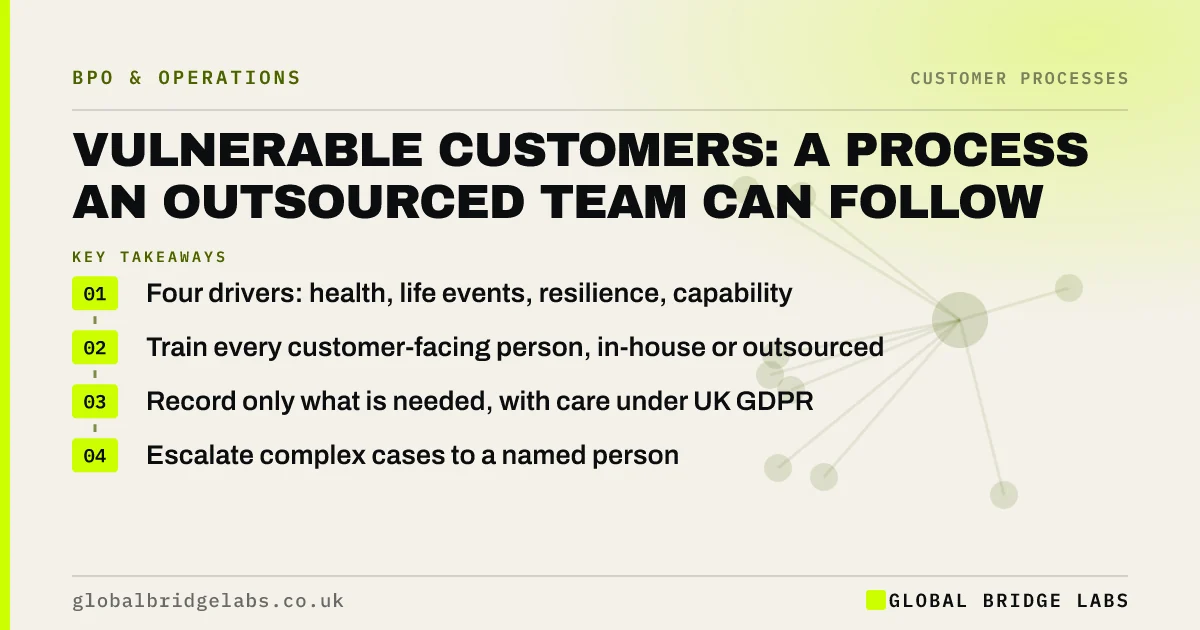
A vulnerable customer process tells everyone who speaks to customers, including an outsourced team, how to recognise vulnerability, what to adjust and when to escalate. FCA guidance FG21/1 groups the drivers of vulnerability into health, life events, resilience and capability. A provider can follow the process well; designing it and handling complex cases stays with you.
- Four drivers: health, life events, resilience, capability.
- Train every customer-facing person, in-house or outsourced.
- Record only what is needed, with care under UK GDPR.
- Escalate complex cases to a named person.
Want a vulnerable customer process your team can follow? Message us on WhatsApp.
Chat on WhatsApp →What makes a customer vulnerable?
The FCA defines a vulnerable customer as someone who, due to their personal circumstances, is especially susceptible to harm, particularly when a firm is not acting with appropriate care. Its guidance names four drivers: health conditions, life events such as bereavement or job loss, low resilience to financial or emotional shocks, and low capability such as limited literacy or digital skills. Vulnerability can be temporary.
What should the process tell an outsourced team to do?
Give the team clear steps: listen for signs, ask permission before recording anything about the customer's situation, make simple adjustments such as more time, a call back or a different channel, and escalate when the situation goes beyond those adjustments. Adjustments should be written down so every agent offers the same options.
- Listen for signs and do not assume.
- Ask permission before recording circumstances.
- Offer set adjustments: time, channel, call back.
- Escalate complex or urgent cases immediately.
How should vulnerability be recorded?
Health information is special category data under UK GDPR, so record only what is needed to help the customer, with their agreement where possible, and restrict who can see it. A short flag and the adjustment needed is often enough. Make sure your processor contract covers this data and that the outsourced team's access is limited.
Want help with recording rules for vulnerability? Message us on WhatsApp.
Chat on WhatsApp →Which firms must follow FCA vulnerability guidance?
FCA-regulated firms, under the Consumer Duty and FG21/1, must show they treat vulnerable customers fairly and get good outcomes for them. Firms in other sectors are not bound by FCA guidance, but it is a sound model, and consumer law and equality duties still apply. Regulated firms keep responsibility when the contact is outsourced.
What does this look like in practice?
A pattern we see: agents want to help but are unsure what they are allowed to offer. A written list of adjustments they can make without asking removes the hesitation and makes the experience consistent.
Vulnerable customer checklist
Put these in place for every customer-facing team.
- A written definition and the four drivers.
- A list of adjustments agents can offer.
- Recording rules agreed under UK GDPR.
- A named escalation contact.
- Training for in-house and outsourced staff.
- Quarterly review of outcomes.
Next step
Tell us how your team handles customers in difficult circumstances today. We will suggest a process an outsourced team could follow alongside yours.
Message us on WhatsApp, or book a 30-minute consultation.
Chat on WhatsApp →Sources and further reading
- FG21/1: Guidance for firms on the fair treatment of vulnerable customers · Financial Conduct Authority
- Consumer Duty · Financial Conduct Authority
- Special category data · Information Commissioner's Office
Frequently asked questions
What are the four drivers of customer vulnerability?
The FCA's guidance FG21/1 groups them as health (conditions affecting the ability to carry out day-to-day tasks), life events (such as bereavement, job loss or relationship breakdown), resilience (low ability to withstand financial or emotional shocks) and capability (such as low literacy or digital skills).
Can an outsourced team support vulnerable customers?
Yes, if it is trained and follows a clear process: recognising signs, asking permission before recording circumstances, offering set adjustments and escalating complex cases to a named person. The business remains responsible for the outcomes, especially in FCA-regulated sectors.
How should information about a customer's vulnerability be stored?
Record only what is needed to help the customer, with their agreement where possible, and restrict who can see it. Health details are special category data under UK GDPR, so a short flag and the adjustment needed is often better than detailed notes.
Written by

Global Bridge Labs (GBL) is a UK–Sri Lanka partner for social media, websites and BPO. Everything here comes from client delivery, not theory.