On this page
- 01Key takeaways
- 02What is a differentiating process?
- 03How do you run the differentiation test?
- 04Why keep differentiating processes in-house?
- 05When can a differentiating process still be outsourced?
- 06What does this look like in practice?
- 07Differentiation checklist
- 08Next step
- 09Sources and further reading
- 10Frequently asked questions
Key takeaways
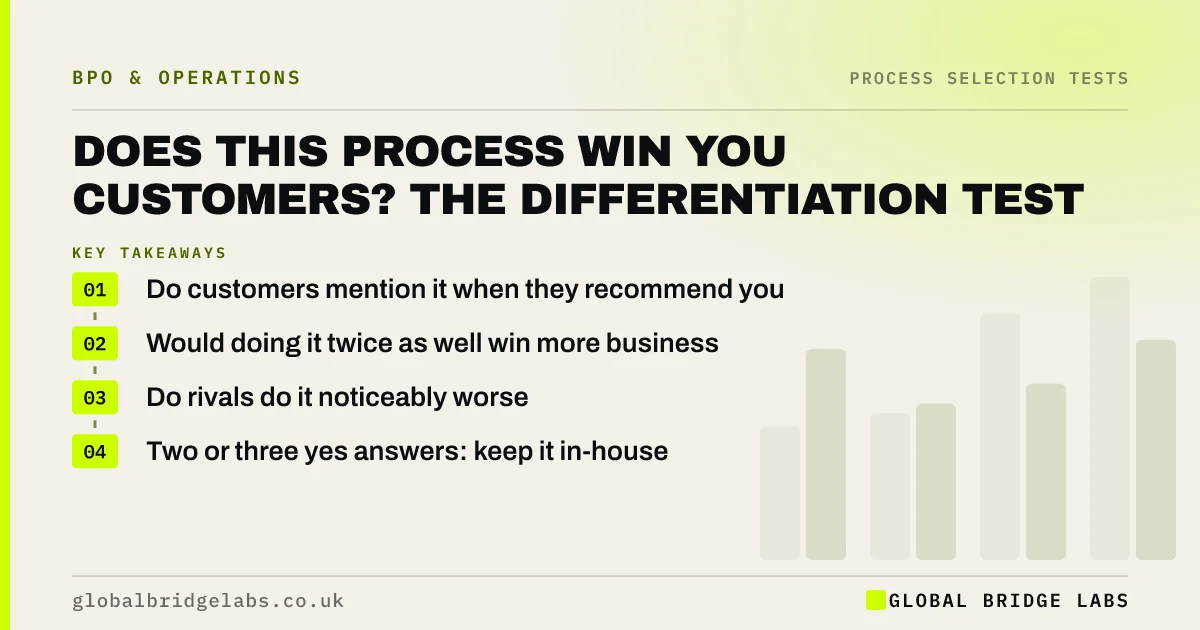
Which processes create competitive advantage? Usually only two or three in an SME: the ones customers mention when they explain why they chose you. The differentiation test asks three questions of each process. If it passes, keep it and invest in it. If it fails, it is a candidate to outsource, however important it feels.
- Do customers mention it when they recommend you?
- Would doing it twice as well win more business?
- Do rivals do it noticeably worse?
- Two or three yes answers: keep it in-house.
Want help finding your differentiating processes? Message us on WhatsApp.
Chat on WhatsApp →What is a differentiating process?
A differentiating process is one where your way of doing it is part of why customers buy from you. A builder's site supervision, a clinic's first appointment, a distributor's same-day dispatch. Most other processes, such as paying suppliers or recording absence, matter but do not win customers. Customers expect them done properly and never think about them.
How do you run the differentiation test?
Ask three questions of each process, using evidence such as reviews, win and loss reasons, and what customers say on calls. Do customers mention it? Would doing it twice as well win more business? Do rivals do it noticeably worse? Two or three yes answers mark a differentiating process.
- Read your last 20 reviews for process mentions.
- List why you won and lost recent deals.
- Ask three customers what nearly made them leave.
Why keep differentiating processes in-house?
Because a provider will run them to the standard you specify, and your advantage comes from doing better than the standard. You also need to keep learning in these processes, which is hard when someone else does the work. Outsource the admin around them instead, so your best people spend more time on the part that wins customers.
- Outsourcing to focus on your core business: what changes
- Skilled staff stuck doing admin? What it costs you
Want to free your best people for the work that wins customers? Message us on WhatsApp.
Chat on WhatsApp →When can a differentiating process still be outsourced?
When the advantage comes from speed or availability rather than expertise. A firm that wins on answering every call within three rings may run that better with a managed team that covers every hour. The test is whether a provider can deliver your advantage to a written standard you can check.
What does this look like in practice?
A pattern we see: owners think five or six processes differentiate them. Reviews usually mention two. The others are important but invisible to customers, which makes them candidates to move.
Differentiation checklist
Use evidence, not instinct, for each answer.
- Search reviews for mentions of the process.
- Check win and loss reasons for the last quarter.
- Ask customers what they value most.
- Score the process 0, 1 or 2 on non-differentiating.
- Record the evidence beside the score.
Next step
Run the test on your five busiest processes and send us the results. We will tell you which we would keep and which look like admin dressed up as advantage.
Message us on WhatsApp, or book a 30-minute consultation.
Chat on WhatsApp →Sources and further reading
- Stop trying to delight your customers (Dixon, Freeman and Toman, 2010) · Harvard Business Review
- The Sourcing and Consultancy Playbooks · Cabinet Office
Frequently asked questions
How do you know which processes give a competitive advantage?
Look for evidence. A process gives an advantage if customers mention it when recommending you, if doing it much better would win more business, and if rivals do it noticeably worse. Reviews, win and loss reasons and customer conversations are the best sources of that evidence.
Should you ever outsource a process that differentiates you?
Rarely the whole of it. If the advantage comes from expertise, keep it and outsource the admin around it. If it comes from speed or availability, such as always answering quickly, a managed team working to a written standard may deliver it better than a small in-house team.
Are most business processes differentiating?
No. In most SMEs only two or three processes are why customers choose them. The rest, such as paying suppliers, recording absence or processing orders, matter and must be done well, but customers expect them and rarely notice them. These are the usual candidates to outsource.
Written by

Global Bridge Labs (GBL) is a UK–Sri Lanka partner for social media, websites and BPO. Everything here comes from client delivery, not theory.