On this page
- 01Key takeaways
- 02How do you identify critical business processes?
- 03Can you outsource a critical process?
- 04What extra controls does a critical process need?
- 05When should criticality keep a process in-house?
- 06What does this look like in practice?
- 07Criticality checklist
- 08Next step
- 09Sources and further reading
- 10Frequently asked questions
Key takeaways
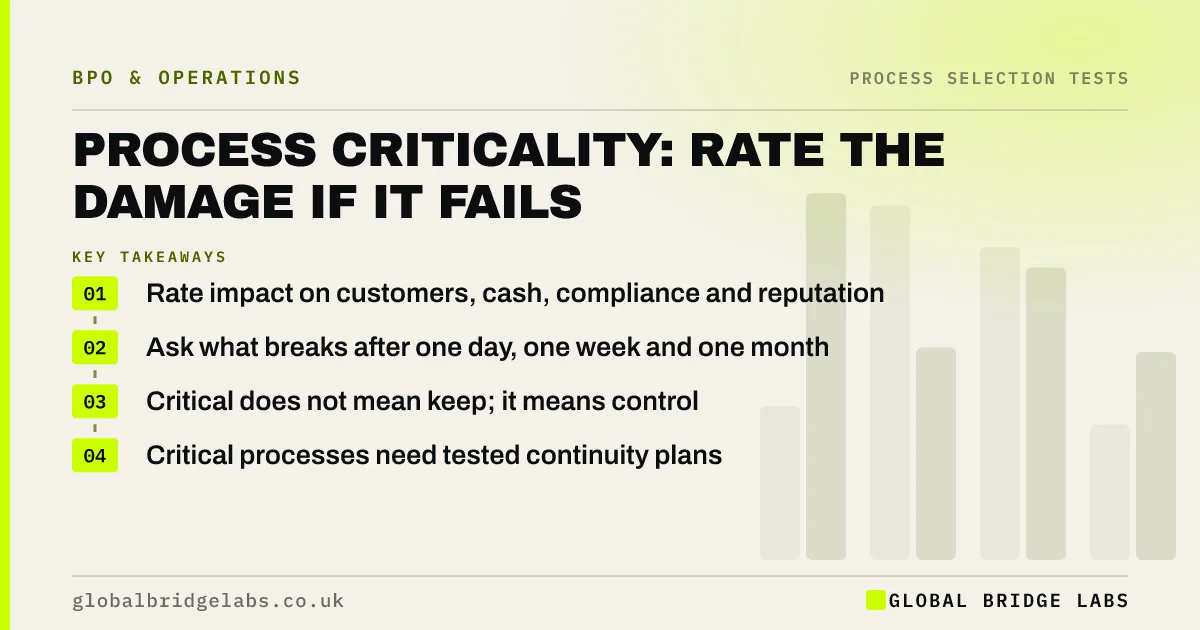
A process criticality assessment rates how much damage a process would cause if it failed for a day, a week or a month. Critical processes can still be outsourced, but they need tighter controls, tested continuity plans and a provider you can audit. Criticality is about the impact of failure, not how important the process feels.
- Rate impact on customers, cash, compliance and reputation.
- Ask what breaks after one day, one week and one month.
- Critical does not mean keep; it means control.
- Critical processes need tested continuity plans.
Want help rating the criticality of your processes? Message us on WhatsApp.
Chat on WhatsApp →How do you identify critical business processes?
For each process, ask what would happen if it stopped for one day, one week and one month. Rate the impact on customers, cash, legal compliance and reputation as low, medium or high. A process that causes high impact within a week is critical. Payroll, customer payments and regulated reporting are usually critical; filing and internal reports rarely are.
- Customers: would they notice, and leave?
- Cash: would money stop arriving or go out wrongly?
- Compliance: would you miss a legal deadline?
- Reputation: would it become public?
Can you outsource a critical process?
Yes. Many firms outsource payroll and payments precisely because a specialist runs them more reliably. The FCA's SYSC 8 rules, for example, allow regulated firms to outsource critical or important functions, provided the firm keeps responsibility and the ability to oversee them. The same principle suits any SME: outsource the work, keep the oversight.
What extra controls does a critical process need?
A critical process needs more than a standard service agreement. Agree a recovery time, test the provider's continuity plan, keep the method and data accessible to you, and review output more often. Keep the final approval step in-house where money or legal filings are involved.
- Agreed recovery time if the provider has an outage.
- A continuity plan you have seen tested.
- Your own copy of the method and data.
- Weekly sampling, not monthly.
- Final approval kept in-house.
Want a control list for one critical process? Message us on WhatsApp.
Chat on WhatsApp →When should criticality keep a process in-house?
When you cannot get the controls above, or when failure would be irreversible and the provider cannot show a track record in that process. A critical process with no written method also stays until it is documented, because you cannot oversee what you cannot describe.
What does this look like in practice?
A pattern we see: owners rate almost everything as critical at first. Asking what breaks after one day rather than one month usually leaves three or four genuinely critical processes, which makes the control work manageable.
Criticality checklist
Record these for each process.
- Impact after one day, one week and one month.
- Which of customers, cash, compliance, reputation is hit.
- A criticality rating: low, medium or high.
- For high: recovery time and continuity test date.
- Who approves output before it goes out.
Next step
Rate your top ten processes for criticality and send us the ones you marked high. We will tell you what controls each would need if outsourced.
Message us on WhatsApp, or book a 30-minute consultation.
Chat on WhatsApp →Sources and further reading
- FCA Handbook SYSC 8: Outsourcing · Financial Conduct Authority
- Small organisations guide to cyber security · National Cyber Security Centre
Frequently asked questions
What makes a business process critical?
A process is critical when its failure would cause serious harm to customers, cash, legal compliance or reputation within a short time, typically a week or less. Payroll, customer payments, supplier payments and regulated filings are common examples in UK SMEs.
Should critical processes be outsourced?
They can be, with stronger controls: an agreed recovery time, a tested continuity plan, your own copy of the method and data, frequent sampling and final approval kept in-house. Many firms outsource payroll for exactly this reason, because a specialist runs it more reliably.
How often should process criticality be reviewed?
Once a year, and whenever the business changes significantly, for example after taking on a large customer, entering a regulated activity or changing a core system. A process that was low impact can become critical as volumes or obligations grow.
Written by

Global Bridge Labs (GBL) is a UK–Sri Lanka partner for social media, websites and BPO. Everything here comes from client delivery, not theory.