On this page
- 01Key takeaways
- 02How do you define the output of a process?
- 03Which measures should every outsourced process have?
- 04What if quality is hard to measure?
- 05When does measurement say keep the process?
- 06What does this look like in practice?
- 07Measurement checklist
- 08Next step
- 09Sources and further reading
- 10Frequently asked questions
Key takeaways
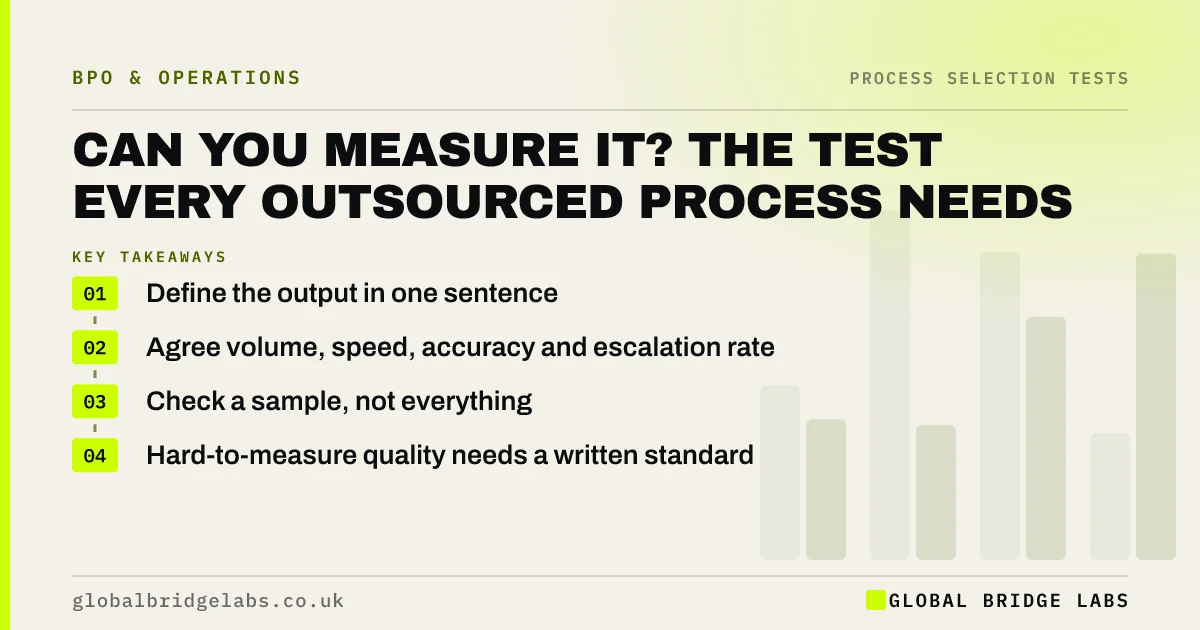
Measurable process outputs are the single best predictor of whether outsourcing a process will work. If you cannot say what a good output looks like and check it, you cannot hold anyone to it. Agree four measures for every outsourced process: volume, speed, accuracy and the rate of escalations.
- Define the output in one sentence.
- Agree volume, speed, accuracy and escalation rate.
- Check a sample, not everything.
- Hard-to-measure quality needs a written standard.
Want help defining measures for a process? Message us on WhatsApp.
Chat on WhatsApp →How do you define the output of a process?
Write it as a finished result someone else can check: a supplier invoice coded, matched and queued for payment within two working days. Avoid activity words such as handle or manage. If you cannot write the sentence, the process is not ready to outsource, because the provider would be guessing what you want.
Which measures should every outsourced process have?
Four measures cover most processes. Agree a target and how it is calculated for each before go-live, and review them weekly for the first month.
- Volume: items completed per day or week.
- Speed: time from trigger to output.
- Accuracy: share of items right first time.
- Escalations: share of items sent back to you.
What if quality is hard to measure?
Some outputs, such as a customer reply or a proposal draft, cannot be marked right or wrong. Write a short quality standard with four or five checks, such as correct facts, approved tone and a clear next step, and score a sample each week. Agreement between two reviewers on the same sample tells you whether the standard is clear enough.
Want an example quality standard for your process? Message us on WhatsApp.
Chat on WhatsApp →When does measurement say keep the process?
When the only measure that matters is a long-term outcome, such as whether a strategy works or a client renews in two years, and no near-term output tells you whether the work was done well. These processes are hard to hold anyone to, and usually stay in-house.
What does this look like in practice?
A pattern we see: agreeing the escalation rate early is what keeps an outsourced process honest. A rising rate shows the provider is sending back work it should handle, long before accuracy falls.
Measurement checklist
Agree these before go-live.
- The output in one sentence.
- Targets for volume, speed and accuracy.
- The escalation rate you expect.
- How each measure is calculated.
- Sample size and frequency for checks.
Next step
Write the one-sentence output for your candidate process and send it to us. We will suggest the four measures and targets we would start with.
Message us on WhatsApp, or book a 30-minute consultation.
Chat on WhatsApp →Sources and further reading
- The Sourcing and Consultancy Playbooks · Cabinet Office
- Stop trying to delight your customers (Dixon, Freeman and Toman, 2010) · Harvard Business Review
Frequently asked questions
Why do outsourced processes need measurable outputs?
Because you cannot hold a provider to a standard you cannot describe or check. Measurable outputs let both sides agree what good looks like, spot problems early and review performance on facts rather than impressions. Processes without them tend to drift and cause disputes.
What should you measure in an outsourced process?
Start with four measures: volume completed, speed from trigger to output, accuracy or right-first-time rate, and the share of items escalated back to you. Agree targets and calculation methods before go-live, and review them weekly for the first month.
How do you measure quality that is subjective?
Write a short quality standard with four or five specific checks, such as correct facts, approved tone and a clear next step. Score a weekly sample against it. If two reviewers score the same sample differently, tighten the standard until they agree.
Written by

Global Bridge Labs (GBL) is a UK–Sri Lanka partner for social media, websites and BPO. Everything here comes from client delivery, not theory.