On this page
- 01Key takeaways
- 02What does the Acas Code require?
- 03Which parts of the process can be supported?
- 04Why does the decision stay with the employer?
- 05What data and confidentiality rules apply?
- 06What does this look like in practice?
- 07Disciplinary process checklist
- 08Next step
- 09Sources and further reading
- 10Frequently asked questions
Key takeaways
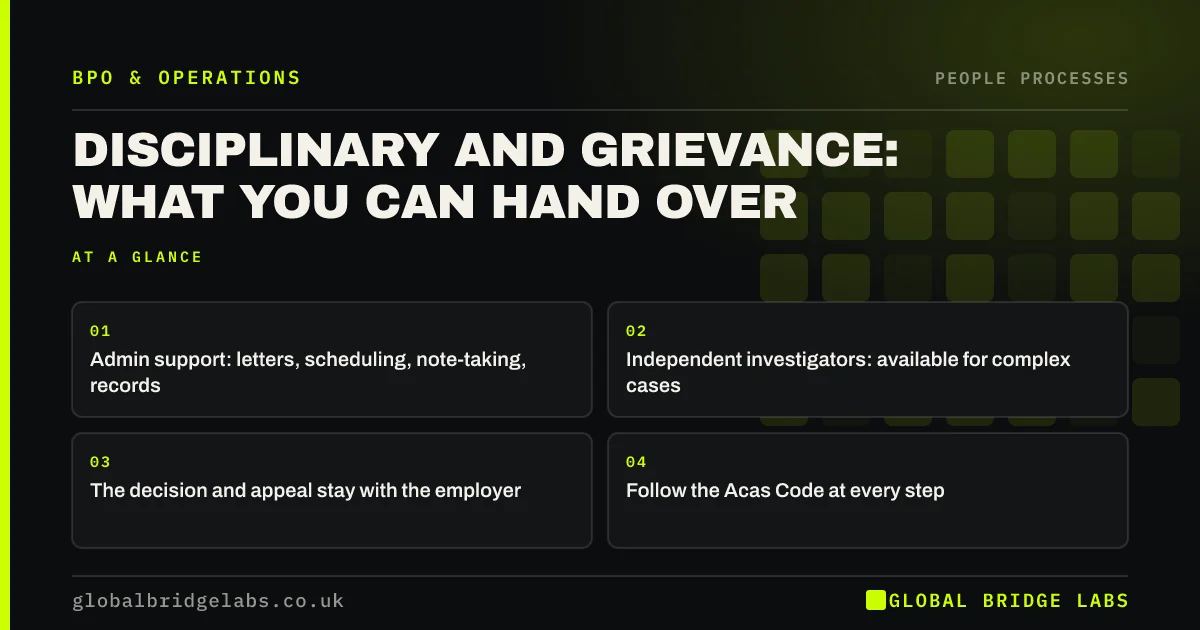
You can outsource parts of a disciplinary process, but not the decision. The Acas Code of Practice expects a fair process: investigation, notice, a hearing with the right to be accompanied, a decision and an appeal. Tribunals can adjust awards by up to 25% where the Code is unreasonably ignored. Admin can move; independent investigations can be bought in; outcomes stay with the employer.
- Admin support: letters, scheduling, note-taking, records.
- Independent investigators: available for complex cases.
- The decision and appeal stay with the employer.
- Follow the Acas Code at every step.
Facing a disciplinary or grievance? Message us on WhatsApp about admin support.
Chat on WhatsApp →What does the Acas Code require?
Establish the facts through investigation, tell the employee the problem in writing, hold a meeting where they can respond, allow them to be accompanied by a colleague or union representative, decide on appropriate action, and offer an appeal. Grievances follow a similar pattern. The Code applies to employers of every size.
Which parts of the process can be supported?
The admin: preparing letters from approved templates, scheduling meetings, booking rooms or calls, taking notes, collating evidence and keeping a complete record. Some employers also use independent HR consultants to investigate, particularly where managers are involved or the case is complex. A general managed team should support admin, not investigate.
- Letters from approved templates.
- Scheduling and arrangements.
- Note-taking at meetings.
- Evidence collation and records.
Why does the decision stay with the employer?
Because the employer is legally responsible for the outcome and must show it acted reasonably on the evidence. A decision made by an outside party is harder to defend and weakens the appeal stage. Keep the hearing, the decision and the appeal with appropriate managers, taking advice where needed.
Want template letters checked against the Acas Code? Message us on WhatsApp.
Chat on WhatsApp →What data and confidentiality rules apply?
Disciplinary and grievance records contain sensitive personal data and sometimes criminal offence data. Limit access to those involved, store records securely, and keep them only as long as your policy says. Anyone supporting the process must be under a confidentiality agreement and a processor contract.
What does this look like in practice?
A pattern we see: small employers lose cases on process rather than substance, such as a missing letter or no offer of an appeal. Structured admin support makes the right steps happen in the right order.
Disciplinary process checklist
Confirm each step is recorded.
- Investigation carried out and documented.
- Allegations set out in writing.
- Hearing offered with reasonable notice.
- Right to be accompanied explained.
- Decision given in writing with reasons.
- Appeal offered and heard by someone else.
Next step
Tell us what disciplinary and grievance support you have today. We will tell you which admin we could handle and where you should take specialist HR advice.
Message us on WhatsApp, or book a 30-minute consultation.
Chat on WhatsApp →Sources and further reading
- Discipline and grievance · Acas
- Employment information · Information Commissioner's Office
Frequently asked questions
Can a disciplinary process be outsourced?
Parts of it. Admin such as letters, scheduling, note-taking and record-keeping can be supported, and independent HR consultants can carry out investigations in complex cases. The disciplinary decision and the appeal should stay with the employer, who is legally responsible for the outcome.
What happens if an employer does not follow the Acas Code?
Employment tribunals can increase or reduce compensation by up to 25% where an employer or employee has unreasonably failed to follow the Acas Code of Practice on disciplinary and grievance procedures. Following the Code also makes dismissals easier to defend as fair.
Who can accompany an employee to a disciplinary hearing?
Workers have a statutory right to be accompanied by a fellow worker, a trade union representative or an official employed by a trade union at disciplinary and grievance hearings. Employers can allow others, such as a family member, if their own policy permits.
Written by

Global Bridge Labs (GBL) is a UK–Sri Lanka partner for social media, websites and BPO. Everything here comes from client delivery, not theory.