On this page
- 01Key takeaways
- 02Which finance and customer processes do most firms run?
- 03Which sales, marketing and people processes are common?
- 04Which IT, data and operations processes belong on the list?
- 05How do you use the list to find gaps?
- 06What does this look like in practice?
- 07Business process list checklist
- 08Next step
- 09Sources and further reading
- 10Frequently asked questions
Key takeaways
This list of business processes covers the 30 that most UK small firms run, grouped into six areas: finance, customer, sales and marketing, people, IT and data, and operations. Use it to check which processes you have, which have no owner, and which might be candidates to outsource.
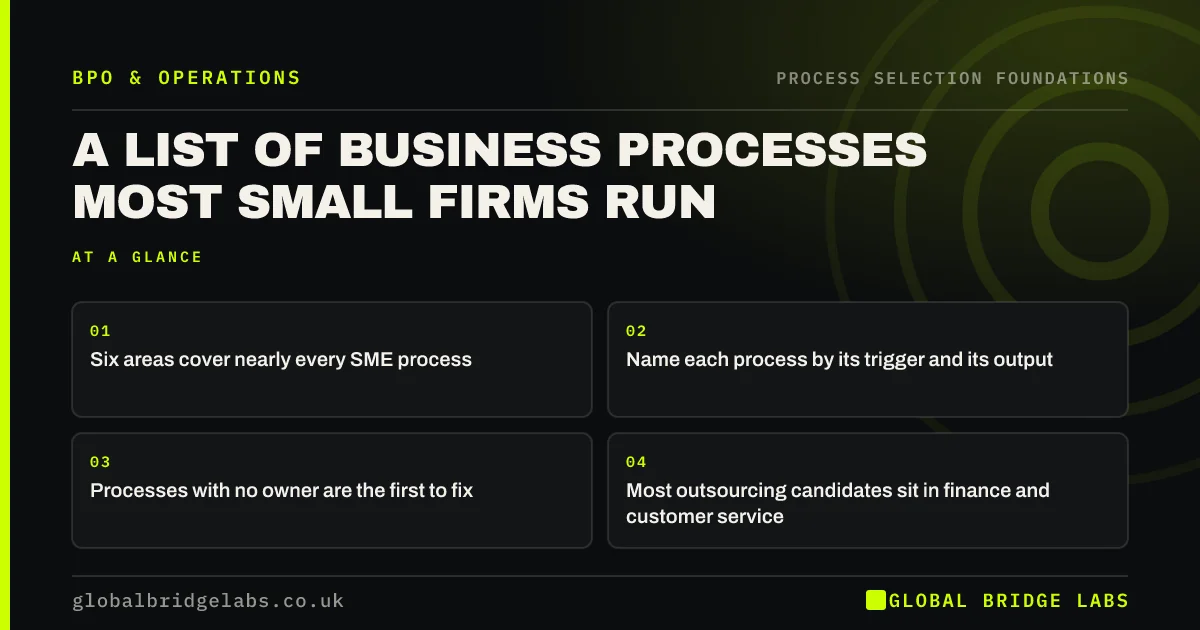
- Six areas cover nearly every SME process.
- Name each process by its trigger and its output.
- Processes with no owner are the first to fix.
- Most outsourcing candidates sit in finance and customer service.
Want this list as a spreadsheet you can score? Message us on WhatsApp.
Chat on WhatsApp →Which finance and customer processes do most firms run?
Finance and customer processes are the most common and usually the most outsourceable, because they run on steady triggers and produce outputs you can check.
- Finance: purchase to pay, billing, cash allocation, payroll, month-end close, VAT returns, budgeting, forecasting.
- Customer: enquiry to response, complaint to resolution, order query handling, renewals, feedback and surveys.
Which sales, marketing and people processes are common?
Sales, marketing and people processes mix routine work with judgement. The production and admin parts travel well; the decisions usually stay.
- Sales and marketing: lead to qualified opportunity, quote to order, proposal production, campaign delivery, reporting.
- People: hire to first day, absence recording, pay changes, pension enrolment, performance reviews, leavers.
Which IT, data and operations processes belong on the list?
These are the processes small firms often run by accident, because nobody was hired to own them. They are easy to forget until something fails.
- IT and data: joiners and leavers access, patching, backups, licence tracking, data quality, reporting.
- Operations: buying, supplier reviews, stock planning, document control, compliance checks, maintenance scheduling.
How do you use the list to find gaps?
Go through the list with your team and mark each process as owned, shared or orphaned. Orphaned processes, with no named owner, cause most of the surprises: missed renewals, failed backups, late returns. Next, note the weekly hours for each owned process. The processes with high hours and a clear output are where outsourcing conversations start.
- A business process register: map every process once
- The process owner: who keeps an outsourced process healthy
Want help marking up the list for your business? Message us on WhatsApp.
Chat on WhatsApp →What does this look like in practice?
A pattern we see: in firms of 10 to 30 people, four or five processes on this list have no owner at all. IT patching, licence renewals and supplier reviews are the usual orphans.
Business process list checklist
Run through these checks once a year.
- Mark every process as owned, shared or orphaned.
- Give each orphan an owner this month.
- Record weekly hours for each owned process.
- Note which processes cross more than two people.
- Flag high-hours processes for scoring.
Next step
Mark up the list for your business and send us the five processes with the most hours. We will tell you which ones are worth scoring for outsourcing first.
Message us on WhatsApp, or book a 30-minute consultation.
Chat on WhatsApp →Sources and further reading
- Business population estimates for the UK and regions 2025 · Department for Business and Trade
- Labour productivity · Office for National Statistics
Frequently asked questions
What are the main business processes in a small company?
The main business processes fall into six areas: finance (purchase to pay, billing, payroll, month-end), customer (enquiries, complaints, renewals), sales and marketing (leads, quotes, campaigns), people (hiring, absence, pensions), IT and data (access, backups, reporting) and operations (buying, stock, compliance).
How should business processes be named?
Name each process by its trigger and output, for example purchase to pay or complaint to resolution. This makes the start and end points clear, which avoids two people describing the same process differently and makes it easier to measure and hand over.
Which business processes are usually outsourced first?
Finance processing and first-line customer service are the most common first choices, because they run in steady volume, follow clear rules and produce outputs that can be checked. Data upkeep and HR admin often follow once the first process is running well.
Written by

Global Bridge Labs (GBL) is a UK–Sri Lanka partner for social media, websites and BPO. Everything here comes from client delivery, not theory.