On this page
- 01Key takeaways
- 02What are the signs you outsourced the wrong process?
- 03Is it the process, the split or the provider?
- 04How do you fix a bad split?
- 05How do you bring a process back in-house?
- 06What does this look like in practice?
- 07Review checklist
- 08Next step
- 09Sources and further reading
- 10Frequently asked questions
Key takeaways
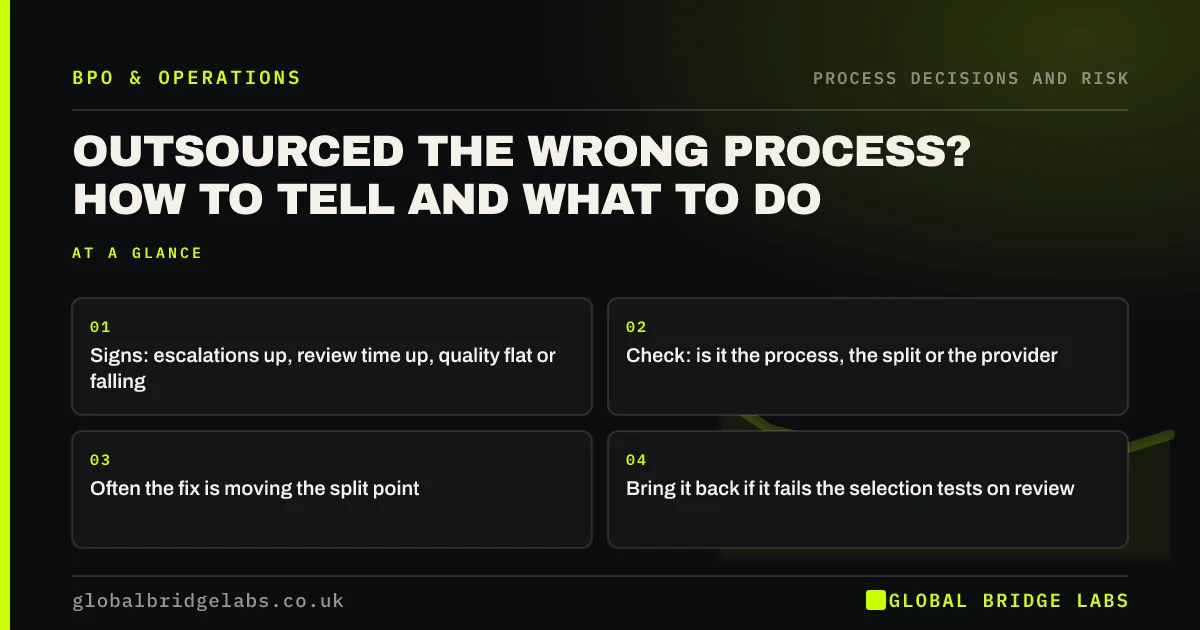
If you have outsourced the wrong process, the signs are rising escalations, falling quality you cannot fix with better instructions, and your own review time going up rather than down. First check whether the problem is the process, the split or the provider. Many failing processes recover by moving the split point; some should come back in-house.
- Signs: escalations up, review time up, quality flat or falling.
- Check: is it the process, the split or the provider?
- Often the fix is moving the split point.
- Bring it back if it fails the selection tests on review.
Worried an outsourced process is not working? Message us on WhatsApp.
Chat on WhatsApp →What are the signs you outsourced the wrong process?
Escalations to your team keep rising, quality stays below target despite clearer instructions, your review time grows instead of shrinking, and customers or colleagues route around the provider. After 90 days, any of these deserves a proper look.
- Escalation rate rising after month two.
- Quality below target despite better guidance.
- Your review time increasing.
- People working around the provider.
Is it the process, the split or the provider?
Re-score the process with what you now know. If it fails on variability, differentiation or controllability, the process was the wrong choice. If it scores well but work bounces back at one point, the split is wrong. If both look right but quality is poor, the provider may be the issue, and switching may solve it.
How do you fix a bad split?
Look at where escalations come from. If most come from one step, move that step back in-house, or move the split so the provider stops before it. Rewrite the rules for that step if the issue is clarity. Measure escalations again after four weeks.
- Outsource, split, fix or keep: four process verdicts
- Decision tables: turn judgement calls into clear rules
Want help finding where your split is failing? Message us on WhatsApp.
Chat on WhatsApp →How do you bring a process back in-house?
Plan it like any handover: notice under the contract, return of data and documentation, a period of parallel running and a named in-house owner. Check whether TUPE could apply in reverse if provider staff mainly worked on your process. A clean exit clause makes this much easier.
What does this look like in practice?
A pattern we see: a process judged a failure is rescued by moving one judgement step back in-house. Bringing the whole process back would have thrown away the routine work that was going well.
Review checklist
Work through these before deciding.
- Escalation and quality trends since go-live.
- Your review time trend.
- Re-score on all five tests.
- Where escalations originate.
- Contract exit terms.
- Decision: re-split, switch or bring back.
Next step
Tell us which outsourced process is not working and what you are seeing. We will give you an honest view on whether to re-split, switch or bring it back.
Message us on WhatsApp, or book a 30-minute consultation.
Chat on WhatsApp →Sources and further reading
- Business transfers, takeovers and TUPE · GOV.UK
- Contracts and liabilities between controllers and processors · Information Commissioner's Office
Frequently asked questions
How do you know if outsourcing a process has failed?
Look for rising escalations to your team after the first two months, quality below target despite clearer instructions, your own review time increasing, and colleagues or customers working around the provider. Review these trends at 90 days.
Should you bring a failing outsourced process back in-house?
Only after checking whether the problem is the process, the split or the provider. Many failing processes recover by moving the split point or switching provider. Bring it back if a fresh score shows the process does not suit outsourcing.
How do you bring outsourced work back in-house?
Give notice under the contract, arrange return of data and documentation, run old and new arrangements in parallel for a period, and name an in-house owner. Check whether TUPE could apply to provider staff who mainly worked on your process.
Written by

Global Bridge Labs (GBL) is a UK–Sri Lanka partner for social media, websites and BPO. Everything here comes from client delivery, not theory.