On this page
Key takeaways
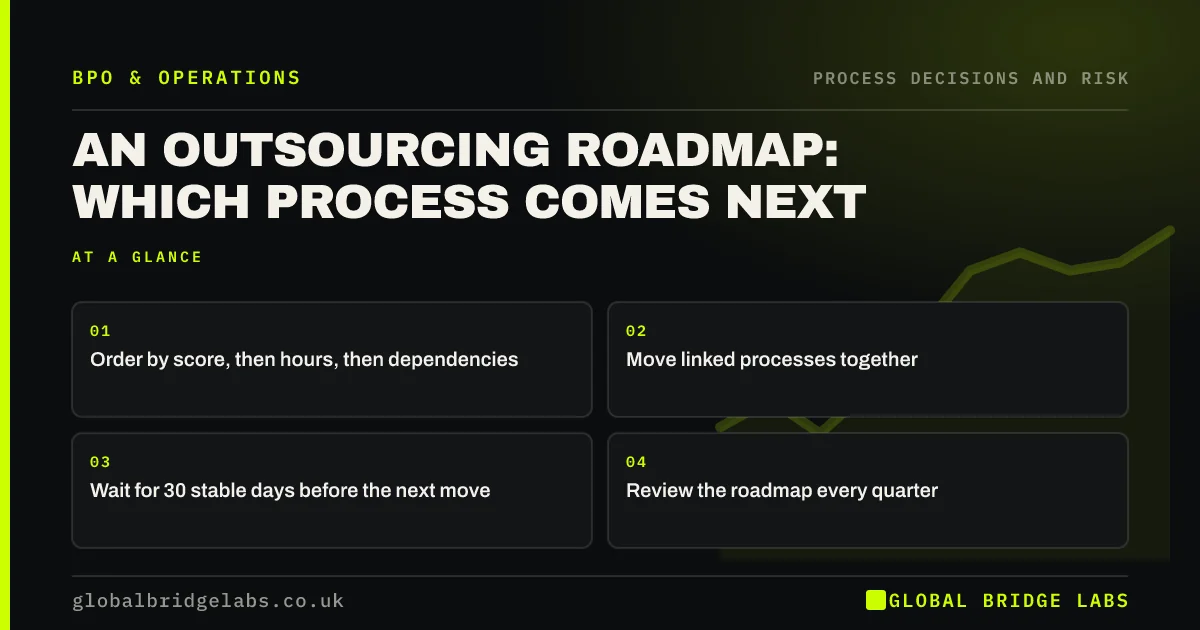
An outsourcing roadmap sets the order in which processes move after the first one, and the pace. Sequence by score, hours and dependencies: high-scoring, high-hours processes first, linked processes together, and fix-first processes once they are ready. Move one process at a time, with at least 30 days of stable running before the next.
- Order by score, then hours, then dependencies.
- Move linked processes together.
- Wait for 30 stable days before the next move.
- Review the roadmap every quarter.
Want a roadmap drafted from your process list? Message us on WhatsApp.
Chat on WhatsApp →How do you order processes on a roadmap?
Start from your scored process register. Put processes scoring 8 or more first, highest weekly hours first among them. Group linked processes so they move together. Place fix-first processes after their fix date. Keep processes with heavy dependencies on in-house work until the processes around them are stable.
- Score 8 to 10, by hours.
- Linked processes grouped.
- Fix-first processes after their fix.
- Heavily dependent processes last.
How fast should you move processes?
One at a time, with each running stably for at least 30 days before the next starts. Stable means measures on target and your review time falling. Moving faster spreads your attention across several handovers at once, which is when quality slips unnoticed.
When should the roadmap pause?
Pause when a moved process misses its measures for two weeks running, when your review time is rising rather than falling, or when the business itself is changing, such as a new system or a restructure. Fix the current process before adding the next.
- Outsourced the wrong process? How to tell and what to do
- Quality drift: why outsourced routine work slips over time
Want a check on whether you are ready for the next process? Message us on WhatsApp.
Chat on WhatsApp →How often should the roadmap change?
Review it every quarter. Volumes, rules and priorities change, and processes kept in-house last year may score differently now. Adding a process is a decision, not an automatic next step.
What does this look like in practice?
A pattern we see: after a good first process, owners want to move five more at once. Firms that keep to one at a time usually end up outsourcing more in a year, because nothing has to be pulled back.
Roadmap checklist
Keep these on the roadmap.
- Each process with its score and hours.
- Planned move month.
- Linked processes grouped.
- Readiness conditions for fix-first items.
- Stability test before each move.
- Quarterly review date.
Next step
Send us your scored process list. We will suggest an order and a pace that fits your team's capacity to manage the change.
Message us on WhatsApp, or book a 30-minute consultation.
Chat on WhatsApp →Sources and further reading
- The Sourcing and Consultancy Playbooks · Cabinet Office
- The Green Book: appraisal and evaluation in central government · HM Treasury
Frequently asked questions
What is an outsourcing roadmap?
An outsourcing roadmap is a plan showing which processes a business will hand over, in what order and when, with the conditions each must meet before it moves. It turns a list of candidates into a sequence the business can manage.
How many processes should you outsource at once?
One at a time for most SMEs, or two tightly linked processes together. Let each run stably for at least 30 days, with measures on target and your review time falling, before starting the next.
How do you decide which process to outsource next?
Take the highest-scoring process on your register, preferring those with the most weekly hours. Move linked processes together, wait for fix-first processes to be ready, and leave heavily dependent processes until the work around them is stable.
Written by

Global Bridge Labs (GBL) is a UK–Sri Lanka partner for social media, websites and BPO. Everything here comes from client delivery, not theory.