On this page
Key takeaways
A good subscription renewal process starts well before the renewal date: a reminder, a check that the customer is getting value, and an easy path to renew or cancel. The reminders, calls and admin outsource well. Renewal pricing, retention offers above a limit and at-risk key accounts stay with you. Consumer subscription rules are tightening, so check current guidance.
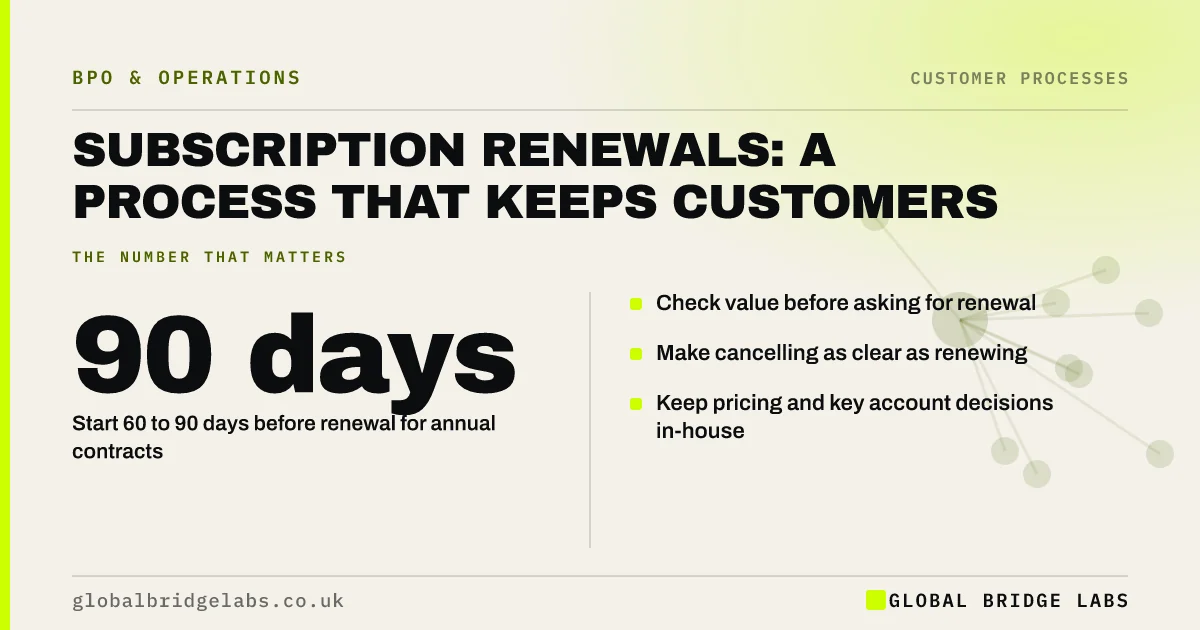
- Start 60 to 90 days before renewal for annual contracts.
- Check value before asking for renewal.
- Make cancelling as clear as renewing.
- Keep pricing and key account decisions in-house.
Want a renewal timetable for your contracts? Message us on WhatsApp.
Chat on WhatsApp →What does a renewal process include?
A renewal list pulled monthly, reminders at set points, a check-in call or email asking whether the service is working, handling of renewals, upgrades and cancellations, and updating billing. For annual contracts, starting 60 to 90 days out gives time to fix problems before the customer decides.
Which renewal work can be outsourced?
Pulling the list, sending reminders, making check-in calls to a script, logging concerns, processing straightforward renewals and cancellations, and updating records. These are routine and time-bound, so they suit a team with set hours for them. Concerns that suggest a customer is at risk escalate to your team with notes.
What consumer rules apply to renewals?
For consumers, renewal terms must be clear and fair, and cancelling should not be harder than signing up. The Digital Markets, Competition and Consumers Act 2024 brings in specific rules for subscription contracts, including reminder notices and easy exit, which are being phased in. Check the current commencement position before you change your process.
Want your renewal process checked against current rules? Message us on WhatsApp.
Chat on WhatsApp →What should stay in-house?
Renewal pricing, discounts or retention offers above a set limit, and conversations with your largest customers. These affect revenue directly and often need negotiation. The provider prepares the account history so your team goes into the conversation informed.
What does this look like in practice?
A pattern we see: customers who cancel at renewal often had a problem months earlier that nobody heard about. A check-in call 60 days out catches many of those while there is still time to fix them.
Renewal process checklist
Run these for every renewal cycle.
- Pull renewals due in the next 90 days.
- Send reminders at agreed points.
- Make a value check-in before asking to renew.
- Escalate at-risk accounts with notes.
- Process renewals and cancellations promptly.
- Update billing the same day.
Next step
Tell us how many renewals you handle a month and how you manage them today. We will suggest a timetable and say what we would run for you.
Message us on WhatsApp, or book a 30-minute consultation.
Chat on WhatsApp →Sources and further reading
- Digital Markets, Competition and Consumers Act 2024 · legislation.gov.uk
- Consumer Rights Act 2015 · legislation.gov.uk
Frequently asked questions
When should renewal reminders be sent?
For annual contracts, start 60 to 90 days before renewal with a value check-in, followed by a reminder about 30 days out and a final notice shortly before. Monthly subscriptions need lighter-touch reminders. Consumer contracts may also carry legal notice requirements, so check current rules.
Can subscription renewals be outsourced?
Yes. Pulling renewal lists, sending reminders, making check-in calls, processing straightforward renewals and cancellations and updating billing are routine tasks. Keep renewal pricing, retention offers above a limit and your largest accounts with your own team.
How do you reduce cancellations at renewal?
Check that customers are getting value well before renewal, fix problems they raise, and make the renewal easy. Customers who cancel often had an unresolved issue months earlier. A check-in 60 days out finds those issues while there is still time to act.
Written by

Global Bridge Labs (GBL) is a UK–Sri Lanka partner for social media, websites and BPO. Everything here comes from client delivery, not theory.