On this page
- 01Key takeaways
- 02What causes variation in business processes?
- 03How do you measure process variation?
- 04How do you reduce variability before outsourcing?
- 05When is high variability a reason to keep a process?
- 06What does this look like in practice?
- 07Variability checklist
- 08Next step
- 09Sources and further reading
- 10Frequently asked questions
Key takeaways
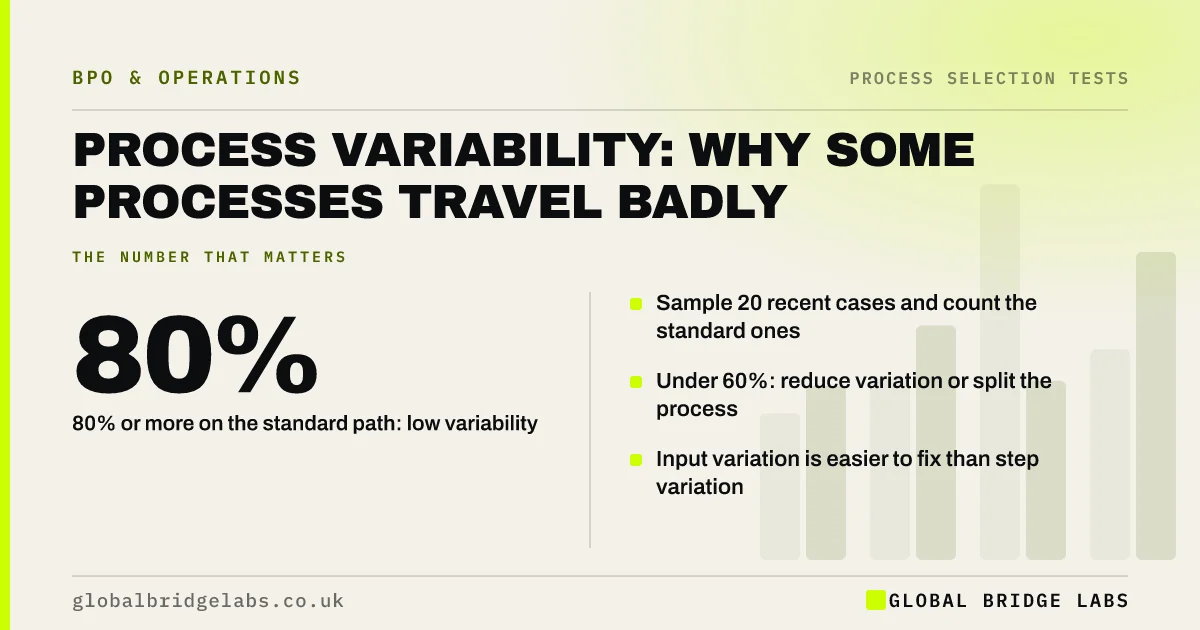
Process variability is how much the inputs, steps or outputs of a process differ from one case to the next. Low-variability processes, where most cases follow the same path, outsource well. High-variability processes, where each case needs a fresh judgement, travel badly. Measure it by sampling 20 recent cases and counting how many followed the standard path.
- Sample 20 recent cases and count the standard ones.
- 80% or more on the standard path: low variability.
- Under 60%: reduce variation or split the process.
- Input variation is easier to fix than step variation.
Want help sampling a process for variability? Message us on WhatsApp.
Chat on WhatsApp →What causes variation in business processes?
Three sources: inputs, steps and outputs. Input variation is when the work arrives in different forms, such as invoices by post, email and portal. Step variation is when people do the work differently. Output variation is when customers or managers want different results. Input and step variation can usually be reduced; output variation often reflects genuine choice.
How do you measure process variation?
Take 20 recent cases and trace each through the process. Mark whether it followed the standard path or needed something different, and why. If 16 or more followed the standard path, variability is low. If fewer than 12 did, the process needs work before it travels well.
- Pick 20 recent cases at random.
- Trace each from trigger to output.
- Mark standard or non-standard.
- Note the reason for each exception.
How do you reduce variability before outsourcing?
Standardise inputs first, with one intake route and a template or form. Then agree one method for the steps, and write rules for the common exceptions. The cases that remain unusual become escalations to your team. Reducing variation also cuts errors, because people make more mistakes on cases that look slightly different.
- Work request intake: one form for every routine job
- Decision tables: turn judgement calls into clear rules
- Human error in repetitive tasks: why good people slip
Want a second view on which variation to remove? Message us on WhatsApp with your sample.
Chat on WhatsApp →When is high variability a reason to keep a process?
When the variation is the value. Bespoke quotes, complex complaints and specialist advice vary because each customer's situation does. Forcing them into a standard path would harm the result. Keep these in-house, or outsource only the routine preparation around them.
What does this look like in practice?
A pattern we see: most of a process's variation comes from two or three input sources. Fixing the intake removes half the exceptions before any step changes.
Variability checklist
Run these checks on each candidate process.
- Sample 20 cases and count the standard path.
- List the top three causes of exceptions.
- Standardise how work arrives.
- Agree one method for the steps.
- Write rules for common exceptions.
- Decide which cases escalate to you.
Next step
Sample 20 cases from your candidate process and send us the reasons for any exceptions. We will tell you which variation to remove and whether the process is ready to move.
Message us on WhatsApp, or book a 30-minute consultation.
Chat on WhatsApp →Sources and further reading
- Labour productivity · Office for National Statistics
- Human factors: managing human failures · Health and Safety Executive
Frequently asked questions
What is process variability?
Process variability is how much the inputs, steps or outputs of a process change from case to case. A low-variability process handles most cases the same way, which suits outsourcing. A high-variability process needs frequent judgement, which makes it harder to hand over without splitting it.
How do you reduce variation in a process?
Standardise how work arrives, using one intake route and a template. Agree one method for the steps and write rules for the common exceptions. Route the genuinely unusual cases to a named person. This lowers errors as well as making the process easier to outsource.
Can high-variability processes be outsourced?
Often only in part. The routine preparation, data gathering and admin around a high-variability process can move, while the judgement stays in-house. If the variation reflects genuine customer need, such as bespoke advice, keep the core of the process with your team.
Written by

Global Bridge Labs (GBL) is a UK–Sri Lanka partner for social media, websites and BPO. Everything here comes from client delivery, not theory.