On this page
- 01Key takeaways
- 02What are the parts of a business process?
- 03How is a process different from a task or a procedure?
- 04What are examples of business processes in a small firm?
- 05Why does an undefined process cost money?
- 06What does this look like in practice?
- 07Define a process in six steps
- 08Next step
- 09Sources and further reading
- 10Frequently asked questions
Key takeaways
What is a business process? It is a repeatable sequence of steps with a trigger, an owner and an output, that turns an input into something a customer or the business needs. Paying suppliers, onboarding a new client and closing the month are processes. Knowing your processes is the starting point for improving, automating or outsourcing any of them.
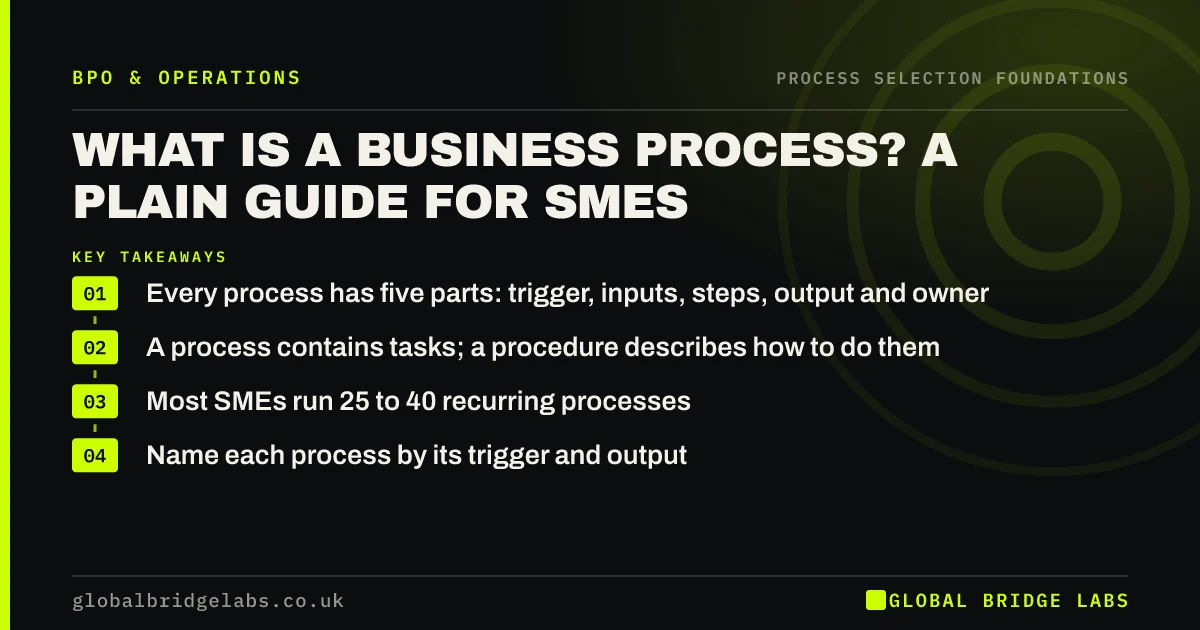
- Every process has five parts: trigger, inputs, steps, output and owner.
- A process contains tasks; a procedure describes how to do them.
- Most SMEs run 25 to 40 recurring processes.
- Name each process by its trigger and output.
Want help listing your business processes? Message us on WhatsApp.
Chat on WhatsApp →What are the parts of a business process?
Every business process has five parts. If you cannot name all five, the process is not yet clear enough to improve or hand over.
- Trigger: the event that starts it, such as an invoice arriving.
- Inputs: the information or materials it needs.
- Steps: the work done, in order, including checks.
- Output: the result, such as a supplier paid on time.
- Owner: the person accountable for the output.
How is a process different from a task or a procedure?
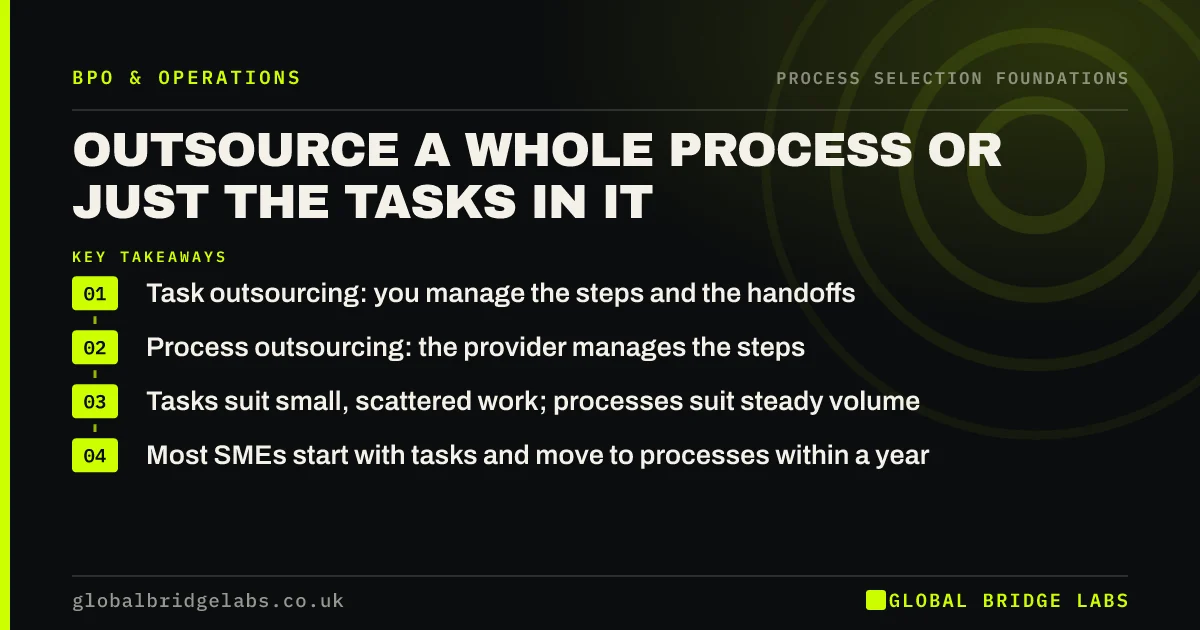
A task is one step inside a process, such as approving an invoice. A procedure, or standard operating procedure, is the written description of how to do the steps. A process is the whole sequence from trigger to output. The distinction matters because you outsource tasks with instructions but a process with an outcome you can measure.
What are examples of business processes in a small firm?
Examples include quote to order, order to cash, purchase to pay, hire to first day, enquiry to booking, complaint to resolution and month-end close. Each crosses more than one person or system and runs on a predictable trigger. A small firm of 15 people typically runs all of these, often without having written any of them down.
Why does an undefined process cost money?
Undefined processes depend on whoever happens to know them, so they slow down when that person is busy and stop when they leave. They also hide rework, because nobody can see where errors start. Defining a process does not need software: a one-page note of trigger, steps, output and owner is enough to begin.
Want a one-page template for defining a process? Message us on WhatsApp and we will send it.
Chat on WhatsApp →What does this look like in practice?
A pattern we see: when a team names its processes for the first time, two people often describe the same process with different start and end points. Agreeing the trigger and the output is usually the most useful ten minutes of the exercise.
Define a process in six steps
Use these steps for each process you want to understand.
- Name it by trigger and output.
- List the inputs it needs.
- Write the steps in order, including checks.
- Name one owner.
- Record how often it runs and how long it takes.
- Note where it hands off to other processes.
Next step
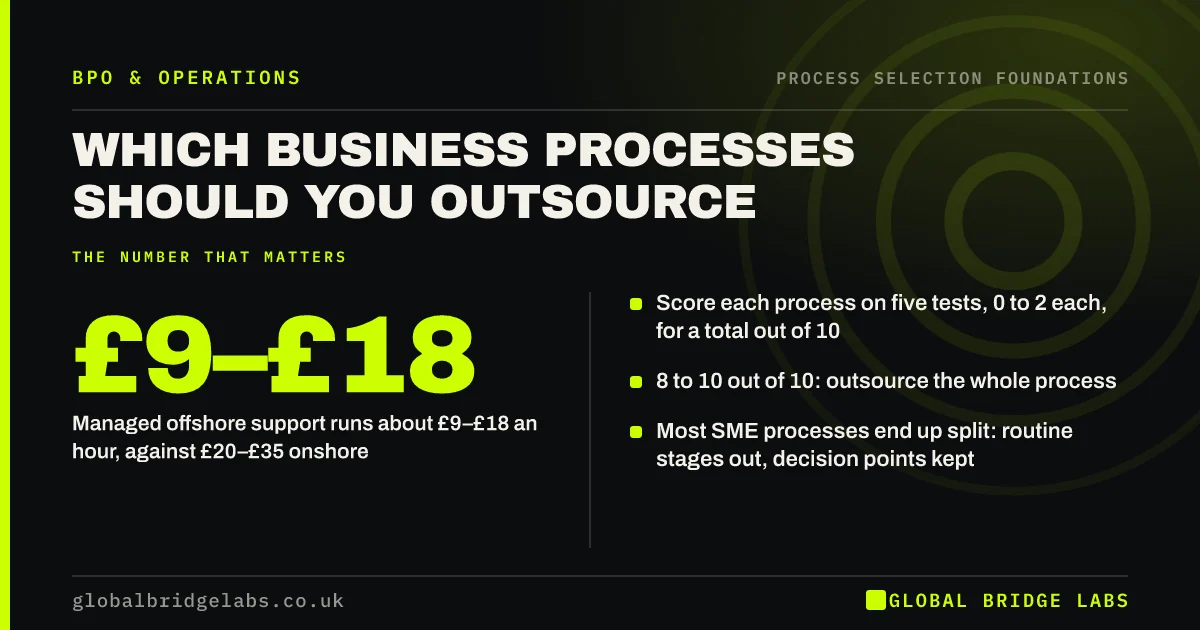
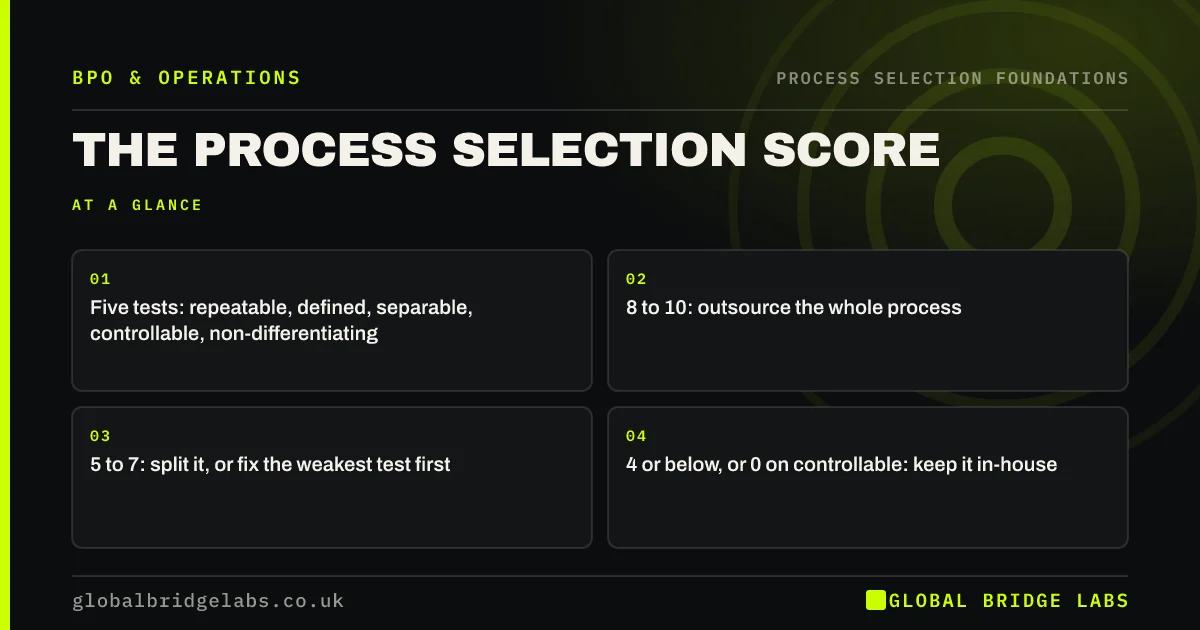
Pick the process that takes most of your team's time and define it with the six steps above. Send it to us and we will tell you whether it is a candidate to outsource, split or keep.
Message us on WhatsApp, or book a 30-minute consultation.
Chat on WhatsApp →Sources and further reading
- Labour productivity · Office for National Statistics
- Business population estimates for the UK and regions 2025 · Department for Business and Trade
Frequently asked questions
What is a business process in simple terms?
A business process is a repeatable set of steps that starts with a trigger, such as an order or an invoice, and ends with an output someone needs, such as goods dispatched or a supplier paid. It has an owner who is accountable for the result and usually crosses more than one person or system.
What is the difference between a process and a procedure?
A process is the whole sequence of work from trigger to output. A procedure is the written instruction for carrying out the steps, often called a standard operating procedure. One process can have several procedures, for example one for checking invoices and another for approving them.
How many business processes does a small business have?
Most UK SMEs of 10 to 50 people run between 25 and 40 recurring processes across finance, sales, customer service, people, IT and operations. Many are never written down. Listing them once, with trigger, output and owner, is the first step to improving or outsourcing any of them.
Written by

Global Bridge Labs (GBL) is a UK–Sri Lanka partner for social media, websites and BPO. Everything here comes from client delivery, not theory.